- Mail Address info@velnustech.com
- Phone Number +91-90990-05498
Contact Info
- C-1024, Siddhivinayak Tower, Kataria Automobile Road Makarba, Ahmedabad - 380051
- +91 90990 05498
- info@velnustech.com
- Week Days: 09.00 to 18.00 Sunday: Closed
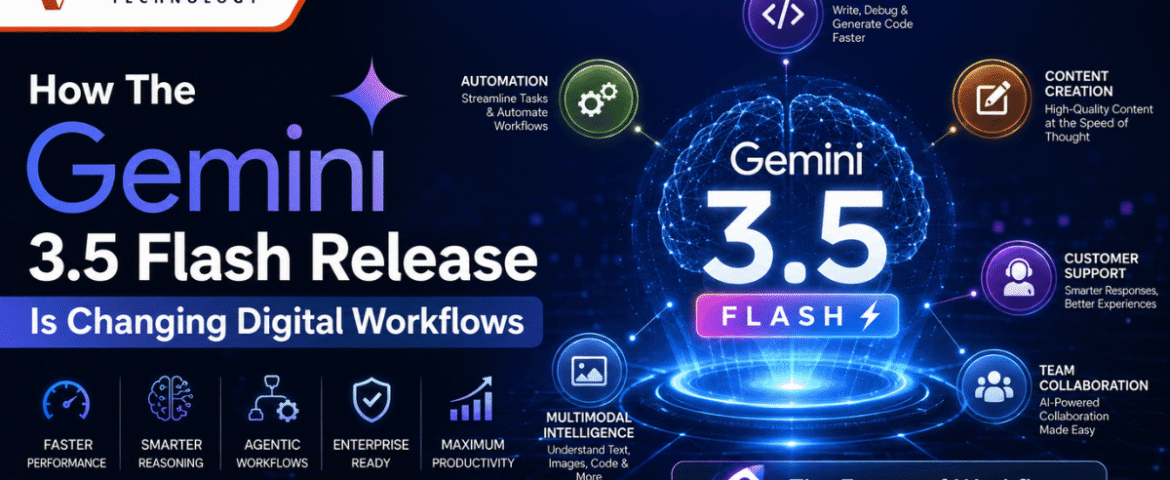
How The Gemini 3.5 Flash Release Is Changing Digital Workflows
Introduction to Gemini 3.5 Flash
The digital landscape is constantly shifting, demanding faster, smarter, and more integrated solutions to manage the overwhelming influx of daily data. At the forefront of this transformation is the Gemini 3.5 Flash release, a groundbreaking advancement in artificial intelligence that is completely redefining how professionals handle their digital workflows. This robust technology is not simply an incremental software update; rather, it is a comprehensive overhaul of how machines understand, process, and execute complex instructions.
In modern environments, the sheer volume of information can easily bottleneck productivity. Professionals across various sectors find themselves toggling between countless applications, trying to synthesize text, video, audio, and visual data manually. The introduction of Gemini 3.5 Flash solves this critical issue by offering frontier-level intelligence combined with unprecedented processing speed. It is designed specifically to eliminate latency while maintaining the deep analytical capabilities required for sophisticated problem-solving. By integrating seamlessly into daily operations, Gemini 3.5 Flash is transforming static, manual tasks into dynamic, autonomous routines, ultimately freeing up human creativity for higher-level strategic thinking.
The Core Mechanics Behind the Model
To understand how the Gemini 3.5 Flash release is changing digital workflows, it is essential to look under the hood at the core mechanics that power this advanced system.
Speed and Low-Latency Performance
Historically, users have had to choose between speed and intelligence. High-speed systems often lacked the nuance required for complex reasoning, while highly intelligent systems suffered from severe latency, making them entirely impractical for real-time applications. Gemini 3.5 Flash entirely eliminates this compromise. It has been heavily optimized to deliver rapid responses without sacrificing the quality of its output. Whether you are analyzing a massive financial spreadsheet or compiling a lengthy report, the ultra-low latency of Gemini 3.5 Flash ensures that the data is processed in a fraction of a second. This immediate feedback loop is critical for maintaining a frictionless, conversational workflow where interruptions are minimized, and continuous progress is achieved.
Unprecedented Context Windows
One of the most significant technical achievements of Gemini 3.5 Flash is its massive context window, capable of retaining and processing over one million tokens of information simultaneously. In practical terms, this means the system can ingest entire libraries of documentation, extensive source code repositories, or hours of transcribed meetings in a single prompt. Because Gemini 3.5 Flash holds all this information in its active memory, it can draw accurate, cross-referenced conclusions without losing track of the initial instructions. This immense capacity allows professionals to feed the system massive raw datasets and receive highly structured, contextually accurate insights instantly.
Advanced Multimodal Processing
We do not work in text alone, and neither does Gemini 3.5 Flash. The model is built from the ground up as a natively multimodal system. It does not need to convert audio into text or images into descriptions before analyzing them; it comprehends these formats directly. You can upload a detailed schematic, a video walkthrough, a spoken recording, and a text-based manual simultaneously. Gemini 3.5 Flash will synthesize all these disparate media types, compare the visual data against the spoken instructions, and generate a cohesive output. This multimodal mastery is revolutionizing fields that rely heavily on visual and auditory information, providing a unified tool for comprehensive data analysis.
Revolutionizing Daily Digital Workflows
The practical applications of Gemini 3.5 Flash extend far beyond theoretical benchmarks. It is actively reshaping how daily tasks are approached, executed, and completed across various professional environments.
Streamlining Data Analysis
Data is only valuable if it can be understood and acted upon. For data analysts and researchers, parsing through unstructured data to find actionable insights has traditionally been a time-consuming, labor-intensive process. Gemini 3.5 Flash automates this heavy lifting. By connecting the model directly to your primary data sources, it can continuously monitor incoming metrics, identify anomalies, and generate real-time summaries. If there is a sudden spike in a specific metric, Gemini 3.5 Flash does not just alert you to the change; it cross-references historical data to explain why the spike occurred and suggests potential strategies to capitalize on it. This transforms data analysis from a retrospective review into a proactive, forward-looking strategy.
Automating Multi-Step Processes
Perhaps the most transformative aspect of Gemini 3.5 Flash is its ability to handle complex, multi-step workflows autonomously. Older systems required users to prompt the machine for every single step of a process. In contrast, Gemini 3.5 Flash thrives on long-horizon instructions. You can provide a broad objective—such as “analyze the past year of sales, identify the three worst-performing products, compare their features with current market trends, and draft a strategy to improve their market fit.” Gemini 3.5 Flash will independently break this macro-command into smaller, logical micro-tasks, execute each one sequentially, and present the final, polished strategy. This capability shifts the user’s role from a micro-manager to a strategic director.
Enhancing Content Creation and Curation
Content creators, marketers, and educators are also reaping the benefits of Gemini 3.5 Flash. The model’s deep reasoning capabilities allow it to generate highly nuanced, context-aware content that goes far beyond basic text generation. Whether you are drafting comprehensive training manuals, writing technical documentation, or developing interactive educational modules, Gemini 3.5 Flash adapts its tone and structure to meet specific audience needs. Furthermore, its multimodal nature means it can suggest appropriate visual pairings, format the layout, and even check the final draft for consistency against external reference materials, effectively serving as an autonomous editorial assistant.
Impact on Software Development and Coding
The technology sector, particularly software development, is experiencing a massive paradigm shift thanks to the coding proficiency embedded within Gemini 3.5 Flash.
Rapid Prototyping and Iteration
Building software requires constant testing, debugging, and rewriting. Gemini 3.5 Flash accelerates this lifecycle exponentially. Developers can describe the desired functionality of an application in plain language, and the model will generate the foundational code in seconds. But it goes beyond simple generation. Because it excels at continuous workflow execution, developers can engage in rapid, iterative loops. If a specific module fails during testing, the developer can simply feed the error log back into Gemini 3.5 Flash. The model will analyze the log, locate the exact line of failing code, and rewrite it for optimal performance.
Complex Debugging and Optimization
Maintaining legacy codebases is often one of the most resource-draining tasks for a development team. Gemini 3.5 Flash drastically reduces this burden. By ingesting the entire codebase into its massive context window, the model can trace variables and logic paths across thousands of files simultaneously. It identifies redundant functions, security vulnerabilities, and inefficient logic, proposing streamlined alternatives. This deep, contextual understanding ensures that optimizations do not inadvertently break other parts of the application, resulting in cleaner, faster, and more reliable software infrastructure.
Transforming Security and System Defense
In an era where digital threats are becoming increasingly sophisticated, defensive measures must evolve accordingly. Gemini 3.5 Flash is proving to be a formidable asset in cybersecurity and system defense.
Proactive Vulnerability Detection
Cybersecurity professionals are leveraging specialized, lightweight versions of this technology to continuously scan digital environments for vulnerabilities. Because Gemini 3.5 Flash operates at exceptional speeds, it can monitor network traffic and analyze system logs in real-time, identifying suspicious patterns that human operators might overlook. It doesn’t just look for known signatures; its deep reasoning allows it to detect anomalous behaviors that suggest a novel attack method. This proactive stance helps organizations identify potential breaches before they can be exploited by malicious actors.
Automated Patching Routines
Identifying a vulnerability is only half the battle; fixing it quickly is crucial to maintaining system integrity. Gemini 3.5 Flash accelerates the remediation process. When a flaw is detected, the model can instantly generate a secure patch, test the patch against the existing system architecture to ensure compatibility, and deploy it automatically. This rapid, automated response cycle drastically reduces the window of exposure, fortifying digital infrastructures against emerging threats with unprecedented efficiency.
Economic and Structural Benefits for Enterprises
Beyond individual productivity, the adoption of Gemini 3.5 Flash offers substantial economic and structural advantages for large-scale operations.
Reducing Overhead Costs
Advanced intelligence often comes with a steep price tag, particularly when deploying massive digital models at scale. Gemini 3.5 Flash disrupts this financial barrier. It delivers frontier-level performance at a fraction of the cost associated with heavier, more cumbersome systems. By requiring less computational power to run efficiently, organizations can deploy this intelligence across every department without inflating their operational budgets. This democratization of advanced technology ensures that even smaller teams can access the analytical power previously reserved for massive corporations.
Scaling Autonomous Operations
As organizations grow, the complexity of managing internal workflows increases exponentially. Gemini 3.5 Flash scales effortlessly. Organizations can deploy multiple instances of the model to handle different operational silos—one instance managing customer inquiries, another analyzing supply chain logistics, and a third overseeing financial compliance. Because these autonomous routines operate continuously and communicate flawlessly, they create a highly synchronized, hyper-efficient organizational structure that can scale without requiring proportional increases in human staffing.
The Future of Productivity with Gemini 3.5 Flash
Looking ahead, the influence of Gemini 3.5 Flash on digital workflows is only set to expand as the technology becomes more deeply integrated into the fabric of our digital ecosystems.
Breaking Down Silos
Traditionally, different departments within an organization operate using disparate software tools, creating isolated pockets of data. Gemini 3.5 Flash acts as a universal translator and integrator. It bridges the gap between different platforms, effortlessly extracting data from a human resources database and cross-referencing it with financial performance metrics in a separate application. This breakdown of digital silos fosters a more holistic, unified approach to organizational management, ensuring that decisions are based on the complete picture rather than fragmented data points.
Real-Time Collaborative Efforts
The future of work is highly collaborative, and Gemini 3.5 Flash enhances this dynamic. Imagine a virtual workspace where human professionals and the model interact seamlessly in real-time. As a team brainstorms a new project, Gemini 3.5 Flash simultaneously researches the feasibility of their ideas, generates visual mockups, and drafts the necessary project timelines. It functions not merely as a tool, but as an active, contributing participant in the collaborative process, elevating the entire team’s output and accelerating the journey from concept to execution.
Also Read : How AI Chatbots Are Transforming Customer Support And Engagement
Conclusion
The release of Gemini 3.5 Flash marks a definitive turning point in the evolution of digital workflows. By perfectly balancing high-speed processing with profound, multimodal reasoning, it has solved the long-standing challenge of latency in advanced technological systems. Its ability to autonomously manage multi-step processes, natively comprehend diverse media formats, and rapidly iterate on complex tasks is fundamentally changing how professionals operate daily.
From software developers looking to streamline code creation to data analysts seeking real-time insights, the applications of Gemini 3.5 Flash are as vast as they are impactful. Furthermore, its cost-efficiency and scalability ensure that these frontier-level capabilities are accessible across various operational scales. Embracing Gemini 3.5 Flash is no longer just about adopting a new software tool; it is about transitioning into a more intelligent, proactive, and hyper-efficient era of digital productivity where automated routines handle the heavy lifting, allowing human ingenuity to truly flourish.
Frequently Asked Questions (FAQs)
Q1 What exactly is Gemini 3.5 Flash?
Gemini 3.5 Flash is a highly advanced, ultra-fast multimodal model designed to process text, audio, video, images, and documents seamlessly. It delivers exceptional intelligence and reasoning capabilities at very high speeds, making it ideal for managing complex, real-world tasks and automated routines continuously.
Q2 How does Gemini 3.5 Flash improve daily productivity?
By eliminating the latency traditionally associated with deep data analysis, it provides instantaneous insights. Furthermore, it excels at taking broad, multi-step instructions and executing the entire workflow autonomously, freeing users from having to prompt the system for every minor step.
Q3 Does this model require text inputs to understand videos or images?
No, it is natively multimodal. This means it comprehends video, audio, PDFs, and images directly without needing them to be transcribed or described in text first. You can feed it various media formats simultaneously, and it will analyze them cohesively.
Q4 Why is the massive context window important?
The model can hold over one million tokens of information in its active memory. This massive context window allows it to ingest entire software codebases, comprehensive libraries of documents, or hours of video at once, ensuring it maintains perfect context and accuracy when generating complex, cross-referenced outputs.
Q5 Is Gemini 3.5 Flash expensive to implement for large-scale operations?
One of the primary advantages of this model is its high cost-efficiency. It delivers frontier-level performance while being significantly more lightweight and economical than traditional large-scale models, allowing organizations to scale their automated routines without massive overhead costs.
Leave A Comment