
- Mail Address info@velnustech.com
- Phone Number +91-90990-05498

Contact Info
- C-1024, Siddhivinayak Tower, Kataria Automobile Road Makarba, Ahmedabad - 380051
- +91 90990 05498
- info@velnustech.com
- Week Days: 09.00 to 18.00 Sunday: Closed
What Is an SEO Specialist? The Complete Guide to SEO Specialists
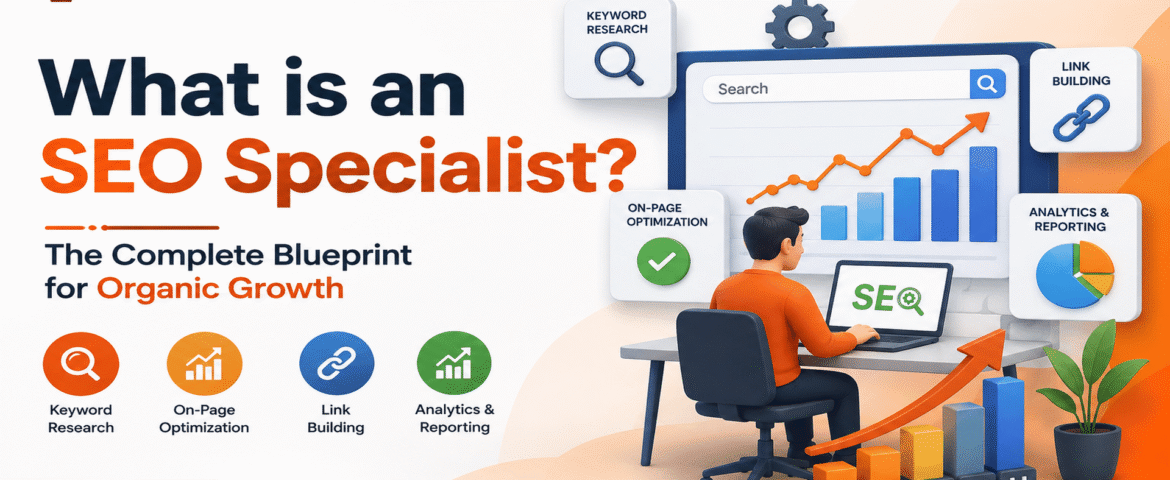
What Is an SEO Specialist?
Search Engine Optimization (SEO) has changed significantly over the years.
What once involved relatively simple technical adjustments and keyword placement has developed into a broader discipline involving search intent, content quality, website architecture, technical accessibility, internal linking, analytics, user experience, and business strategy.
At the center of this work is the SEO specialist.
An SEO specialist helps a website become easier for search engines to discover and understand while making its pages more useful to the people who visit them. Depending on the website, their work may include keyword research, technical audits, content optimization, competitor analysis, internal linking, performance measurement, and SEO strategy.
But there is an important distinction:
An SEO specialist does not simply try to “rank a website.”
Their real job is to connect three things:
What people need → What the website provides → How search engines understand it
Google’s current guidance emphasizes creating unique, useful content for people and maintaining a technically sound website. Its 2026 guidance also says that SEO best practices continue to matter for Google’s generative AI search experiences.
Quick Answer: What Does an SEO Specialist Do?
An SEO specialist improves a website’s organic search visibility by researching what people search for, analyzing search intent, solving technical problems, optimizing content and website structure, and measuring the results over time.
A typical SEO specialist may work across:
- Keyword research
- Search intent
- Technical SEO
- On-page SEO
- Content strategy
- Internal linking
- Competitor analysis
- Local SEO
- Search performance
- SEO reporting
- Website architecture
- Organic growth strategy
The exact responsibilities depend on the business, website size, industry, and goals.
The Modern SEO Specialist
A modern SEO specialist is no longer just a person who checks keywords and rankings.
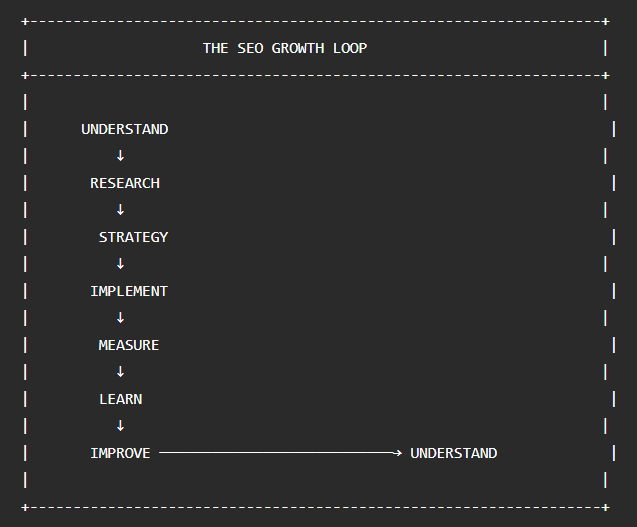
Their work can be understood through four connected stages:
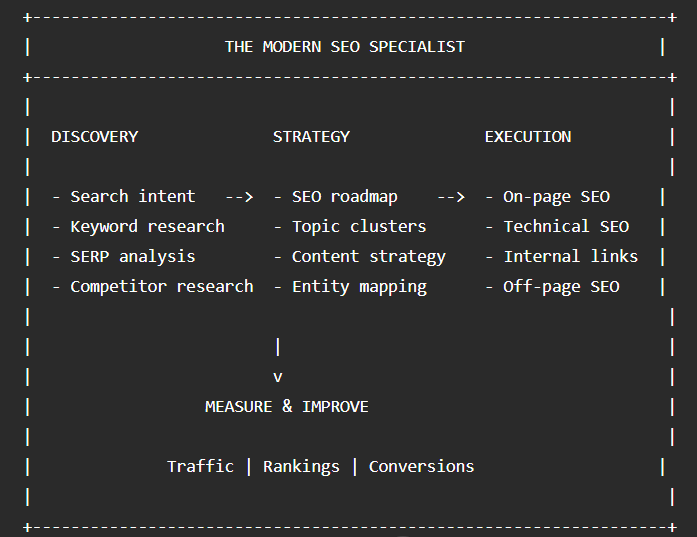
This framework shows why SEO is more than keyword placement.
An SEO specialist first tries to understand the search landscape, then develops a strategy, implements improvements, and measures what happens afterward.
The process repeats because websites, competitors, search behavior, and search systems continue to change.
What Does an SEO Specialist Do?
An SEO specialist can have many responsibilities, but most of the work falls into several major areas.
1. Keyword Research
Keyword research is the process of identifying the words and phrases people use when searching for information, products, services, or solutions.
However, professional keyword research is not simply:
“Find a keyword with high search volume.”
A specialist also considers:
- Search intent
- Relevance to the business
- Competition
- Search demand
- Customer problems
- Commercial value
- Existing search results
- Related topics
- The stage of the customer’s journey
For example, consider these searches:
“What is CRM software?”
This is primarily informational.
“Best CRM software for small business”
This suggests commercial investigation.
“CRM software pricing”
This may indicate stronger purchase consideration.
The SEO specialist’s job is to understand these differences and create or optimize pages accordingly.
Search Intent Classification
Before optimizing a page, an SEO specialist needs to understand why someone is searching.
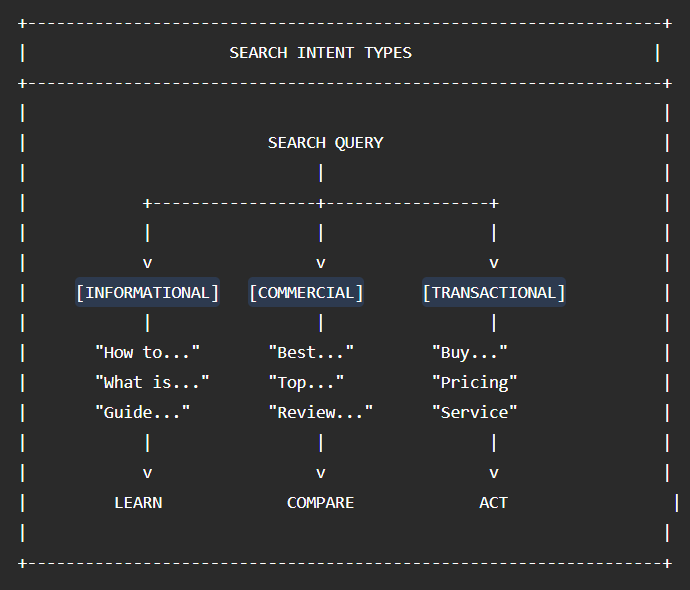
Search Intent Classification Table
| Search Intent | Example Query | User’s Goal | Suitable Content |
|---|---|---|---|
| Informational | “What is SEO?” | Learn | Guide, tutorial, FAQ |
| Navigational | “Google Search Console” | Find a specific site | Official/product page |
| Commercial | “Best SEO tools” | Compare options | Comparison, review |
| Transactional | “Hire SEO specialist” | Take action | Service/landing page |
| Local | “SEO specialist near me” | Find a nearby provider | Local/service page |
The important lesson is that the same keyword strategy doesn’t work for every search.
A person looking for a definition needs education.
A person comparing services needs evidence and comparisons.
A person ready to hire needs a clear path to action.
2. Technical SEO
Technical SEO focuses on the technical foundation of a website.
An SEO specialist may investigate:
- Crawling
- Indexing
- Website architecture
- XML sitemaps
- Robots.txt
- Redirects
- Canonical URLs
- Broken links
- HTTPS
- Mobile accessibility
- Page performance
- Structured data
- JavaScript rendering
Technical SEO matters because search engines need to be able to access and process important content.
Google’s documentation explains that pages need to meet technical requirements to be eligible for Search, and its current AI-search guidance continues to emphasize a technically accessible website.
A Simple Technical SEO Model
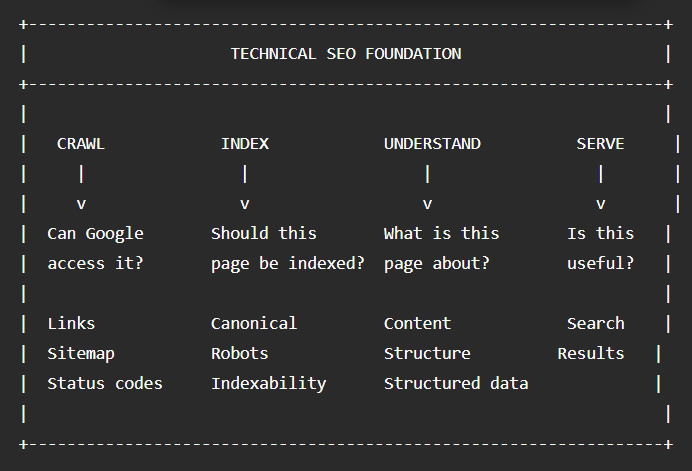
A technical audit should not become a list of hundreds of warnings that nobody understands.
The specialist should prioritize problems according to their likely effect on users, search accessibility, and business objectives.
3. On-Page SEO
On-page SEO focuses on elements that exist on the page itself.
This can include:
- Page title
- Headings
- Main content
- Internal links
- Images
- Image alt text
- URLs
- Relevant metadata
- Content structure
- Search-intent alignment
Good on-page SEO isn’t about inserting the same keyword repeatedly.
Instead, the page should clearly communicate:
What is this page about?
Who is it for?
What question does it answer?
What should the visitor be able to do after reading it?
That approach naturally produces better content than trying to hit an arbitrary keyword density.
4. Content Optimization
An SEO specialist may improve existing content instead of constantly publishing new articles.
For example, an old article might have:
- Outdated information
- Weak explanations
- Poor structure
- Missing examples
- No internal links
- Unclear search intent
- Thin sections
- Unsupported claims
The specialist can determine whether the page should be:
Updated → Expanded → Consolidated → Redirected → or Removed
The answer should depend on the page’s purpose and value, not simply on whether it contains a target keyword.
Google’s current guidance places particular emphasis on content that provides unique value rather than simply rephrasing information already available online.
5. Internal Linking
Internal links connect related pages on the same website.
For example:
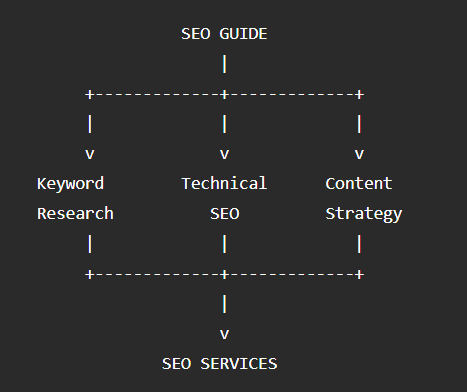
Internal linking can help users discover related information and help search engines understand relationships between pages.
Links should be added because they are useful to the reader—not simply because more links appear to be better.
6. Competitor and SERP Analysis
An SEO specialist also studies competing pages and the search results themselves.
They may examine:
- What topics competitors cover
- Which content formats appear
- Common questions
- Search-result features
- Content gaps
- Page structure
- Internal links
- Competitor strengths
- Competitor weaknesses
The purpose isn’t to copy competitors.
Instead, the specialist asks:
What useful information is missing, unclear, outdated, or poorly explained?
That question can lead to genuinely better content.
The 7-Step SEO Specialist Workflow
A professional SEO process can be simplified into seven stages.
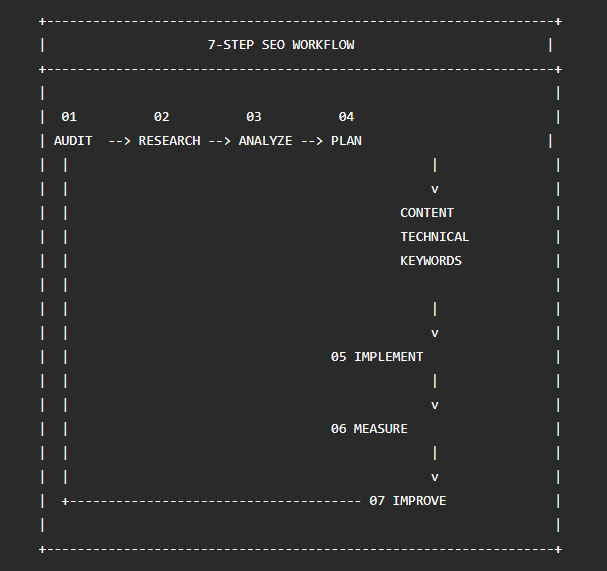
Step 1: Understand the Business
Before changing the website, the specialist should understand:
- What the company sells
- Who its customers are
- Where customers are located
- What problems the business solves
- Which products or services matter most
- How customers make decisions
- What the business considers a successful result
SEO without business context can produce traffic that has little commercial value.
Step 2: Audit the Website
The specialist examines the current website to identify technical, content, structural, and search-performance issues.
Step 3: Research Keywords and Search Intent
The specialist identifies relevant search opportunities and determines what users expect from each query.
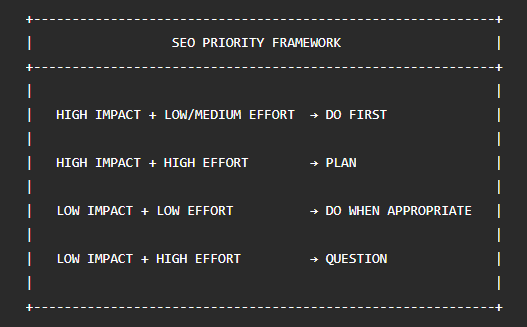
Step 4: Prioritize Opportunities
Not every SEO issue deserves immediate attention.
A useful prioritization model is:
Step 5: Implement Changes
This can involve content changes, technical fixes, internal linking, metadata improvements, new pages, or other appropriate work.
Step 6: Measure Results
Performance may be evaluated using:
- Organic clicks
- Impressions
- Search queries
- Search visibility
- Relevant rankings
- Organic conversions
- Leads
- Revenue
- Indexed pages
- Technical health
Step 7: Improve
SEO is an ongoing process.
The specialist reviews what happened, identifies new opportunities, and adjusts the strategy.
SEO Specialist Skills
A strong SEO specialist needs more than knowledge of keywords.
| Skill | Why It Matters | Importance |
| Keyword Research | Finds relevant search opportunities | High |
| Search Intent | Matches content with user needs | High |
| Technical SEO | Helps identify website accessibility issues | High |
| Content Optimization | Improves usefulness and relevance | High |
| Analytics | Turns performance data into decisions | High |
| Competitor Analysis | Finds gaps and opportunities | Medium |
| HTML/CSS Basics | Helps understand website structure | Medium |
| Communication | Helps work with developers and writers | High |
| Problem Solving | Helps diagnose complex SEO issues | High |
| Business Understanding | Connects SEO with business goals | High |
An SEO specialist doesn’t necessarily need to be a professional programmer.
However, understanding how websites work can make technical SEO work much more effective.
On-Page SEO vs Technical SEO vs Off-Page SEO
These three terms are often confused.
| SEO Area | Main Focus | Examples |
| On-Page SEO | Page content and elements | Titles, headings, content, internal links |
| Technical SEO | Website infrastructure | Crawling, indexing, redirects, architecture |
| Off-Page SEO | External signals and visibility | Earned links, mentions, digital reputation |
| Local SEO | Local search visibility | Business information, local pages, reviews |
These areas can overlap.
A successful SEO strategy normally considers the website as a complete system rather than treating each category in isolation.
SEO Specialist vs SEO Agency vs SEO Tool
These three are not interchangeable.
| Feature | SEO Specialist | SEO Agency | SEO Tool |
| SEO Strategy | Yes | Yes | No |
| Keyword Research | Yes | Yes | Provides data |
| Technical Analysis | Yes | Yes | Detects issues |
| Content Strategy | Yes | Yes | Assists research |
| Human Judgment | Yes | Yes | No |
| Business Understanding | Yes | Yes | No |
| Reporting | Yes | Yes | Yes |
| Implementation | Sometimes | Often | Usually no |
| Team Support | Individual | Multiple specialists | Software |
| Decision Making | Human | Human team | Data-based assistance |
An SEO tool can identify an issue.
An SEO specialist decides whether that issue actually matters, why it matters, and what should be done about it.
SEO Tools an SEO Specialist Uses
Tools are important, but tools do not replace judgment.
Google Search Console
Google Search Console provides information about a site’s performance and visibility in Google Search, including search queries, impressions, clicks, and indexing-related information.
Google Analytics
Analytics tools help connect website visits with user behavior and business outcomes.
Website Crawlers
Crawler software can identify technical issues across websites, including broken links, duplicate metadata, redirect problems, and other structural issues.
Keyword Research Platforms
These tools can help discover:
- Search queries
- Related topics
- Competition
- Search trends
- Content opportunities
The important distinction is:
Tool output ≠ SEO strategy.
A specialist interprets the data in the context of the website.
SEO Audit Checklist
A basic SEO audit can start with this checklist:
- Important pages are accessible to search engines
- Important pages can be indexed
- Website uses HTTPS
- XML sitemap is available where appropriate
- Robots.txt is correctly configured
- Important pages have descriptive titles
- Headings are logically organized
- Internal links connect related pages
- Broken links are addressed
- Redirects are reviewed
- Duplicate/near-duplicate pages are handled appropriately
- Images have useful alternative text where appropriate
- Pages work well on mobile devices
- Important content is easy to find
- Content matches search intent
- Outdated information is reviewed
- Search performance is monitored
Technical SEO also includes canonicalization. Google describes a canonical URL as the representative URL for a set of duplicate or similar pages, while noting that a canonical preference is a hint rather than an absolute rule.
Before and After: What SEO Changes Can Look Like
| Before SEO Work | After Thoughtful SEO Work |
| Random keyword targeting | Search-intent-based targeting |
| Unclear website structure | Logical information architecture |
| Thin explanations | Useful, complete explanations |
| Few relevant internal links | Connected topic structure |
| Outdated content | Reviewed and updated information |
| Technical problems ignored | Prioritized technical improvements |
| Traffic treated as the only goal | Relevant traffic and business outcomes |
| Competitor content copied | Original information and perspective |
| SEO based entirely on tools | Data combined with human judgment |
The goal isn’t to make every website look the same.
The goal is to make the website more useful and easier to understand.
What Makes a Good SEO Specialist?
A good SEO specialist should be able to connect:
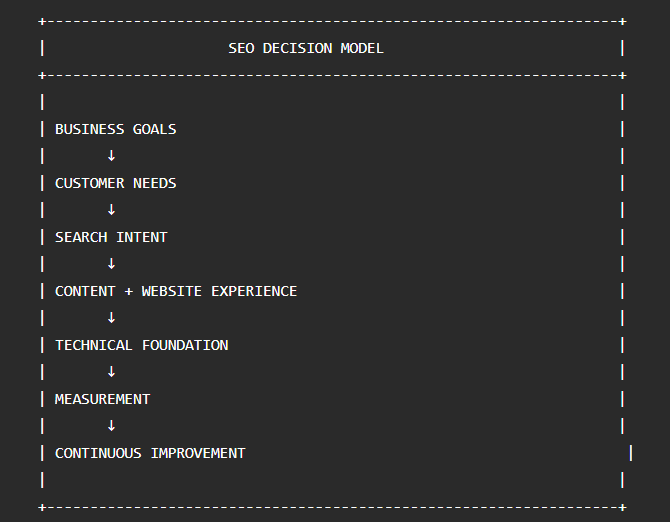
This is why SEO shouldn’t be treated as a collection of isolated tricks.
For example, getting more visitors sounds positive.
But suppose those visitors are searching for something completely unrelated to the company’s service.
Traffic increased, but the business didn’t necessarily improve.
A better question is:
Are we attracting the right people and giving them a useful reason to stay?
That is a much stronger SEO question.
How to Choose an SEO Specialist
If you’re considering hiring an SEO professional, don’t judge them only by how many keywords they promise to rank.
Instead, ask:
1. What is your SEO process?
A professional should be able to explain the process clearly.
2. What will you analyze first?
They should want to understand the business and website before making major recommendations.
3. How will you measure success?
Look for measurements connected to actual business objectives.
4. What work will you perform?
Ask whether they will handle technical SEO, content, strategy, reporting, implementation, or coordination with your development team.
5. How will you communicate recommendations?
Good SEO recommendations should be understandable to the people responsible for implementing them.
Be Careful With Guaranteed Rankings
No SEO specialist can honestly control Google’s ranking systems.
Promises such as:
“Guaranteed #1 ranking”
should therefore be treated cautiously.
The better question is:
What improvements can you make, why do you recommend them, and how will we measure their impact?
SEO and AI: What Should an SEO Specialist Do in 2026?
AI has become part of many SEO workflows.
An SEO specialist may use AI for:
- Brainstorming
- Research assistance
- Organizing information
- Creating outlines
- Summarizing large datasets
- Draft assistance
- Identifying content gaps
- Automating repetitive tasks
But AI should remain a tool, not a replacement for expertise and verification.
Google’s current guidance does not say that websites must avoid AI completely. Instead, Google emphasizes useful, original content and warns against using automation primarily to manipulate search rankings. Its 2026 generative-AI guidance specifically encourages site owners to provide unique value and avoid simply reworking information that an AI system could easily generate from existing material.
That creates an important principle for modern SEO:
AI TOOL
   ↓
RESEARCH / ASSISTANCE
   ↓
HUMAN REVIEW
   ↓
FACT CHECKING
   ↓
ORIGINAL INSIGHT
   ↓
USEFUL FINAL CONTENT
The objective should not be to make AI-generated content “look human.”
The objective should be to make the final content genuinely useful.
Common SEO Mistakes
Keyword Stuffing
Repeating the same keyword unnecessarily can make content awkward and difficult to read.
Publishing Content Without a Purpose
Publishing hundreds of articles without a clear audience or business purpose doesn’t automatically create a strong SEO strategy.
Copying Competitors
Competitor research is useful.
Copying competitor content and changing a few words is not a meaningful content strategy.
Ignoring Existing Content
Sometimes the best opportunity is improving an existing page instead of creating another article.
Focusing Only on Rankings
Rankings can be useful measurements, but qualified traffic, leads, sales, and user satisfaction may matter more to the business.
Treating Every SEO Tool Warning as Critical
SEO tools can produce useful information, but not every warning requires immediate action.
A specialist needs to understand context and prioritize.
Creating Content Only for Search Engines
The strongest approach is to create content for the people who will actually use it.
Google’s current guidance repeatedly emphasizes this people-first principle.
When Should a Business Hire an SEO Specialist?
An SEO specialist can be particularly useful when:
- Organic traffic has stopped growing
- Important pages aren’t receiving search visibility
- A website has technical problems
- Competitors are gaining search visibility
- A new website is being launched
- Existing content isn’t performing
- The company wants long-term organic growth
- Internal staff don’t have SEO expertise
- The website has hundreds or thousands of pages
- The business wants to connect SEO with leads or sales
The right time to hire an SEO specialist isn’t necessarily when traffic is already falling.
SEO can also be used proactively to build a stronger foundation before problems become expensive to fix.
SEO Specialist Career: How to Become One
If you want to become an SEO specialist, you don’t need to learn everything at once.
A practical learning path looks like this:
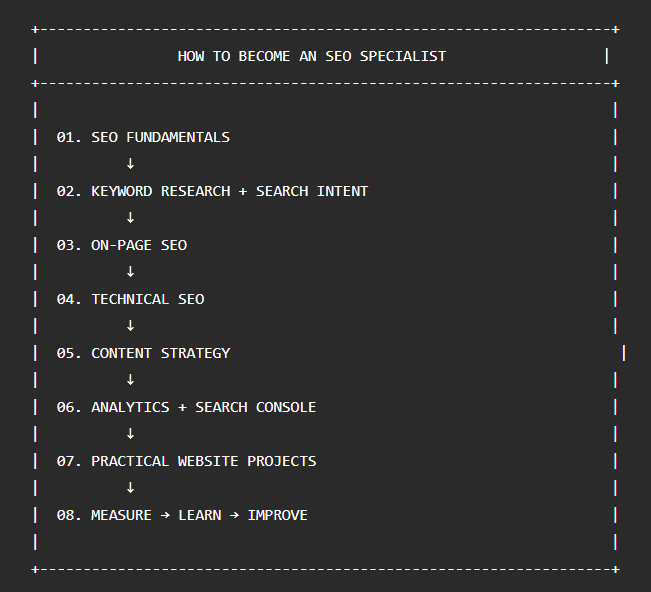
The fastest way to understand SEO is not to memorize hundreds of definitions.
Work on real websites.
Perform audits.
Study search results.
Improve pages.
Measure what changes.
Then repeat the process.
Final Thoughts
An SEO specialist is much more than someone who finds keywords or checks rankings.
Modern SEO connects:
Business goals + customer needs + search intent + content + technical SEO + measurement
The strongest SEO strategies begin with understanding the person behind the search.
Someone searching for “what is SEO?” needs a clear explanation.
Someone searching for “best SEO tools” needs useful comparisons.
Someone searching for “SEO specialist for my business” needs evidence, transparency, and a clear next step.
The SEO specialist’s responsibility is to understand those differences and build a website experience that meets those needs.
The long-term objective isn’t to find a secret trick that forces a search engine to rank a page.
It’s to build something that deserves to be discovered.
That means creating useful information, maintaining a technically accessible website, understanding your audience, answering real questions, providing original value, and continuously improving based on evidence.
Google’s latest guidance for generative AI search reinforces this direction: unique, useful content and sound SEO fundamentals remain important, while tactics designed mainly to manipulate AI or search systems are not a sustainable strategy.
That is the real role of an SEO specialist in modern search.
Recommended Article Structure at a Glance
SEO SPECIALIST
│
├── Quick Answer
│
├── Modern SEO Specialist Framework
│
├── What Does an SEO Specialist Do?
│   ├── Keyword Research
│   ├── Search Intent
│   ├── Technical SEO
│   ├── On-Page SEO
│   ├── Content Optimization
│   ├── Internal Linking
│   └── Competitor Analysis
│
├── 7-Step SEO Workflow
│
├── SEO Specialist Skills
│
├── On-Page vs Technical vs Off-Page SEO
│
├── SEO Specialist vs Agency vs Tool
│
├── SEO Tools
│
├── SEO Audit Checklist
│
├── Before vs After SEO
│
├── Choosing an SEO Specialist
│
├── SEO + AI
│
├── Common SEO Mistakes
│
├── SEO Career Path
│
├── Final Thoughts
│
└── FAQs
Frequently Asked Questions About SEO Specialists
What is an SEO specialist?
An SEO specialist is a professional who helps improve a website’s visibility in organic search through activities such as keyword research, search-intent analysis, technical SEO, content optimization, internal linking, competitor research, and performance measurement.
What does an SEO specialist do every day?
Daily responsibilities vary, but they may include analyzing Search Console data, researching keywords, auditing webpages, improving content, checking technical issues, reviewing competitors, creating SEO recommendations, and monitoring performance.
Is SEO a technical job?
SEO can involve significant technical knowledge, especially when working with large or complex websites. However, an SEO specialist doesn’t necessarily need to be a full-time developer.
What skills does an SEO specialist need?
Important skills include keyword research, search-intent analysis, technical SEO, content optimization, analytics, competitor research, communication, problem-solving, and understanding how websites work.
Can an SEO specialist guarantee Google rankings?
A responsible SEO professional should not promise a guaranteed Google ranking. Search rankings depend on many factors outside an individual specialist’s direct control.
How long does SEO take?
There is no universal SEO timeline. Results depend on competition, website condition, content quality, authority, industry, technical issues, search demand, and the work being implemented.
One Reply to “What Is an SEO Specialist? The Complete Guide to SEO Specialists”
[…] Also Read : What Is an SEO Specialist? The Complete Guide to SEO Specialists […]