
- Mail Address info@velnustech.com
- Phone Number +91-90990-05498

Contact Info
- C-1024, Siddhivinayak Tower, Kataria Automobile Road Makarba, Ahmedabad - 380051
- +91 90990 05498
- info@velnustech.com
- Week Days: 09.00 to 18.00 Sunday: Closed
GPT-6 Astra and AI Disruption: The Powerful Shift Changing Software, Jobs & Business
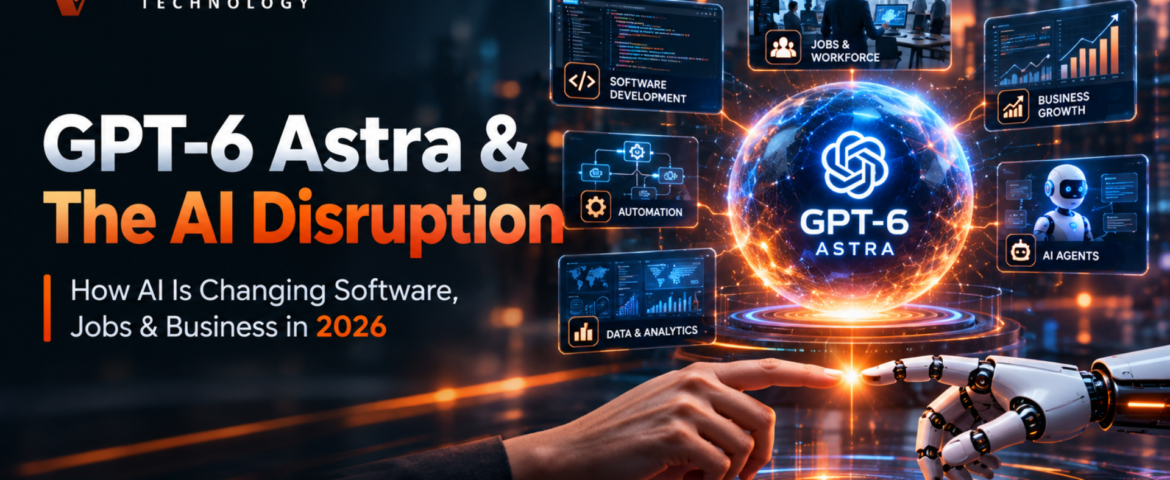
GPT-6 Astrais most important for us because ai is moving beyond simply genrating answers , text and code. OpenAI says that astra is designed for computer use, browsing, software engineering, cybersecurity, science and professional work. In practical terms, the bigger shift is from AI as a tool you use to AI as an agent that can carry out multi-step work for you.
That shift could change how companies buy software, how freelancers work, how employees complete routine tasks, and how small businesses automate their operations.
But does that mean that traditional software and human jobs will disappear?
Not exactly.
The more realistic picture is that the way we use software and divide work between humans and AI is changing very quickly.
And GPT-6 Astra is one of the clearest examples of that transition.
What Is GPT-6 Astra?
GPT-6 Astra is OpenAI’s latest advanced AI model, announced on September 3, 2026.
OpenAI describes Astra as its most intelligent and aligned model to date. According to the company, the model brings significant advances in computer use, web browsing, software engineering, cybersecurity, scientific work, and other professional tasks.
OpenAI has also published strong benchmark results for Astra, including 99.9% on ARC-AGI-3, 98% on FrontierMath Tier 4, and 100% on ExploitBench. Those numbers are worth paying attention to, but there is an important distinction to make: these are results from OpenAI’s own evaluations. They show how Astra performed under particular benchmark conditions; they do not establish that the model is better than humans at every kind of work.
The more interesting question, then, is not simply how high Astra can score on a benchmark. It is what the model can actually do when given a complicated task.
Consider a typical business request:
“Research these 20 competitors, compare their pricing, put the information into a spreadsheet, identify the strongest opportunities, and prepare a presentation.”
A conventional chatbot could help with parts of that assignment. You could ask it to write a competitor-analysis template, summarize information, generate spreadsheet formulas, or create presentation content. But a person would generally still have to move between websites, applications, documents, and other tools to complete the entire workflow.
That is where the agent-style approach becomes important.
Instead of treating every instruction as a separate question, an agent can approach the request as a larger task. It can reason about the steps involved, interact with available tools and computer interfaces, work through several actions, and move toward a final deliverable.
That changes the role AI can play.
The conversation is no longer only about generating an answer. It is increasingly about whether the system can participate in the process that produces the answer.
For GPT-6 Astra, that distinction is central.
The potential impact of the model comes from its ability to handle more of the work between an initial instruction and the final result—not simply from producing better-written paragraphs.
Why Is GPT-6 Astra Different From Previous AI Models?
The difference becomes clearer when traditional AI assistants are compared with agent-style systems.
| Traditional AI Assistant | Agent-Style AI |
|---|---|
| Answers questions | Works toward a specific goal |
| Generates text | Can work through multiple steps |
| Suggests code | Can assist with software-engineering tasks |
| Explains a process | Can execute parts of the process |
| Usually waits for the next instruction | Can continue through a workflow |
| Produces individual outputs | Can work toward an end-to-end result |
This does not mean Astra can simply be given control of an entire company and left to operate without supervision.
Real-world AI systems still depend on permissions, connected tools, available data, context, and appropriate human oversight. The quality of the final result can also depend heavily on how clearly a task is defined and what information the system is allowed to access.
The important change is happening at the level of interaction.
AI systems are moving beyond the traditional question-and-answer interface and becoming increasingly capable of working inside the digital environments where modern work takes place.
According to OpenAI, Astra can use computers, browse the web, create documents, spreadsheets, and presentations, and work through complex multi-step tasks.
That matters because most professional work is rarely a single action.
A marketer might research a market, collect information, analyze the results, update a campaign document, and prepare a report. A developer might inspect a codebase, identify a problem, modify several files, run tests, and review the results. A researcher might gather sources, organize findings, compare evidence, and turn the analysis into a structured report.
The value of an agent-style model lies in its ability to connect those individual steps.
That is the larger shift represented by GPT-6 Astra: AI is being developed not only as something that answers questions, but as a system that can potentially participate in the workflows people use to get work done.
What Can GPT-6 Astra Actually Do?
Computer Use
One of the most important capabilities is computer use.
Instead of only telling you which buttons to click, an advanced AI agent can potentially interact with software and websites as part of completing a task.
For example, imagine a small business owner needs to organize customer information.
A traditional workflow might look like this:
Open CRM → search customers → update records → create follow-ups → prepare report → send report.
With an AI-agent workflow, the long-term goal is closer to:
Give the AI the objective → AI works through the CRM and other tools → human reviews the result.
That could save considerable time on repetitive digital work.
Of course, businesses should not give an AI unrestricted access to important systems simply because the technology can operate a computer.
Permissions and human approval still matter.
Coding and Software Engineering
Software development is another major area.
AI coding tools are already useful for:
- generating code
- debugging
- explaining unfamiliar code
- writing tests
- documenting projects
- refactoring
- creating prototypes
A more capable model can take a larger software task and reason through multiple stages.
For a freelancer, this could mean spending less time writing repetitive code and more time understanding the client’s actual problem.
For a small software company, it could mean a smaller team can build and maintain more products.
But there is an important catch.
Writing code is not the same thing as engineering a reliable product.
Someone still needs to understand requirements, architecture, security, testing, user experience and business consequences.
AI can reduce the amount of manual work.
It does not remove the need for good judgment.
Research and Browsing
Research is another area where agentic AI can make a difference.
Suppose you’re preparing a market report.
Instead of searching Google manually for hours, copying information into documents and organizing everything yourself, an AI system can potentially handle more of that research workflow.
For example:
- Define the research question.
- Find relevant sources.
- Compare information.
- Identify patterns.
- Organize findings.
- Create a report.
- Highlight uncertainties.
This is especially useful for freelancers, marketers, consultants and small-business owners.
But there’s one rule worth remembering:
AI-generated research still needs source verification.
A fast answer is not necessarily an accurate answer.
Business Tasks
This is where GPT-6 Astra becomes particularly interesting for small businesses.
Think about everyday work such as:
- preparing reports
- organizing customer information
- analyzing spreadsheets
- drafting proposals
- creating presentations
- researching competitors
- summarizing documents
- preparing marketing content
- handling repetitive administrative workflows
These tasks don’t necessarily require a person to spend hours doing them manually.
An AI agent could become the layer connecting multiple business tools.
For example:
Customer inquiry → AI understands request → checks CRM → prepares response → updates record → schedules follow-up → creates task for salesperson.
That is much closer to automation than traditional chatbot usage.
Cybersecurity
Cybersecurity is both an opportunity and a major concern.
OpenAI says GPT-6 Astra is its first model to reach the Critical cybersecurity capability level under its Preparedness Framework. OpenAI says that, with appropriate tools and access, Astra can find previously unknown vulnerabilities and develop exploitation methods against well-protected systems without a person guiding every step.
That creates a difficult situation.
The same capability that can help security researchers find weaknesses could potentially be abused by attackers.
This is why AI safety cannot simply be treated as a software feature.
It becomes part of the security architecture.
Businesses using powerful AI agents will need:
- permission controls
- monitoring
- access restrictions
- audit logs
- human approval for sensitive actions
- secure API credentials
- clear rules about what an agent can and cannot do
How Could GPT-6 Astra Disrupt the Software Industry?
This is probably the biggest business question surrounding Astra.
And there is already evidence that investors are taking the issue seriously.
On September 8, 2026, Reuters reported that concerns about AI competition contributed to significant declines in several software stocks, including Salesforce, Intuit and ServiceNow. The broader software and services index also fell.
Why would an AI model affect software companies?
Because traditionally, businesses buy software to help employees perform specific tasks.
- CRM software helps manage customers.
- Accounting software manages finances.
- Project-management software organizes work.
- Marketing software manages campaigns.
- Analytics software turns data into reports.
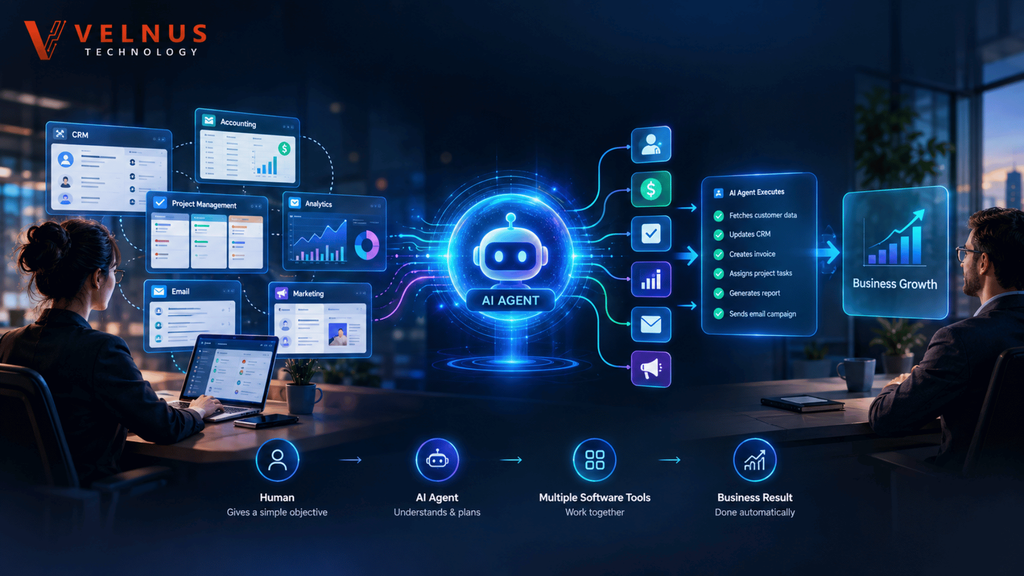
But imagine an AI agent that can interact with several of these systems.
Suddenly, the question changes from:
“Which software should I buy?”
to:
“What work do I need to accomplish?”
That is a much bigger change.
From SaaS Applications to AI Agents
For years, the dominant business model was SaaS — Software as a Service.
You would subscribe to a software product.
Your employees would learn how to use it.
They would perform tasks inside that software.
The emerging model could look different.
You tell an AI agent what outcome you want.
The agent uses software behind the scenes.
This doesn’t necessarily mean SaaS disappears.
Instead, the interface could change.
Think of it like this:
Old model:
Human → Software → Result
Emerging models:
Human → AI Agent → Multiple Software Tools → Result
That middle layer could become extremely valuable.
Will AI Replace Traditional Software?
Probably not overnight.
Software still provides:
- Databases
- Authentication
- Workflows
- Infrastructure
- Analytics
- Specialized functionality
An AI agent needs those systems to do useful work.
However, AI could change how people interact with software.
Instead of opening ten different dashboards, a user might increasingly ask an AI system to retrieve information, perform actions and summarize the results.
So the bigger threat to traditional software may not be:
“AI will destroy every software company.”
It may be:
“AI will change what customers expect software to do.”
Software that only stores information may become less valuable than software that can actively participate in completing work.
Why Are Software Companies Under Pressure?
The pressure comes from changing customer expectations.
If an AI agent can automate tasks that previously required several applications and several manual steps, businesses may question whether they need every individual tool.
That does not mean every SaaS product becomes unnecessary.
Specialized software will still matter.
But companies may increasingly ask:
- Does this software save us time?
- Can AI operate it?
- Does it integrate with our other systems?
- Does it provide useful proprietary data?
- Can it automate work instead of simply recording work?
Those questions could influence the next generation of SaaS.
What Does GPT-6 Astra Mean for AI Agents?
This may ultimately be the most important part of the story.
Chatbots answer.
Agents act.
That is an oversimplification, but it explains the direction very well.
An AI agent can be thought of as a system that combines:
Reasoning + tools + memory/context + permissions + actions + feedback
Imagine a sales agent.
Instead of simply generating an email, an AI system could potentially:
- Review new leads.
- Check existing customer information.
- Prioritize prospects.
- Research a company.
- Draft a personalized message.
- Update the CRM.
- Schedule a follow-up.
- Alert a salesperson when human intervention is required.
That is a fundamentally different experience from asking ChatGPT to “write me a sales email.”
And this is where AI automation becomes interesting for small businesses.
Will GPT-6 Astra Replace Human Jobs?
This question gets the most attention, but it needs a more balanced answer.
Some tasks will almost certainly become automated. Some jobs will change significantly. And some new roles will emerge.
The biggest risk is not necessarily that an AI replaces an entire profession overnight.
The more immediate change is that one person using AI may be able to do the work that previously required several people or significantly more time.
For example:
- A freelancer who previously handled five client reports per week might eventually handle ten.
- A marketing employee might automate research and reporting.
- A developer might spend less time on repetitive implementation.
- An accountant might automate data preparation while focusing more on review and client advice.
- A customer-support team might let AI handle simple requests and send complex cases to humans.
So the valuable skill is increasingly becoming:
Knowing what should be automated, what should remain human and how to supervise the automation.
That is why AI literacy is becoming a business skill rather than
Why is GPT-6 Astra important for cybersecurity?
Powerful AI can enhance cybersecurity, but it can also expand the capabilities available to attackers.
OpenAI has acknowledged the seriousness of this issue by classifying Astra at a critical cybersecurity capability threshold and outlining additional safeguards regarding its deployment and monitoring.
For businesses, this means that adopting AI must go hand-in-hand with robust security practices.
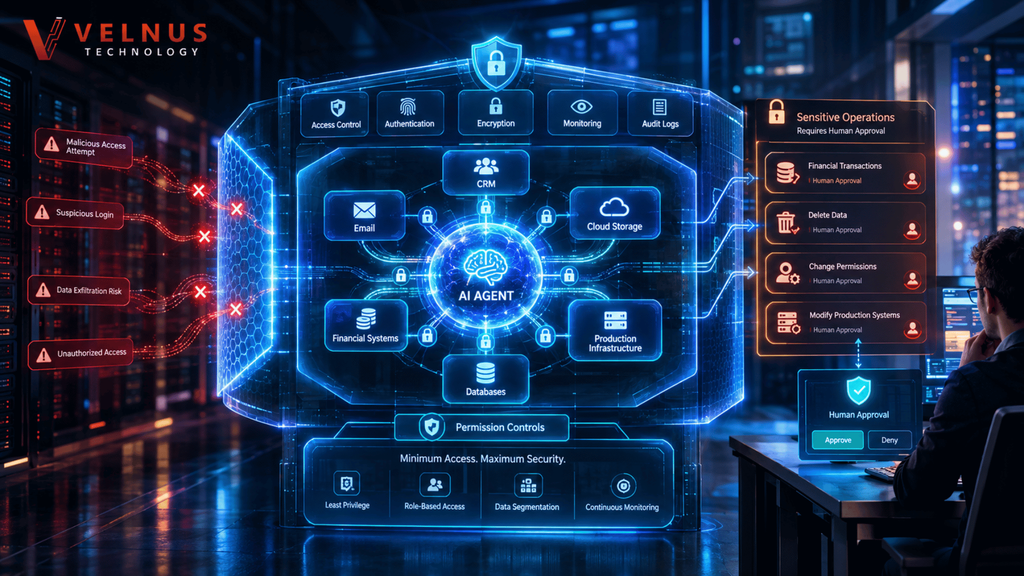
If an AI agent can access your CRM, email, cloud storage, or financial systems, its permissions matter.
A simple principle applies:
Grant AI the minimum access necessary to perform its tasks.
Do not grant an AI agent administrator-level access to everything simply because it makes automation easier.
Businesses should also monitor agent activity and require approval for high-impact actions, such as:
- Financial transactions
- Deleting data
- Changing permissions
- Sending sensitive information
- Publishing content
- Modifying production systems
The more capable the AI becomes, the more critical these controls will be.
GPT-6 Astra vs. Traditional Software
| Area | Traditional Software | AI-Agent Approach |
|---|---|---|
| Interface | Menus and dashboards | Natural-language instructions + software |
| Workflow | User performs steps | AI can execute multiple steps |
| Automation | Usually predefined | Can adapt to changing tasks |
| Data | Often application-specific | Can integrate information across tools |
| Human Role | Operates the software | Sets goals and reviews results |
| Key Value | Functionality | Results and automation |
This does not mean traditional software becomes obsolete.
Instead, AI can serve as an interface layer on top of the software.
This is a crucial distinction.
How can businesses prepare for AI disruption?
You don’t need to completely rebuild your business around AI overnight.
Start small.
1. Identify repetitive tasks
Make a list of the tasks your team performs every week.
Look for tasks that involve:
- Copying data
- Writing similar emails
- Preparing reports
- Updating records
- Summarizing information
- Scheduling
- Basic research
These are good candidates for automation.
2. Start with low-risk workflows
Don’t start by handing over control of your entire business to AI.
Begin with something simple.
For example:
Lead → AI qualification → Human approval → CRM update
Scale up once the workflow is operating reliably.
3. Keep humans in the loop
Not every decision should be automated.
Human approval is required for sensitive or high-stakes tasks.
This is particularly important in finance, healthcare, cybersecurity, legal work, and customer data management.
4. Connect your existing tools
AI becomes even more valuable when it can work with the systems your business already uses.
These might include:
- CRM
- Spreadsheets
- Accounting software
- Project management tools
- Helpdesk software
- Databases
The goal isn’t to replace everything.
The goal is to enable your existing ecosystem to work together more effectively.
5. Train your employees
Adopting AI is not just a technology project. Employees need to understand:
- How to prompt AI
- How to verify AI output
- What information should not be shared
- How to review automated actions
- When to speak to a human
A company with excellent AI tools but poorly trained employees can still face serious problems.
What does GPT-6 Astra mean for Indian businesses?
For Indian businesses, this opportunity is particularly interesting.
Many small and medium-sized companies still rely heavily on manual processes.
Consider a typical business scenario:
- A customer sends a WhatsApp message.
- Someone reads it.
- An employee checks the CRM.
- They look up pricing.
- They provide a response.
- Then, they update the customer record.
- Later, they set a follow-up reminder.
A large part of that workflow could be automated.
The same applies to:
- Lead management
- Customer support
- Invoice processing
- Sales follow-ups
- Marketing reports
- Employee documentation
- Market research
- Appointment scheduling
Perhaps the biggest benefit isn’t about replacing employees.
It could enable small teams to operate like large companies.
This matters in India, where millions of businesses operate with relatively small teams and limited technology budgets.
AI infrastructure is also becoming a major part of the broader ecosystem. Reuters reported on September 9 that OpenAI is deepening its collaboration with Samsung on next-generation semiconductor development and enterprise AI, illustrating how the AI race has moved beyond models to encompass chips, memory, and infrastructure.
What is the future of AI beyond GPT-6 Astra?
GPT-6 Astra should perhaps not be viewed as the finish line.
The more interesting question is:
What happens when AI models become capable of operating continuously across multiple business systems?
We might see an evolution like this:
Apps → AI-powered apps → AI agents → Networks of specialized agents
Ultimately, a business could have various AI systems that…
Also Read : What Is an SEO Specialist? The Complete Guide to SEO Specialists
Final Takeaway
The biggest lesson from GPT-6 Astra isn’t simply that AI has become smarter.
It’s that AI is moving closer to doing the work itself.
That distinction matters.
The previous generation of AI taught us how useful a machine can be when it can understand language and generate information.
The next generation is asking a different question:
What if the AI can understand the objective, use the tools, operate the software and complete much of the workflow?
That is where the real AI disruption begins.
For freelancers, entrepreneurs and small-business owners, this doesn’t mean waiting for the future.
It means identifying repetitive work today and asking a very practical question:
“If AI could handle one part of my business every day, which task would save me the most time?”
That may be a much more useful starting point than simply asking what the latest AI model can do.
FAQs About GPT-6 Astra
What is GPT-6 Astra?
GPT-6 Astra is OpenAI’s latest advanced AI model, announced on September 3, 2026. OpenAI says it is designed for computer use, browsing, software engineering, cybersecurity, science and professional work.
Is GPT-6 Astra better than previous GPT models?
It is designed as a major capability step beyond previous models, particularly for computer use, coding, research, cybersecurity and complex multi-step work. OpenAI’s published evaluations report strong benchmark results, although benchmark performance should not be interpreted as meaning the model is better than humans at every task.
Can GPT-6 Astra use a computer?
Yes. Computer use is one of Astra’s highlighted capabilities. OpenAI says the model can handle demanding computer and browser workflows.
Will GPT-6 Astra replace software?
Probably not in a simple one-for-one way. Instead, AI may change how people interact with software. Traditional applications could increasingly become tools that AI agents operate on behalf of users.
Will GPT-6 Astra replace jobs?
Some individual tasks are likely to become automated, while many jobs will change rather than disappear completely. The biggest impact may come from people using AI to perform more work in less time.
2 Replies to “GPT-6 Astra and AI Disruption: The Powerful Shift Changing Software, Jobs & Business”
[…] Also Read : GPT-6 Astra and AI Disruption: The Powerful Shift Changing Software, Jobs & Business […]
[…] Also Read : GPT-6 Astra and AI Disruption: The Powerful Shift Changing Software, Jobs & Business […]