
- Mail Address info@velnustech.com
- Phone Number +91-90990-05498

Contact Info
- C-1024, Siddhivinayak Tower, Kataria Automobile Road Makarba, Ahmedabad - 380051
- +91 90990 05498
- info@velnustech.com
- Week Days: 09.00 to 18.00 Sunday: Closed
future of work
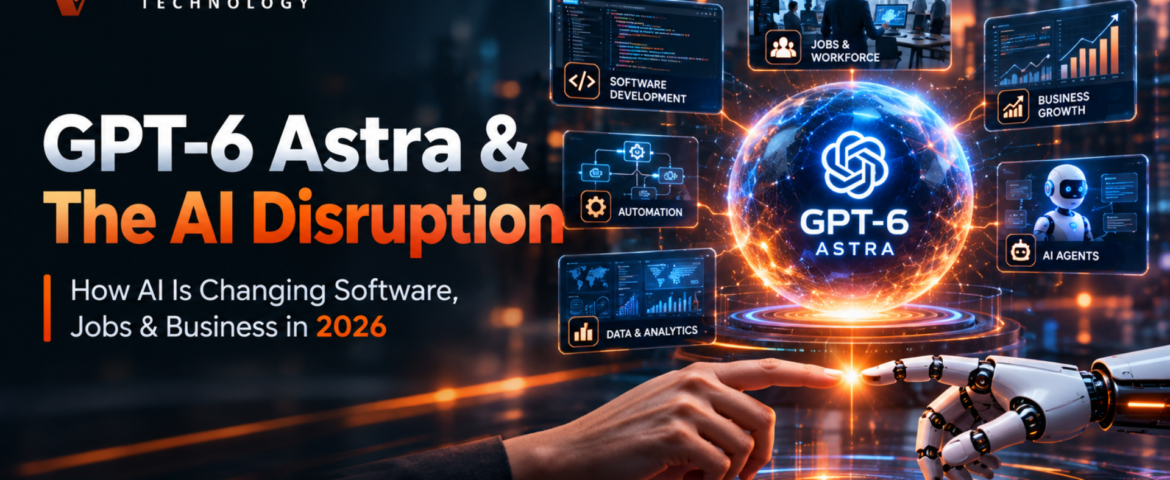
GPT-6 Astra and AI Disruption: The Powerful Shift Changing Software, Jobs & Business
- By pmayank658@gmail.com
- 2 Comments
- Latest News technology
GPT-6 Astrais most important for us because ai is moving beyond simply genrating answers , text and code. OpenAI says that astra is designed for computer use, browsing, software engineering, cybersecurity, science and professional work. In practical terms, the bigger shift is from AI as a tool you use to AI as an agent that can carry out multi-step work for you. That shift could change how companies buy software, how freelancers work, how employees complete routine tasks, and how small businesses automate their operations. But does that mean that traditional software and human jobs will disappear? Not exactly. The more realistic picture is that the way we use software and divide work between humans and AI is changing very quickly. And GPT-6 Astra is one of the clearest examples of that transition. What Is GPT-6 Astra? GPT-6 Astra is OpenAI’s latest advanced AI model, announced on September 3, 2026. OpenAI describes Astra as its most intelligent and aligned model to date. According to the company, the model brings significant advances in computer use, web browsing, software engineering, cybersecurity, scientific work, and other professional tasks. OpenAI has also published strong benchmark results for Astra, including 99.9% on ARC-AGI-3, 98% on FrontierMath Tier 4, and 100% on ExploitBench. Those numbers are worth paying attention to, but there is an important distinction to make: these are results from OpenAI’s own evaluations. They show how Astra performed under particular benchmark conditions; they do not establish that the model is better than humans at every kind of work. The more interesting question, then, is not simply how high Astra can score on a benchmark. It is what the model can actually do when given a complicated task. Consider a typical business request: “Research these 20 competitors, compare their pricing, put the information into a spreadsheet, identify the strongest opportunities, and prepare a presentation.” A conventional chatbot could help with parts of that assignment. You could ask it to write a competitor-analysis template, summarize information, generate spreadsheet formulas, or create presentation content. But a person would generally still have to move between websites, applications, documents, and other tools to complete the entire workflow. That is where the agent-style approach becomes important. Instead of treating every instruction as a separate question, an agent can approach the request as a larger task. It can reason about the steps involved, interact with available tools and computer interfaces, work through several actions, and move toward a final deliverable. That changes the role AI can play. The conversation is no longer only about generating an answer. It is increasingly about whether the system can participate in the process that produces the answer. For GPT-6 Astra, that distinction is central. The potential impact of the model comes from its ability to handle more of the work between an initial instruction and the final result—not simply from producing better-written paragraphs. Why Is GPT-6 Astra Different From Previous AI Models? The difference becomes clearer when traditional AI assistants are compared with agent-style systems. Traditional AI Assistant Agent-Style AI Answers questions Works toward a specific goal Generates text Can work through multiple steps Suggests code Can assist with software-engineering tasks Explains a process Can execute parts of the process Usually waits for the next instruction Can continue through a workflow Produces individual outputs Can work toward an end-to-end result This does not mean Astra can simply be given control of an entire company and left to operate without supervision. Real-world AI systems still depend on permissions, connected tools, available data, context, and appropriate human oversight. The quality of the final result can also depend heavily on how clearly a task is defined and what information the system is allowed to access. The important change is happening at the level of interaction. AI systems are moving beyond the traditional question-and-answer interface and becoming increasingly capable of working inside the digital environments where modern work takes place. According to OpenAI, Astra can use computers, browse the web, create documents, spreadsheets, and presentations, and work through complex multi-step tasks. That matters because most professional work is rarely a single action. A marketer might research a market, collect information, analyze the results, update a campaign document, and prepare a report. A developer might inspect a codebase, identify a problem, modify several files, run tests, and review the results. A researcher might gather sources, organize findings, compare evidence, and turn the analysis into a structured report. The value of an agent-style model lies in its ability to connect those individual steps. That is the larger shift represented by GPT-6 Astra: AI is being developed not only as something that answers questions, but as a system that can potentially participate in the workflows people use to get work done. What Can GPT-6 Astra Actually Do? Computer Use One of the most important capabilities is computer use. Instead of only telling you which buttons to click, an advanced AI agent can potentially interact with software and websites as part of completing a task. For example, imagine a small business owner needs to organize customer information. A traditional workflow might look like this: Open CRM → search customers → update records → create follow-ups → prepare report → send report. With an AI-agent workflow, the long-term goal is closer to: Give the AI the objective → AI works through the CRM and other tools → human reviews the result. That could save considerable time on repetitive digital work. Of course, businesses should not give an AI unrestricted access to important systems simply because the technology can operate a computer. Permissions and human approval still matter. Coding and Software Engineering Software development is another major area. AI coding tools are already useful for: A more capable model can take a larger software task and reason through multiple stages. For a freelancer, this could mean spending less time writing repetitive code and more time understanding the client’s actual problem. For a small software company, it could mean a smaller team can build and
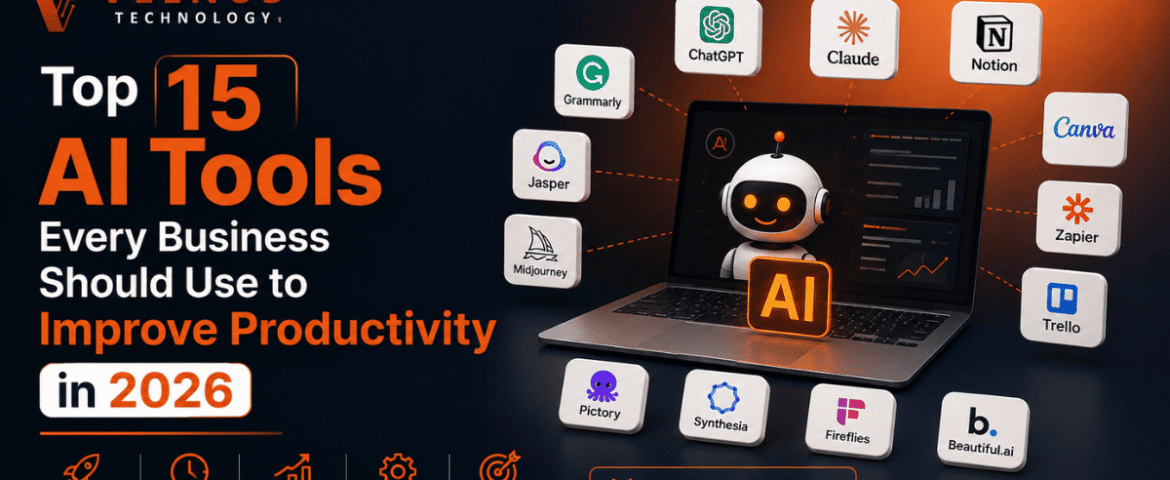
Top 15 AI Tools Every Business Should Use to Improve Productivity in 2026
- By KHUSHI LIMBASIYA
- 0 Comments
- technology Latest News
Modern organizational workflows have moved far beyond manual operations, static spreadsheets, and repetitive routine tasks. To stay competitive in today’s fast-moving digital economy, integrating advanced AI Tools into your daily business stack is no longer an option—it is a core necessity. From intelligent content generation and complex data analysis to automated project management and predictive customer service, artificial intelligence is actively restructuring how work gets done. This comprehensive guide breaks down the top 15 AI Tools that every modern business should deploy in 2026 to streamline operations, eliminate administrative bottlenecks, and maximize overall output. The Transformation of Business Operations Through AI The integration of artificial intelligence across corporate departments has transitioned from basic task automation to full-scale autonomous execution. Modern enterprises are adopting specialized software engines capable of processing vast amounts of unstructured data, recognizing subtle operational patterns, and executing complex, multi-step decisions in real-time. When deployed effectively, business-grade AI Tools serve as specialized digital force multipliers. They allow human teams to shed repetitive administrative tasks—such as manual data entry, routine scheduling, and basic customer inquiries—and direct their efforts toward strategic planning, high-level creative execution, and core business expansion. 1. ChatGPT Enterprise Next-Generation Conversational Intelligence & Reasoning ChatGPT Enterprise remains a foundational tool for organizational operations. Powered by advanced frontier models, this platform acts as a versatile internal assistant capable of analyzing massive datasets, drafting technical documentation, writing code, and answering complex business queries. Key Productivity Benefits 2. Microsoft 365 Copilot Native Suite Productivity Acceleration Microsoft 365 Copilot integrates artificial intelligence directly into standard workplace applications like Word, Excel, PowerPoint, Outlook, and Teams. It serves as an embedded digital assistant that understands full organizational context across your entire operational ecosystem. Key Productivity Benefits 3. Google Gemini Multimodal Workspace Integration Google Gemini offers deep integration across cloud storage, email, document processing, and spreadsheet applications. Its primary strength lies in its native multimodal processing, allowing it to interpret and synthesize text, high-resolution visuals, code, and audio seamlessly within a single workspace. Key Productivity Benefits 4. Claude Long-Document Processing and High-Reasoning Tasks Developed with a strict focus on precision, safety, and deep contextual understanding, Claude excels at processing massive volumes of complex text. It is widely adopted by legal, compliance, and research departments that require rigorous document analysis and nuanced logical reasoning. Key Productivity Benefits 5. Zapier AI Orchestration and Workflow Automation Zapier serves as the central neural network for modern tech stacks. By connecting thousands of distinct software applications, its AI-powered features allow non-technical teams to construct intricate, multi-step automated workflows using standard conversational language. Key Productivity Benefits 6. Notion AI Centralized Knowledge Management and Documentation Notion AI turns static company workspaces into dynamic knowledge repositories. It provides built-in writing, editing, summarization, and search capabilities across all internal project notes, meeting transcripts, and corporate wikis. Key Productivity Benefits 7. Motion Automated Task and Calendar Scheduling Motion acts as an intelligent executive assistant that manages time allocation for entire organizations. Using predictive algorithms, it builds custom daily schedules for team members, constantly rearranging priorities as new urgent tasks emerge. Key Productivity Benefits 8. GitHub Copilot Developer Productivity and Pair Programming For software engineering departments, GitHub Copilot acts as an AI pair programmer. Operating directly within developer coding environments, it provides real-time code completion, suggests optimizations, and writes unit tests automatically. Key Productivity Benefits 9. Perplexity Real-Time Market Research and Information Retrieval Perplexity functions as an advanced, citation-backed intelligence engine designed specifically for fast business research. Instead of requiring researchers to open dozens of search tabs, it scans the web in real-time, synthesizes verified answers, and cites every source explicitly. Key Productivity Benefits 10. Jasper Enterprise Marketing and Brand Copy Generation Jasper is an AI writing engine tailored specifically for enterprise marketing teams, brand managers, and creative agencies. It generates on-brand promotional material across multiple channels while strict adherence to brand voice guides. Key Productivity Benefits 11. Midjourney Visual Asset Conceptualization and Creative Ideation Midjourney is a premier generative image platform recognized for producing high-fidelity visual assets, photorealistic concept art, and innovative marketing graphics. Key Productivity Benefits 12. Fireflies Conversation Intelligence and Meeting Transcription Fireflies operates as an autonomous meeting assistant that joins digital video conferences, records discussions, generates transcriptions, and extracts key action items automatically. Key Productivity Benefits 13. Grammarly Real-Time Communication and Style Optimization Grammarly goes far beyond simple spell-checking, serving as an enterprise-wide communication assistant. It monitors written output across web browsers, email clients, and desktop applications to ensure clarity, proper tone, and brand compliance. Key Productivity Benefits 14. Synthesia AI Video Generation and Multilingual Localization Synthesia allows businesses to create professional video content using photorealistic avatars and synthetic speech, entirely eliminating the need for traditional camera setups, actors, or studio equipment. Key Productivity Benefits 15. Glean Enterprise Search and Grounded Context Layer Glean acts as an intelligent search engine that indexing data across all your disparate corporate tools, including cloud drives, messaging applications, ticketing systems, and databases. It provides a secure context layer so employees can find accurate answers without switching platforms. Key Productivity Benefits Strategic Framework for Evaluating AI Tools Selecting the right software requires a clear framework to avoid tool bloat and integration bottlenecks. Organizations should evaluate new software solutions using four essential criteria: Key Selection Criteria Also Read : How AI Chatbots Are Transforming Customer Support And Engagement Conclusion The corporate landscape in 2026 demands operational speed, contextual clarity, and administrative efficiency. Deploying the right suite of AI Tools allows modern businesses to automate repetitive tasks, extract actionable insights from unstructured data, and streamline cross-departmental workflows. By adopting enterprise-grade intelligence platforms—spanning conversational reasoning, automated project scheduling, intelligent software development, and centralized organizational search—businesses can eliminate operational bottlenecks and build a resilient, future-ready workforce. The key to sustainable growth lies in building a cohesive, connected software ecosystem that amplifies human capability at every level. Frequently Asked Questions (FAQs) Q1 What are AI Tools and how do they benefit modern businesses? AI Tools are software applications that leverage machine learning algorithms, natural language processing, and advanced neural models