
- Mail Address info@velnustech.com
- Phone Number +91-90990-05498

Contact Info
- C-1024, Siddhivinayak Tower, Kataria Automobile Road Makarba, Ahmedabad - 380051
- +91 90990 05498
- info@velnustech.com
- Week Days: 09.00 to 18.00 Sunday: Closed
Customer Engagement
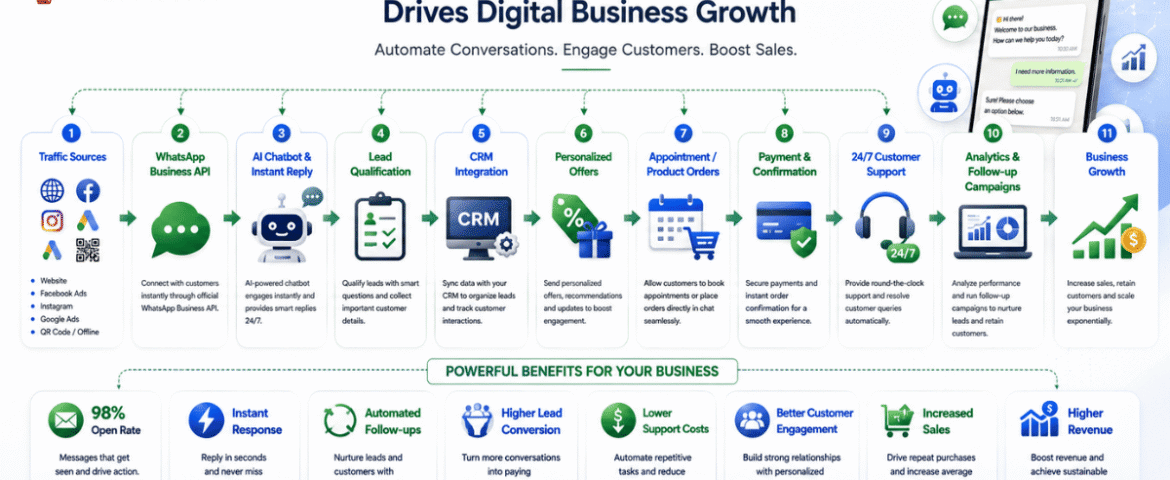
Digital Business Growth: The Power Of WhatsApp Automation
- By KHUSHI LIMBASIYA
- 1 Comment
- technology Latest News
Introduction to Modern Digital Business Growth The landscape of modern commerce is moving at an unprecedented speed. Consumers today expect instant answers, personalized recommendations, and effortless transactional experiences right at their fingertips. Traditional marketing funnels that rely heavily on static landing pages, long web forms, and email newsletters are experiencing a sharp decline in efficiency. Open rates for traditional marketing emails continue to plummet, while consumers grow tired of waiting hours—or even days—for a business to respond to a basic inquiry. To achieve sustainable Digital Business Growth, organizations must adapt to where their customers are actually spending their time. Today, that destination is instant messaging. WhatsApp has evolved from a simple personal chat app into an engine for scaling operations, capturing qualified leads, and closing sales. By replacing slow, friction-filled touchpoints with automated, conversational interactions, businesses can connect with prospects in real time. WhatsApp automation bridges the gap between passive marketing interest and immediate revenue generation, serving as a critical pillar for long-term digital expansion. Understanding WhatsApp Automation in the Digital Ecosystem What is WhatsApp Automation? WhatsApp automation is the strategic integration of software workflows, artificial intelligence, and the official WhatsApp Business API to handle customer communication without manual intervention. Rather than relying on a human team to type individual responses to every inquiry, automated systems trigger pre-designed message paths, answer complex questions, qualify leads, send promotional broadcasts, and process orders automatically. These systems do not feel like rigid, frustration-inducing phone trees. Modern messaging engines utilize conversational logic and natural language processing to deliver helpful, human-like responses within milliseconds. Moving Beyond Traditional Communication Channels Achieving meaningful Digital Business Growth requires choosing marketing channels that offer high visibility and engagement. When comparing traditional outreach methods to automated messaging, the performance gap is vast: Communication Channel Average Open Rate Average Response Time Engagement Potential Traditional Email 15% – 25% 6 to 24 Hours Low to Medium SMS Marketing 80% – 90% 1 to 2 Hours Low (Text Only) WhatsApp Automation 95% – 98% Under 90 Seconds Extremely High (Interactive/Multimodal) Because instant messaging carries an open rate approaching 98%, your promotional campaigns, product updates, and transactional alerts are almost guaranteed to be read. This direct line to the consumer eliminates the friction that typically slows down sales cycles. How WhatsApp Automation Fuels Digital Business Growth 1. Accelerating Lead Capture and Conversion Rates Speed to lead is one of the single most influential factors in determining sales success. Studies show that reaching out to a potential customer within the first five minutes of an inquiry increases the probability of conversion exponentially. Through automated entry points—such as web widgets, QR codes, or social media click-to-chat ads—a prospect can initiate a conversation with a single tap. The automated system instantly engages the lead, asks qualifying questions, and collects verified data (such as names, preferences, and intent) without forcing the user to leave the app. By removing landing page redirects and tedious forms, conversion rates increase significantly. 2. Personalization at Scale for Customer Retention True Digital Business Growth isn’t just about acquiring new users; it relies heavily on maximizing the lifetime value of existing customers. Automation allows brands to deliver deeply personalized experiences to thousands of individuals simultaneously. By syncing messaging workflows with underlying databases, automated messages can dynamically insert recipient names, reference previous purchases, send targeted replenishment reminders, or recommend complementary products. This level of tailored interaction makes customers feel recognized, building strong brand loyalty and encouraging repeat purchases. 3. Driving Revenue with In-Chat Transactions Modern messaging frameworks allow users to browse catalogs, select product variations, schedule appointments, and complete secure payments directly inside the chat interface. Removing the requirement for a customer to jump across multiple browser tabs or build external accounts keeps them inside a high-trust, comfortable environment. The fewer steps required to make a purchase, the higher your overall revenue generation will be. 4. Slashing Operational Overhead and Support Costs Scaling customer support manually is expensive. As customer bases grow, hiring larger support teams to answer repetitive questions creates high overhead costs. Automated bots can resolve up to 80% of routine customer service inquiries—such as checking order statuses, verifying store hours, or providing policy details—without human intervention. This round-the-clock availability drastically reduces support ticket volumes, enabling your existing staff to focus on high-touch, complex sales opportunities that directly impact your bottom line. High-Converting Strategies for Digital Business Growth Seamless Click-to-WhatsApp Campaign Integration One of the most scalable ways to drive paid acquisition is connecting social media advertisements directly to an automated messaging flow. Instead of sending ad traffic to a generic website where visitors might drop off, a “Click-to-WhatsApp” campaign opens a conversation immediately. When a user taps the ad, a pre-written message appears on their screen. Once they press send, the automated bot triggers an interactive greeting, presents relevant offers, and guides the prospect toward a purchasing decision in real time. Automated Cart Recovery and Re-Engagement E-commerce businesses lose billions annually to abandoned shopping carts. While email reminders often go unread in spam folders, an automated message sent via WhatsApp cuts through the noise. If a customer leaves items in their cart without completing the purchase, an automated workflow can send a friendly reminder 30 to 60 minutes later. By including high-resolution product images, a direct checkout link, or a time-sensitive discount code, businesses routinely recover 20% to 50% of abandoned orders using this single automated channel. Intelligent Chatbot Flows and Zero-Party Data Collection Privacy regulations and changing browser standards have made third-party tracking cookies unreliable. As a result, gathering zero-party data—data that a customer explicitly and voluntarily shares with a brand—is critical for Digital Business Growth. Interactive chat flows allow you to ask targeted, conversational questions: By gamifying the qualification process with interactive buttons and quick replies, customers willingly share their preferences. This data can be immediately stored and used to segment your audience for highly targeted future marketing campaigns. Scaling Your Operations with Velnus Technology Building a reliable, secure, and enterprise-ready messaging architecture requires dedicated technical expertise. This is
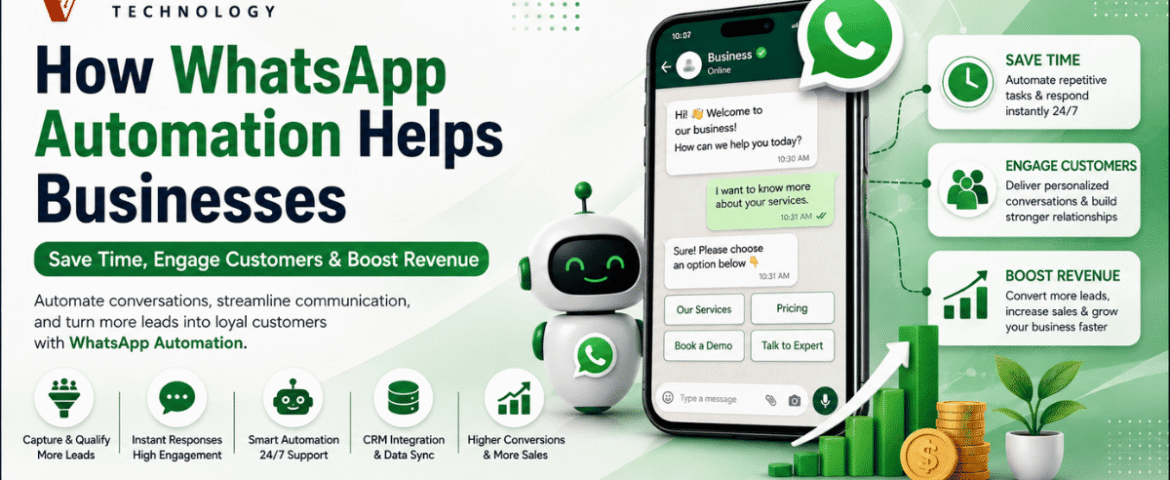
How WhatsApp Automation Helps Businesses Save Time, Engage Customers & Boost Revenue
- By KHUSHI LIMBASIYA
- 0 Comments
- Latest News technology
Introduction to the Power of WhatsApp Automation In the modern digital economy, the speed and quality of customer communication can dictate the success or failure of a business. As traditional channels like email and phone calls become increasingly saturated, businesses are looking for more direct and effective ways to connect with their audiences. With over 3 billion people globally checking the app multiple times a day, WhatsApp has emerged as the premier platform for customer interaction. However, managing a massive influx of messages manually is impossible for growing teams. This is where WhatsApp automation becomes an essential strategy. WhatsApp automation involves utilizing intelligent workflows, chatbots, and application programming interfaces (APIs) to handle conversations and send messages without requiring manual human intervention. Rather than being simple auto-responders, these systems provide smart, context-aware interactions that closely mimic human responses, allowing a business to scale its customer service seamlessly. By integrating WhatsApp automation, organizations can fundamentally transform their operations, significantly reducing manual effort while maximizing engagement and sales. The Shift from Traditional Channels to Messaging For years, businesses relied heavily on email marketing and standard customer service desks. Unfortunately, email campaigns today often struggle, typically yielding open rates of only around 20 percent and minimal click-through rates of 2 to 5 percent. Consumers are fatigued by cluttered inboxes and delayed email responses. In stark contrast, WhatsApp campaigns achieve staggering open rates of 98 percent. Furthermore, click-through rates on automated WhatsApp messages range between 45 and 60 percent. This massive disparity exists because WhatsApp feels inherently personal, immediate, and conversational to the user. When a business leverages WhatsApp automation, they are placing their brand directly into an environment that customers already trust and check constantly. How WhatsApp Automation Saves Time and Resources One of the most immediate and measurable impacts of implementing WhatsApp automation is the sheer amount of time and effort it saves for internal teams. By automating routine interactions, businesses can reallocate their human resources to more complex, strategic tasks. Providing True 24/7 Customer Support Customers do not only browse products or experience issues during standard business hours. Decision-makers and consumers alike frequently research solutions late at night or on weekends. Most businesses simply cannot afford the overhead of maintaining a 24/7 human support team. WhatsApp automation solves this by keeping your business available around the clock. Automated responses ensure that no inquiry goes unanswered, regardless of the time of day. Whether a customer is asking for a product catalog at midnight or requesting an appointment early Sunday morning, the automated system can acknowledge the request, provide the necessary information, or confirm a future meeting instantly. One sports facility that implemented such automation saved significant capital by avoiding the cost of hiring two full-time employees for off-hour shifts, all while providing continuous support. Resolving Common Queries Instantly A significant portion of incoming customer messages consists of repetitive, frequently asked questions (FAQs). Handling these manually creates bottlenecks and frustrates both customers and staff. By deploying AI-driven chatbots to handle the bulk of basic inquiries, businesses report that their response times improve drastically, sometimes by as much as 90 to 97 percent. This immediate resolution keeps the customer satisfied and allows live agents to dedicate their time to high-value, complex problem-solving. Streamlining Internal Workflows Beyond customer-facing interactions, WhatsApp automation can also be utilized for internal communications and operational workflows. Boosting Customer Engagement with WhatsApp Engagement is the lifeblood of customer retention and brand loyalty. Because WhatsApp is a platform that consumers actively monitor, businesses leveraging automation can achieve unprecedented levels of interaction. Leveraging Unmatched Visibility When you send an automated message via email, it may sit unread for days. When you send it via WhatsApp, it is almost guaranteed to be seen immediately. WhatsApp automation ensures that campaigns, from simple birthday greetings to localized promotions, enjoy exceptional visibility. This directness makes the platform ideal for quickly raising brand awareness and ensuring critical marketing messages are actually consumed by the target audience. Personalization at Scale A common misconception about automation is that it feels cold and robotic. However, modern WhatsApp automation can be highly personalized and contextually relevant, which actively builds customer trust. By integrating WhatsApp automation with your CRM platform, the system can dynamically pull specific customer data—such as their name, previous order history, or preferences—into the automated messages. Nurturing Leads Automatically A slow reply can quickly cost a business a valuable deal. Many potential sales are lost simply because leads are not nurtured quickly or consistently enough. WhatsApp automation ensures that no opportunity slips through the cracks by deploying automated follow-ups and continuous lead nurturing sequences. If a prospect abandons a booking or leaves a conversation, an automated message can gently nudge them to continue. Automated systems can even run interactive quizzes or chatbot flows to naturally qualify prospects and segment them before passing them to a human sales representative. Businesses utilizing automated follow-ups report seeing engagement levels 20 percent higher than when relying solely on manual follow-ups. Driving Revenue Growth Through WhatsApp Automation Ultimately, the goal of saving time and engaging customers is to drive bottom-line revenue. WhatsApp automation directly contributes to sales growth through several powerful mechanisms. Recovering Abandoned Carts In the e-commerce sector, shopping cart abandonment is a massive source of lost revenue. Customers frequently add items to their digital carts but leave the site before checking out. Upselling and Cross-Selling Strategies Once a customer is engaged, automated systems can actively recommend complementary products or upgrades. Utilizing AI suggestions for upselling and cross-selling through WhatsApp can boost a business’s average order value by 25 to 35 percent. Additionally, features like in-chat payments allow customers to complete their purchases directly within the messaging interface via one-click checkout links, drastically reducing purchase friction and accelerating the sales cycle. Lowering Customer Acquisition and Support Costs Revenue growth is not just about making more sales; it is also about reducing operational expenses. By successfully implementing these automated workflows, businesses globally are saving vast amounts of capital, freeing up resources for innovation and expansion.
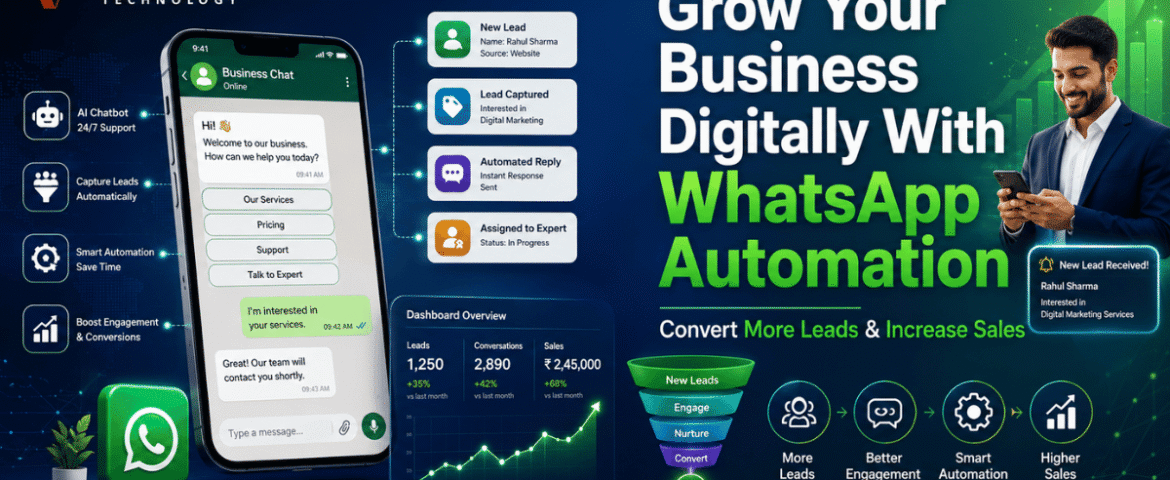
Grow Your Business Digitally With WhatsApp Automation: Convert More Leads & Increase Sales
- By KHUSHI LIMBASIYA
- 0 Comments
- technology Latest News
The digital landscape is shifting, and the way consumers communicate with businesses has evolved dramatically. In 2026, relying purely on traditional email capture forms and slow-moving sales funnels means leaving massive amounts of revenue on the table. Modern consumers demand instant, personalized, and interactive communication. Enter WhatsApp Automation—the single most powerful lead generation and sales channel available today. With over 3 billion active users globally, this messaging platform is no longer just a way to chat with friends. It has transformed into a highly efficient business ecosystem. By implementing WhatsApp Automation, businesses can capture verified leads instantly, reduce response times from hours to seconds, and guide prospects seamlessly through the sales funnel. If your goal is to convert more leads and increase sales, adopting this technology is no longer optional; it is an absolute necessity. The Shift from Traditional Funnels to Conversational Commerce Why Email and Web Forms Are Falling Behind For years, the standard lead generation model involved driving traffic to a landing page, forcing visitors to fill out a static form, and adding them to an automated email sequence. While this method once worked, it is fundamentally broken in today’s fast-paced digital economy. When a potential customer receives an automated email, there is a high probability it lands in a promotions folder or spam filter. Average email open rates hover around 20%, and click-through rates rarely exceed 2% to 5%. Furthermore, web forms often result in drop-offs; every extra field you ask a user to fill out decreases the likelihood of conversion. The traditional funnel creates friction, delays communication, and causes businesses to lose high-intent prospects simply because the response was not fast enough. The Superiority of Messaging Platforms By contrast, WhatsApp Automation completely flips this dynamic. Messages sent through this platform boast an astounding open rate of over 98%, with the vast majority of them read within three minutes of delivery. This medium is inherently conversational. Because it happens in an environment users are already familiar with and trust, they are far more likely to engage, answer qualification questions, and build a relationship with your brand. Key Benefits of WhatsApp Automation for Business Growth Capturing Verified Data Instantly One of the biggest hurdles in traditional lead generation is fake data. Users frequently submit temporary or “junk” email addresses to bypass forms. When you leverage WhatsApp Automation, you automatically capture a verified phone number and a real profile name. This ensures your sales team is dedicating their time to real people, completely eliminating the guesswork and dramatically improving the quality of your database. Achieving Lightning-Fast Response Times Speed is the ultimate competitive advantage. Studies consistently show that businesses replying within the first five minutes of an inquiry see significantly higher conversion rates. WhatsApp Automation allows you to deploy intelligent workflows that respond to new leads instantly, 24/7. Whether it is the middle of the night or a busy holiday weekend, your automated system ensures that no prospect is ever left waiting. A prompt, helpful response captures the lead while their interest is at its absolute peak. Gathering Zero-Party Data Without Friction Instead of relying on complex buyer persona assumptions or long surveys, WhatsApp Automation enables you to ask direct, conversational questions. By setting up an automated qualification flow, you can playfully ask a prospect about their budget, timeline, and specific needs. This zero-party data is given willingly by the customer in a chat interface, providing you with a perfectly qualified lead without the friction of a traditional web form. Powerful Strategies to Convert More Leads and Increase Sales Deploying Click-to-Chat Advertisements One of the most effective ways to fill your sales pipeline is by combining your paid advertising efforts with WhatsApp Automation. Instead of directing ad clicks to a slow-loading website, Click-to-Chat ads instantly open a conversation in the messaging app. When the user hits send on a pre-filled message, your automated system takes over. This strategy opens a crucial messaging window where you can interact with the prospect, answer their questions, and guide them toward a purchase without them ever leaving the app. By minimizing redirects and keeping the user in a native environment, you significantly lower your cost per acquisition and increase your return on ad spend. Utilizing Interactive Conversational Flows Modern WhatsApp Automation goes far beyond basic text replies. You can now build highly interactive flows directly within the chat window. Imagine a potential customer wanting to book an appointment, configure a product, or check availability. Instead of sending them a link to a website, the automation provides a rich, app-like interface right inside the conversation. These interactive elements reduce abandonment rates drastically because they eliminate the need for page loads and external navigation. The entire transaction, from initial inquiry to final confirmation, happens seamlessly in one place. Automated Lead Nurturing and Drip Campaigns Not every lead is ready to buy on day one. For those who need more time, WhatsApp Automation allows you to create sophisticated nurturing sequences. Unlike easily ignored email drip campaigns, conversational nudges delivered directly to a user’s phone are highly effective. If a prospect abandons a transaction or stops responding during the qualification phase, the system can automatically send a gentle, personalized follow-up message 24 hours later. You can share product tutorials, success stories, or limited-time offers, systematically moving the lead closer to a purchasing decision. Partnering with Velnus Technology for Automation Success Implementing a robust automation strategy requires technical expertise and a deep understanding of conversational design. This is where Velnus Technology excels. By partnering with Velnus Technology, businesses can unlock the full potential of WhatsApp Automation without struggling through a steep learning curve. Velnus Technology specializes in building tailored communication workflows that align perfectly with your specific sales objectives. From setting up complex API integrations to designing intelligent qualification chatbots, Velnus Technology ensures that your automated systems run flawlessly. Their expertise means you get a customized solution that not only captures leads but strategically guides them through a high-converting pipeline, leaving your competitors far behind. Step-by-Step Guide
How AI Chatbots Are Transforming Customer Support And Engagement
- By KHUSHI LIMBASIYA
- 0 Comments
- Latest News technology
The landscape of customer experience has undergone a seismic shift. In 2026, we have definitively crossed the tipping point where artificial intelligence is no longer an experimental novelty but the foundational pillar of digital communication. At the heart of this transformation are AI Chatbots, intelligent systems that have evolved far beyond the rigid, rule-based scripts of the past. Today, these conversational engines are autonomous, context-aware, and emotionally intelligent tools capable of resolving complex issues, predicting user needs, and driving measurable business outcomes across every industry. The Evolution of Customer Support: From Rule-Based Scripts to Conversational AI Chatbots To understand the magnitude of today’s technology, one must look at how quickly the industry has evolved. For years, digital support was synonymous with frustration. Early iterations of virtual assistants were built on simple decision trees. If a user’s query did not exactly match a pre-programmed keyword, the bot would fail, leading to cyclical errors and ultimate user abandonment. Breaking the Limitations of Legacy Systems Legacy systems relied on static logic. They were fundamentally reactive, waiting for a user to input a command and responding with a generic, one-size-fits-all answer. These systems lacked memory, meaning that if a user switched from a mobile app to a desktop browser, the conversation would reset. This lack of continuity was a primary driver of customer dissatisfaction. Modern AI Chatbots have completely broken free from these limitations. Driven by advanced Large Language Models (LLMs) and sophisticated machine learning algorithms, today’s conversational AI does not look for exact keyword matches. Instead, it understands the underlying intent and semantic meaning behind a user’s words. It can decipher colloquialisms, handle typos, and even interpret the emotional state of the user, crafting responses that are dynamic, empathetic, and highly accurate. The Rise of Context-Aware AI Chatbots The most significant leap in modern customer support is the transition to context-aware systems. In 2026, an AI Chatbot does not treat each message in a vacuum. It accesses a rich tapestry of historical data—previous purchases, past support tickets, browsing behavior, and real-time signals—to inform its responses. If a user visits a pricing page, leaves, and later opens a chat widget, the AI Chatbot already knows what the user was looking at and can proactively offer tailored assistance or relevant discounts. This level of contextual awareness transforms a simple support tool into a proactive engagement engine. Core Capabilities of Modern AI Chatbots The transformation of customer engagement is fueled by several core technological advancements. The capabilities of AI Chatbots have expanded rapidly, making them indistinguishable from top-tier human representatives in many routine scenarios. Natural Language Processing and Sentiment Analysis At the core of every modern AI Chatbot is Natural Language Processing (NLP). NLP allows the system to read, decipher, and understand human language in a way that is highly valuable. However, the true game-changer in 2026 is the integration of real-time Sentiment Analysis. AI Chatbots can now detect frustration, urgency, or satisfaction in a user’s text or voice. If a customer uses urgent language or types in all caps to express dissatisfaction about a delayed delivery, the AI Chatbot recognizes this negative sentiment immediately. It can automatically adjust its tone to be more empathetic, prioritize the ticket, or instantly route the conversation to a specialized human escalation team, ensuring that high-risk situations are diffused rapidly. Memory-Rich and Omnichannel Experiences Personalization is no longer a luxury; it is a baseline expectation. AI Chatbots now operate with shared memory across all communication channels. Whether a customer initiates contact via SMS, transitions to a web chat, and finally sends an email, the AI Chatbot maintains the entire thread of the conversation. This omnichannel consistency eliminates the most universally despised aspect of customer support: forcing the user to repeat their problem multiple times to different systems. By providing a continuous, unbroken narrative, AI Chatbots ensure that every interaction feels like an ongoing relationship rather than an isolated transaction. Multimodal Interactions Text-based chat is no longer the sole medium for support. The latest AI Chatbots are multimodal, meaning they can process and respond to multiple forms of input simultaneously. A user attempting to assemble a piece of furniture or troubleshoot a blinking router can now upload a photo or a short video directly into the chat. The AI Chatbot analyzes the visual input alongside the text, identifies the specific model or the error in the setup, and provides visual annotations or step-by-step video responses to solve the problem. This multimodal capability bridges the gap between digital convenience and the hands-on guidance traditionally requiring a physical technician. How AI Chatbots Are Driving Unprecedented Business Outcomes The financial and operational impacts of deploying sophisticated conversational AI are staggering. The global AI customer service market is projected to reach $15.12 billion in 2026, on its way to $47.82 billion by 2030, representing a compound annual growth rate (CAGR) of over 25%. This growth is driven by tangible, measurable returns. Scalability and 24/7 Availability One of the most immediate benefits of AI Chatbots is infinite scalability. A human workforce is limited by physical constraints, time zones, and shift schedules. During seasonal spikes, product launches, or unexpected outages, support queues can stretch for hours. AI Chatbots absorb these massive spikes in volume instantaneously. They provide instant resolutions at 2:00 AM on a Sunday just as effectively as they do at 10:00 AM on a Tuesday. This 24/7 availability ensures that global consumer bases receive immediate attention, fundamentally eliminating the concept of “business hours” in the context of customer support. Substantial Return on Investment (ROI) The deployment of AI Chatbots is no longer viewed purely as a cost center, but as a massive driver of profitability. Organizations implementing advanced AI support are currently seeing returns on investment ranging from 3.5x to 8x. By successfully resolving up to 80% of routine interactions autonomously—such as password resets, order tracking, and basic troubleshooting—AI Chatbots drastically reduce overhead. It is estimated that conversational AI will reduce contact center labor costs by a staggering $80 billion globally in 2026 alone.



WhatsApp Marketing: The Complete Guide to Growing Your Business
- By KHUSHI LIMBASIYA
- 0 Comments
- technology Latest News
What is WhatsApp Marketing? WhatsApp marketing is a communication strategy that uses WhatsApp to connect with customers, promote products or services, provide support, send updates, and build long-term relationships. With billions of active users worldwide, WhatsApp has become one of the most effective messaging platforms for businesses that want direct and personalized communication. Unlike traditional marketing channels, WhatsApp enables real-time conversations. Messages are delivered instantly, allowing businesses to interact with customers in a more engaging and convenient way. From sharing promotional offers to answering customer queries, WhatsApp marketing creates a seamless communication experience. The platform supports text messages, images, videos, PDFs, voice notes, product catalogs, and interactive buttons, making it a versatile marketing tool for businesses of all sizes. Why WhatsApp Marketing is Important Customer expectations have changed significantly over the years. People prefer quick responses, personalized communication, and convenient support. WhatsApp fulfills these expectations by offering a familiar and user-friendly platform. Some major reasons why WhatsApp marketing has become important include: Businesses that communicate effectively through WhatsApp often experience stronger customer loyalty and better conversion rates. Benefits of WhatsApp Marketing High Open Rates WhatsApp messages are generally opened much faster than emails or SMS. This allows businesses to deliver important information quickly. Instant Customer Communication Customers can receive updates, ask questions, and get immediate responses without waiting for long email replies. Personalized Customer Experience Businesses can send personalized messages based on customer interests, previous purchases, or inquiries, creating a more meaningful interaction. Multimedia Support WhatsApp supports: This makes marketing campaigns more engaging than plain text messages. Improved Customer Support Customers appreciate fast assistance. Businesses can resolve queries, handle complaints, and provide after-sales support directly through WhatsApp. Cost-Effective Marketing Compared to many advertising channels, WhatsApp marketing requires relatively low investment while offering excellent engagement. Better Customer Retention Regular communication helps businesses stay connected with existing customers, increasing repeat purchases and long-term loyalty. How WhatsApp Marketing Works WhatsApp marketing begins by obtaining customer consent before sending messages. Businesses should always communicate with users who have voluntarily agreed to receive updates. The typical workflow includes: Building a Contact List Collect customer phone numbers through: Always ensure customers provide permission before messaging them. Segmenting Your Audience Not every customer has the same interests. Organizing contacts into groups improves message relevance. Examples include: Segmentation improves engagement and reduces unnecessary messaging. Creating Valuable Content Effective WhatsApp marketing focuses on delivering value rather than constant promotions. Useful content includes: Sending Messages at the Right Time Timing plays an important role in customer engagement. Avoid sending messages: Choose times when customers are more likely to read and respond. Types of WhatsApp Marketing Campaigns Promotional Campaigns Promotional campaigns inform customers about: Lead Generation Campaigns Businesses can capture potential customers by encouraging users to request information or inquire about services. Customer Support Campaigns Support messages improve customer satisfaction by providing: Feedback Campaigns Customer opinions help improve products and services. Businesses can request: Event Marketing WhatsApp is useful for promoting: Reminder Campaigns Reminder messages help customers remember: Features That Make WhatsApp Marketing Effective Rich Media Messaging Businesses can share attractive content through: Visual content usually performs better than plain text. Quick Replies Frequently asked questions can be answered quickly using predefined responses, saving time and improving efficiency. Automated Responses Automation allows businesses to: Automation ensures customers receive immediate responses even outside working hours. Labels and Contact Organization Contacts can be organized using labels for better management and faster follow-up. Broadcast Messaging Broadcast messages allow businesses to send updates to multiple customers individually without creating group conversations. Interactive Buttons Interactive buttons simplify customer actions by allowing them to: Best Practices for WhatsApp Marketing Obtain Customer Consent Always receive permission before sending marketing messages. Respecting customer preferences builds trust and complies with communication standards. Personalize Every Message Use customer names and tailor content according to their interests whenever possible. Keep Messages Short People prefer concise and easy-to-read messages. Avoid lengthy paragraphs. Provide Value Every message should offer something useful, such as: Avoid Excessive Messaging Sending too many promotional messages may cause customers to ignore future communications or unsubscribe. Use High-Quality Images Professional visuals improve customer engagement and increase the effectiveness of marketing campaigns. Include Clear Calls-to-Action Encourage customers to take action using simple instructions such as: Common WhatsApp Marketing Strategies Product Announcements Inform customers whenever new products or services become available. Exclusive Offers Reward subscribers with special discounts available only through WhatsApp. Customer Education Share educational content that helps customers understand products, services, or industry trends. Seasonal Promotions Plan campaigns around holidays, festivals, and shopping seasons. Limited-Time Offers Create urgency by promoting offers available for a short duration. Loyalty Programs Reward repeat customers with exclusive promotions and early access to new products. Abandoned Inquiry Follow-Up Reconnect with potential customers who previously expressed interest but did not complete their purchase or inquiry. Content Ideas for WhatsApp Marketing Businesses can regularly share: Educational Tips Provide useful information related to your industry. Product Demonstrations Show how products work through short videos or images. Customer Success Stories Share real experiences that highlight positive outcomes. Behind-the-Scenes Content Offer customers a glimpse into product creation, daily operations, or company culture without revealing confidential information. Polls and Surveys Ask customers for opinions to encourage interaction. Frequently Asked Questions Answer common questions proactively to reduce support requests. Common Mistakes to Avoid Sending Messages Without Permission Unsolicited messaging can damage customer trust and reduce engagement. Ignoring Customer Responses WhatsApp is designed for conversations. Respond promptly to customer inquiries. Overloading Customers Sending too many promotional messages may lead customers to stop engaging. Poor Quality Content Low-quality images, unclear messages, and spelling mistakes reduce professionalism. Inconsistent Communication Long periods without communication followed by excessive messaging create an inconsistent customer experience. Not Segmenting Contacts Sending identical messages to every customer often results in lower engagement. Measuring WhatsApp Marketing Performance Successful campaigns should be measured regularly. Key performance indicators include: Message Delivery Rate Measures how many messages successfully reach customers. Open Rate Indicates how many recipients view your messages. Response Rate Shows how many