
- Mail Address info@velnustech.com
- Phone Number +91-90990-05498

Contact Info
- C-1024, Siddhivinayak Tower, Kataria Automobile Road Makarba, Ahmedabad - 380051
- +91 90990 05498
- info@velnustech.com
- Week Days: 09.00 to 18.00 Sunday: Closed
AI integration
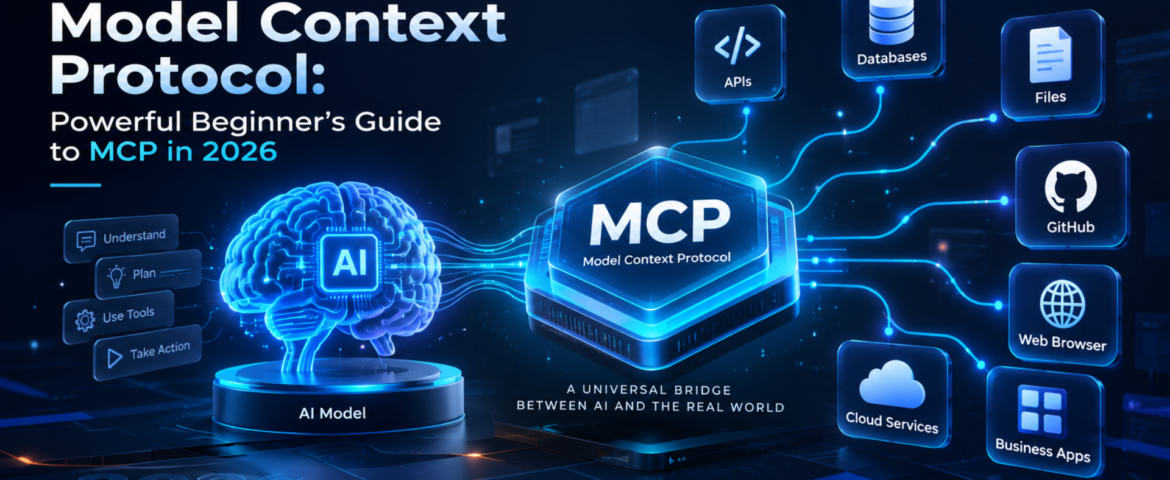
Model Context Protocol: Powerful Beginner’s Guide to MCP in 2026
- By pmayank658@gmail.com
- 1 Comment
- Latest News technology
Model Context Protocol (MCP) is an open standard that gives AI applications a consistent way to connect with external data, tools, and services. Instead of building a separate custom integration for every AI application, developers can use MCP to create a standardized connection between an AI system and the capabilities it needs. In simple words: MCP helps AI move beyond just answering questions and interact with the tools and information it needs to complete a task. For example, imagine asking an AI assistant to check your customer database, find an order, create a report, and send the result to your team. MCP can provide a standardized way for the AI application to discover and use those external capabilities. MCP was introduced by Anthropic and has since developed into a broader ecosystem. The current specification defines MCP around hosts, clients, and servers, with servers exposing resources, prompts, and tools. In this guide, you’ll learn what Model Context Protocol is, how it works, MCP vs API, real-world examples, security considerations, and how beginners and small businesses can use it. Table of Contents What Is Model Context Protocol? Model Context Protocol is an open protocol that standardizes how AI applications connect to external context, data sources, and tools. Think of MCP like a USB-C connection for AI applications. USB-C gives different devices a common way to connect with accessories. Similarly, MCP provides a common way for AI applications to connect with external systems. Without a common protocol, developers may need to create individual integrations between every AI application and every external service. With MCP, a compatible AI application can connect to an MCP server that exposes specific capabilities. For example: AI assistant → MCP → CRM The AI can then potentially use approved CRM capabilities instead of relying only on information already inside the model. The official MCP specification describes three major concepts: hosts, clients and servers. MCP uses JSON-RPC for communication. Why Does Model Context Protocol Matter? Traditional AI chatbots are excellent at generating and explaining information, but an AI system becomes much more useful when it can interact with external systems. Consider a small business owner who asks: “Show me this week’s highest-value leads and summarize which ones need follow-up.” A basic chatbot may not know the company’s latest lead data. An AI application connected through MCP could potentially access an approved CRM tool, retrieve relevant information, analyze it and return a useful summary. That creates a shift: From: AI that mainly generates responses To: AI that can work with external context and tools. This is particularly important for AI agents, where the system may need to use multiple tools to accomplish a goal. How Does Model Context Protocol Work? The basic MCP workflow looks like this: User → AI application → MCP client → MCP server → External system Here’s the simple version. 1. The user gives the AI a goal For example: “Find my latest customer orders.” 2. The AI application identifies the required capability The application may determine that it needs access to an order-management system. 3. The MCP client connects to an MCP server The client acts as the connector inside the host AI application. 4. The MCP server exposes capabilities The server can provide resources, prompts and tools. 5. The AI uses an approved capability For example, it might call a tool that retrieves order information. 6. The result goes back to the AI application The AI can then use that information to generate the final response. The important point is that MCP standardizes the communication layer. The external system still controls what capabilities are exposed and what permissions are available. What Are the Main Components of MCP? MCP becomes much easier to understand when you separate its three main components. What is an MCP host? The host is the AI application that wants to use MCP. It could be an AI assistant, development environment or another application capable of working with MCP. What is an MCP client? The MCP client is the connector inside the host application. It communicates with MCP servers and handles the protocol interaction. What is an MCP server? An MCP server exposes specific data or capabilities that an MCP client can use. For example, an MCP server could provide access to: MCP servers can expose three important types of capabilities: Resources: information or context that can be provided to the AI. Tools: functions that the AI can call. Prompts: reusable prompt templates or workflows. These concepts are defined in the official MCP specification. What Is the Difference Between MCP and an API? This is one of the most common MCP questions. An API is a way for software systems to communicate with a particular service. MCP is a standardized protocol for making AI applications interact with tools and context through a common interface. Here’s a simple comparison: MCP Traditional API Designed around AI application interoperability Designed for software-to-software communication Standardizes AI access to tools and context Defines a service’s own endpoints Can expose tools, resources and prompts Usually exposes endpoints and data Useful for AI agents Useful for applications and services Helps AI applications discover and use capabilities Requires understanding the API’s interface They aren’t competitors. In fact, an MCP server can sit in front of an existing API. For example: AI application → MCP server → CRM API → CRM database This allows the existing business system to remain in place while MCP provides a standardized AI-facing interface. What Can You Do With MCP? MCP can support many AI workflows. Connect AI to business data An AI application can potentially access approved business information such as customer records, documents or inventory data. Connect AI to development tools Developers can connect AI applications to repositories, files, issue trackers and other development capabilities. GitHub documents MCP support across several development environments and GitHub Copilot experiences. Build AI-powered workflows Instead of creating one-off integrations for every AI application, developers can expose reusable capabilities through MCP. Give AI access to external tools An
How AI Chatbots Are Transforming Customer Support And Engagement
- By KHUSHI LIMBASIYA
- 0 Comments
- Latest News technology
The landscape of customer experience has undergone a seismic shift. In 2026, we have definitively crossed the tipping point where artificial intelligence is no longer an experimental novelty but the foundational pillar of digital communication. At the heart of this transformation are AI Chatbots, intelligent systems that have evolved far beyond the rigid, rule-based scripts of the past. Today, these conversational engines are autonomous, context-aware, and emotionally intelligent tools capable of resolving complex issues, predicting user needs, and driving measurable business outcomes across every industry. The Evolution of Customer Support: From Rule-Based Scripts to Conversational AI Chatbots To understand the magnitude of today’s technology, one must look at how quickly the industry has evolved. For years, digital support was synonymous with frustration. Early iterations of virtual assistants were built on simple decision trees. If a user’s query did not exactly match a pre-programmed keyword, the bot would fail, leading to cyclical errors and ultimate user abandonment. Breaking the Limitations of Legacy Systems Legacy systems relied on static logic. They were fundamentally reactive, waiting for a user to input a command and responding with a generic, one-size-fits-all answer. These systems lacked memory, meaning that if a user switched from a mobile app to a desktop browser, the conversation would reset. This lack of continuity was a primary driver of customer dissatisfaction. Modern AI Chatbots have completely broken free from these limitations. Driven by advanced Large Language Models (LLMs) and sophisticated machine learning algorithms, today’s conversational AI does not look for exact keyword matches. Instead, it understands the underlying intent and semantic meaning behind a user’s words. It can decipher colloquialisms, handle typos, and even interpret the emotional state of the user, crafting responses that are dynamic, empathetic, and highly accurate. The Rise of Context-Aware AI Chatbots The most significant leap in modern customer support is the transition to context-aware systems. In 2026, an AI Chatbot does not treat each message in a vacuum. It accesses a rich tapestry of historical data—previous purchases, past support tickets, browsing behavior, and real-time signals—to inform its responses. If a user visits a pricing page, leaves, and later opens a chat widget, the AI Chatbot already knows what the user was looking at and can proactively offer tailored assistance or relevant discounts. This level of contextual awareness transforms a simple support tool into a proactive engagement engine. Core Capabilities of Modern AI Chatbots The transformation of customer engagement is fueled by several core technological advancements. The capabilities of AI Chatbots have expanded rapidly, making them indistinguishable from top-tier human representatives in many routine scenarios. Natural Language Processing and Sentiment Analysis At the core of every modern AI Chatbot is Natural Language Processing (NLP). NLP allows the system to read, decipher, and understand human language in a way that is highly valuable. However, the true game-changer in 2026 is the integration of real-time Sentiment Analysis. AI Chatbots can now detect frustration, urgency, or satisfaction in a user’s text or voice. If a customer uses urgent language or types in all caps to express dissatisfaction about a delayed delivery, the AI Chatbot recognizes this negative sentiment immediately. It can automatically adjust its tone to be more empathetic, prioritize the ticket, or instantly route the conversation to a specialized human escalation team, ensuring that high-risk situations are diffused rapidly. Memory-Rich and Omnichannel Experiences Personalization is no longer a luxury; it is a baseline expectation. AI Chatbots now operate with shared memory across all communication channels. Whether a customer initiates contact via SMS, transitions to a web chat, and finally sends an email, the AI Chatbot maintains the entire thread of the conversation. This omnichannel consistency eliminates the most universally despised aspect of customer support: forcing the user to repeat their problem multiple times to different systems. By providing a continuous, unbroken narrative, AI Chatbots ensure that every interaction feels like an ongoing relationship rather than an isolated transaction. Multimodal Interactions Text-based chat is no longer the sole medium for support. The latest AI Chatbots are multimodal, meaning they can process and respond to multiple forms of input simultaneously. A user attempting to assemble a piece of furniture or troubleshoot a blinking router can now upload a photo or a short video directly into the chat. The AI Chatbot analyzes the visual input alongside the text, identifies the specific model or the error in the setup, and provides visual annotations or step-by-step video responses to solve the problem. This multimodal capability bridges the gap between digital convenience and the hands-on guidance traditionally requiring a physical technician. How AI Chatbots Are Driving Unprecedented Business Outcomes The financial and operational impacts of deploying sophisticated conversational AI are staggering. The global AI customer service market is projected to reach $15.12 billion in 2026, on its way to $47.82 billion by 2030, representing a compound annual growth rate (CAGR) of over 25%. This growth is driven by tangible, measurable returns. Scalability and 24/7 Availability One of the most immediate benefits of AI Chatbots is infinite scalability. A human workforce is limited by physical constraints, time zones, and shift schedules. During seasonal spikes, product launches, or unexpected outages, support queues can stretch for hours. AI Chatbots absorb these massive spikes in volume instantaneously. They provide instant resolutions at 2:00 AM on a Sunday just as effectively as they do at 10:00 AM on a Tuesday. This 24/7 availability ensures that global consumer bases receive immediate attention, fundamentally eliminating the concept of “business hours” in the context of customer support. Substantial Return on Investment (ROI) The deployment of AI Chatbots is no longer viewed purely as a cost center, but as a massive driver of profitability. Organizations implementing advanced AI support are currently seeing returns on investment ranging from 3.5x to 8x. By successfully resolving up to 80% of routine interactions autonomously—such as password resets, order tracking, and basic troubleshooting—AI Chatbots drastically reduce overhead. It is estimated that conversational AI will reduce contact center labor costs by a staggering $80 billion globally in 2026 alone.
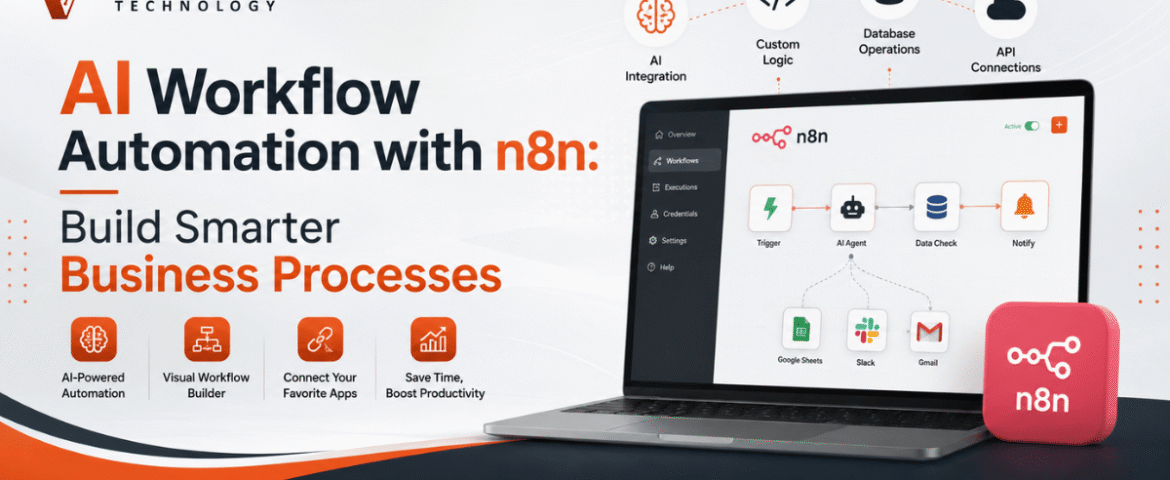
AI Workflow Automation with n8n: Build Smarter Business Processes
- By KHUSHI LIMBASIYA
- 0 Comments
- technology Latest News
Artificial intelligence is transforming the way organizations manage everyday operations. Businesses no longer need to rely on repetitive manual work, disconnected systems, or time-consuming data handling. By combining AI with workflow automation, teams can automate complex tasks, improve productivity, reduce errors, and make faster decisions. AI workflow automation has become one of the most valuable technologies for businesses looking to scale efficiently. With n8n, organizations can connect hundreds of applications, integrate AI models, automate data processing, and build intelligent workflows without spending months on development. Whether you want to automate customer communication, content generation, lead management, reporting, or document processing, n8n provides a flexible and scalable platform for creating AI-powered workflows. What is AI Workflow Automation? AI workflow automation is the process of combining artificial intelligence with workflow automation tools to complete business tasks automatically. Unlike traditional automation, AI-powered workflows can analyze information, generate responses, classify data, summarize documents, and make intelligent decisions. Instead of simply moving data from one application to another, AI enables workflows to understand context and perform tasks that previously required human involvement. Common AI capabilities include: When integrated into n8n workflows, these capabilities become powerful business automation solutions. Why Choose n8n for AI Workflow Automation? n8n is an open-source workflow automation platform that allows users to visually build complex automations while maintaining complete flexibility. Some key advantages include: Visual Workflow Builder Build workflows using drag-and-drop nodes without creating complicated code. AI Integration Connect AI models directly into workflows for intelligent automation. Large Integration Library Connect hundreds of applications from CRM systems to cloud storage and communication platforms. Custom Logic Create advanced conditions, loops, filters, and decision-making paths. Self Hosting Option Maintain full control over your data with self-hosted deployments. API Friendly Integrate with virtually any platform using REST APIs and webhooks. How AI Workflow Automation Works in n8n A typical AI workflow consists of several connected steps. Step 1: Receive Input Data enters the workflow through: Step 2: Process Information n8n transforms and organizes incoming data before passing it to AI services. Step 3: AI Analysis The AI model performs tasks such as: Step 4: Decision Making The workflow decides what action to take based on AI output. Step 5: Automated Actions The workflow automatically: Benefits of AI Workflow Automation Businesses adopting AI automation experience improvements across multiple departments. Increased Productivity Employees spend less time on repetitive work and more time on strategic activities. Faster Response Times Automated workflows operate instantly without waiting for manual intervention. Better Accuracy AI reduces manual data entry mistakes and improves consistency. Lower Operational Costs Automation minimizes labor-intensive tasks and improves resource utilization. Improved Customer Experience Customers receive faster responses and more personalized interactions. Scalable Operations Workflows continue operating efficiently even as business volume increases. Popular AI Workflow Automation Use Cases AI Content Generation Automatically create: Content can then be reviewed before publication. AI Email Automation Incoming emails can be: This reduces inbox overload. Lead Qualification AI analyzes incoming leads based on: Qualified leads can automatically move into sales pipelines. Document Processing AI extracts information from: Extracted data is automatically stored in business systems. Customer Support Automation AI can: Support teams handle only complex issues. Data Synchronization Keep information updated across multiple platforms without manual copying. Whenever records change, every connected application stays synchronized. Meeting Notes Automation AI summarizes meeting transcripts and automatically creates: This saves hours every week. Essential Components of an AI Workflow A well-designed workflow usually contains several important elements. Trigger Starts the automation. Examples include: Data Processing Clean, organize, and transform information before AI processing. AI Model The intelligence layer performs: Decision Logic Conditional branches determine the next workflow path. Output Results may include: AI Workflow Automation for Marketing Marketing teams benefit significantly from AI automation. Examples include: Content Planning Generate weekly content ideas automatically. Campaign Reporting Collect marketing metrics into one dashboard. Audience Segmentation AI categorizes customers based on behavior. SEO Assistance Generate: Social Media Scheduling Automatically generate captions and prepare publishing workflows. AI Workflow Automation for Sales Sales departments can automate repetitive administrative work. Examples include: Lead Routing Assign leads to appropriate sales representatives. Proposal Generation Create customized proposals automatically. Sales Follow-Up Schedule follow-up emails based on customer behavior. CRM Updates Automatically update customer information. AI Workflow Automation for Human Resources HR teams can improve efficiency with AI. Examples include: Resume Screening AI evaluates resumes using predefined criteria. Interview Scheduling Automatically coordinate interview availability. Employee Onboarding Generate onboarding tasks for new employees. Policy Assistance Answer employee questions using AI knowledge. AI Workflow Automation for Finance Finance teams save time through intelligent automation. Examples include: Automation reduces processing delays and human error. AI Workflow Automation for Operations Operations departments often manage numerous repetitive tasks. AI workflows help automate: Best Practices for AI Workflow Automation Start Small Begin with one workflow before expanding automation. Keep Workflows Simple Avoid unnecessary complexity. Simple workflows are easier to maintain. Validate AI Output Review important AI-generated information before final use. Monitor Performance Track execution times and workflow success rates. Handle Errors Create fallback paths whenever external services fail. Secure Sensitive Data Protect confidential information through encryption and access controls. Common Challenges While AI workflow automation offers major benefits, some challenges should be considered. Poor Data Quality Incorrect input leads to poor AI results. Clean data improves workflow accuracy. Over Automation Not every business process should be automated. Human review remains valuable for critical decisions. API Limitations External services may impose request limits. Proper error handling is essential. Workflow Maintenance Regular updates keep automations reliable as connected applications evolve. Tips for Building Better AI Workflows in n8n Design Before Building Create a workflow diagram before implementation. Use Modular Workflows Break large workflows into reusable components. Test Frequently Validate each workflow section individually. Add Logging Track every important workflow step. Optimize Execution Reduce unnecessary processing to improve speed. Keep Documentation Document workflow logic for future maintenance. Future of AI Workflow Automation Artificial intelligence continues to evolve rapidly. Future workflows will become even more intelligent through: Organizations adopting AI workflow automation today