
- Mail Address info@velnustech.com
- Phone Number +91-90990-05498

Contact Info
- C-1024, Siddhivinayak Tower, Kataria Automobile Road Makarba, Ahmedabad - 380051
- +91 90990 05498
- info@velnustech.com
- Week Days: 09.00 to 18.00 Sunday: Closed
Top 15 AI Tools Every Business Should Use to Improve Productivity in 2026
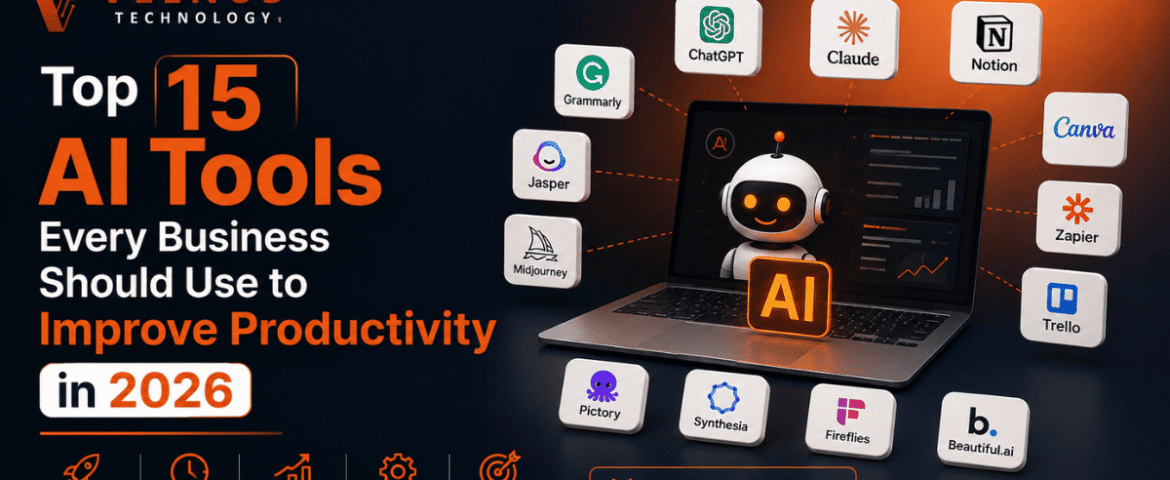
Modern organizational workflows have moved far beyond manual operations, static spreadsheets, and repetitive routine tasks. To stay competitive in today’s fast-moving digital economy, integrating advanced AI Tools into your daily business stack is no longer an option—it is a core necessity. From intelligent content generation and complex data analysis to automated project management and predictive customer service, artificial intelligence is actively restructuring how work gets done.
This comprehensive guide breaks down the top 15 AI Tools that every modern business should deploy in 2026 to streamline operations, eliminate administrative bottlenecks, and maximize overall output.
The Transformation of Business Operations Through AI
The integration of artificial intelligence across corporate departments has transitioned from basic task automation to full-scale autonomous execution. Modern enterprises are adopting specialized software engines capable of processing vast amounts of unstructured data, recognizing subtle operational patterns, and executing complex, multi-step decisions in real-time.
When deployed effectively, business-grade AI Tools serve as specialized digital force multipliers. They allow human teams to shed repetitive administrative tasks—such as manual data entry, routine scheduling, and basic customer inquiries—and direct their efforts toward strategic planning, high-level creative execution, and core business expansion.
1. ChatGPT Enterprise
Next-Generation Conversational Intelligence & Reasoning
ChatGPT Enterprise remains a foundational tool for organizational operations. Powered by advanced frontier models, this platform acts as a versatile internal assistant capable of analyzing massive datasets, drafting technical documentation, writing code, and answering complex business queries.
┌─────────────────────────────────────────────────────────────┐
│                   CHATGPT ENTERPRISE                        │
├───────────────────────────────┬─────────────────────────────┤
│ Core Capabilities             │ Enterprise Features         │
├───────────────────────────────┼─────────────────────────────┤
│ • Advanced Data Analysis      │ • Dedicated Privacy Shields │
│ • Multi-Language Coding       │ • Custom Knowledge Bases    │
│ • Complex Text Generation     │ • Role-Based Access Control │
└───────────────────────────────┴─────────────────────────────┘
Key Productivity Benefits
- Rapid Prototyping: Accelerates ideation, campaign drafting, and strategic planning across marketing, sales, and product teams.
- Enterprise Security: Features dedicated administrative controls, single sign-on (SSO), and absolute guarantees that internal corporate data is never used to train shared public models.
- Data Synthesis: Instantly converts raw spreadsheets, CSV files, and unstructured customer feedback into actionable graphical insights.
2. Microsoft 365 Copilot
Native Suite Productivity Acceleration
Microsoft 365 Copilot integrates artificial intelligence directly into standard workplace applications like Word, Excel, PowerPoint, Outlook, and Teams. It serves as an embedded digital assistant that understands full organizational context across your entire operational ecosystem.
Key Productivity Benefits
- Automated Meeting Intelligence: Generates real-time meeting summaries, action-item tracking, and sentiment analysis within digital video calls.
- Instant Document Processing: Transforms complex text files into polished slide decks or executive summaries in seconds.
- Email Management: Analyzes incoming correspondence, prioritizes urgent threads, and drafts context-aware replies directly in your inbox.
3. Google Gemini
Multimodal Workspace Integration
Google Gemini offers deep integration across cloud storage, email, document processing, and spreadsheet applications. Its primary strength lies in its native multimodal processing, allowing it to interpret and synthesize text, high-resolution visuals, code, and audio seamlessly within a single workspace.
Key Productivity Benefits
- Cross-Application Synergy: Summarizes lengthy email chains directly inside your inbox and automatically populates relevant points into structured document drafts.
- Advanced Visual Understanding: Processes complex technical diagrams, blueprints, and visual charts directly within collaborative cloud files.
- Scalable Data Reasoning: Evaluates expansive context windows, making it ideal for analyzing massive corporate archives without losing track of details.
4. Claude
Long-Document Processing and High-Reasoning Tasks
Developed with a strict focus on precision, safety, and deep contextual understanding, Claude excels at processing massive volumes of complex text. It is widely adopted by legal, compliance, and research departments that require rigorous document analysis and nuanced logical reasoning.
Key Productivity Benefits
- Massive Context Handling: Easily ingests and analyzes full legal contracts, regulatory frameworks, and dense technical manuals in a single request.
- Low-Hallucination Threshold: Designed to deliver factual, grounded responses with minimal errors, making it highly reliable for sensitive business analysis.
- Structured Code Generation: Assists technical teams in writing, auditing, and refactoring clean code across various programming environments.
5. Zapier
AI Orchestration and Workflow Automation
Zapier serves as the central neural network for modern tech stacks. By connecting thousands of distinct software applications, its AI-powered features allow non-technical teams to construct intricate, multi-step automated workflows using standard conversational language.
[Trigger Event] ──► [Zapier AI Engine] ──► [Multi-App Execution]
(New Lead Form)     (Analyzes & Sorts)    (Updates CRM + Sends Slack Alert)
Key Productivity Benefits
- No-Code Automation Builders: Enables team members to describe a routine business process in plain text and automatically generates the background workflow.
- Smart Data Routing: Extracts key information from incoming documents and populates structured internal databases automatically.
- Cross-Platform Synchronization: Keeps team communication tools, customer management suites, and project dashboards aligned without human intervention.
6. Notion AI
Centralized Knowledge Management and Documentation
Notion AI turns static company workspaces into dynamic knowledge repositories. It provides built-in writing, editing, summarization, and search capabilities across all internal project notes, meeting transcripts, and corporate wikis.
Key Productivity Benefits
- Instant Organizational Search: Answers detailed employee questions by scanning every page, policy document, and project board across your company workspace.
- Automated Content Drafting: Generates detailed project briefs, technical specifications, and team updates directly inside collaborative note spaces.
- Action-Item Extraction: Converts messy meeting transcripts into clear, assigned task lists with defined dead-lines.
7. Motion
Automated Task and Calendar Scheduling
Motion acts as an intelligent executive assistant that manages time allocation for entire organizations. Using predictive algorithms, it builds custom daily schedules for team members, constantly rearranging priorities as new urgent tasks emerge.
Key Productivity Benefits
- Dynamic Calendar Optimization: Automatically slots project tasks into team calendars based on available hours, task deadlines, and priority levels.
- Meeting Defense: Blocks out dedicated, distraction-free deep work hours to prevent employee burnout and fragmented schedules.
- Project Capacity Planning: Measures actual team productivity speed against estimated task durations to forecast future project delivery dates accurately.
8. GitHub Copilot
Developer Productivity and Pair Programming
For software engineering departments, GitHub Copilot acts as an AI pair programmer. Operating directly within developer coding environments, it provides real-time code completion, suggests optimizations, and writes unit tests automatically.
┌─────────────────────────────────────────────────────────────┐
│                    GITHUB COPILOT                           │
├───────────────────────────────┬─────────────────────────────┤
│ Developer Tools               │ Efficiency Metrics          │
├───────────────────────────────┼─────────────────────────────┤
│ • Contextual Autocomplete     │ • Up to 55% Faster Coding   │
│ • Automated Unit Testing      │ • Reduced Syntax Errors     │
│ • Legacy Code Refactoring     │ • Real-time Debugging Help  │
└───────────────────────────────┴─────────────────────────────┘
Key Productivity Benefits
- Accelerated Software Delivery: Significantly speeds up development cycles by writing repetitive boilerplate code automatically.
- Instant Debugging Support: Identifies logical errors and syntax bugs on the fly, offering corrected code blocks with contextual explanations.
- Multilingual Code Support: Assists developers across dozens of programming languages, maintaining project consistency across complex engineering teams.
9. Perplexity
Real-Time Market Research and Information Retrieval
Perplexity functions as an advanced, citation-backed intelligence engine designed specifically for fast business research. Instead of requiring researchers to open dozens of search tabs, it scans the web in real-time, synthesizes verified answers, and cites every source explicitly.
Key Productivity Benefits
- Fact-Checked Market Analysis: Delivers detailed summaries of industry trends, competitor activities, and regulatory changes backed by live web sources.
- Data Transparency: Provides clear footnote links for every claim made, allowing internal analysts to verify information quickly.
- Structured Synthesis: Generates clean comparison tables and technical summaries directly from vast online research inputs.
10. Jasper
Enterprise Marketing and Brand Copy Generation
Jasper is an AI writing engine tailored specifically for enterprise marketing teams, brand managers, and creative agencies. It generates on-brand promotional material across multiple channels while strict adherence to brand voice guides.
Key Productivity Benefits
- Brand Voice Enforcement: Learns company style guides, tone rules, and product terminology to ensure content remains consistent across all departments.
- Multi-Channel Campaign Scaling: Transforms a single core document into blog posts, social media updates, newsletter copy, and ad scripts instantly.
- Marketing Template Libraries: Offers structured layouts for common assets like landing page headlines, email subject lines, and press releases.
11. Midjourney
Visual Asset Conceptualization and Creative Ideation
Midjourney is a premier generative image platform recognized for producing high-fidelity visual assets, photorealistic concept art, and innovative marketing graphics.
Key Productivity Benefits
- Rapid Storyboarding: Allows creative teams to generate detailed visual mockups and campaign ideas in minutes without initial photography budgets.
- High-Resolution Production: Delivers commercial-ready imagery suitable for digital advertising, presentation decks, and web headers.
- Style Consistency Controls: Enables precise parameters for color palettes, lighting styles, and artistic directions across image batches.
12. Fireflies
Conversation Intelligence and Meeting Transcription
Fireflies operates as an autonomous meeting assistant that joins digital video conferences, records discussions, generates transcriptions, and extracts key action items automatically.
[Live Meeting] ──► [Fireflies Transcription] ──► [Actionable Summary]
(Video Call)       (Speaker Tracking)            (Pushed to CRM & Slack)
Key Productivity Benefits
- Automated Note-Taking: Eliminates manual administrative work by generating accurate transcripts with speaker identification.
- Topic Searchability: Allows team members to search past meeting recordings for specific keywords, pricing discussions, or project commitments.
- System Integration: Pushes summarized meeting notes, follow-up deadlines, and sentiment logs directly into CRM systems.
13. Grammarly
Real-Time Communication and Style Optimization
Grammarly goes far beyond simple spell-checking, serving as an enterprise-wide communication assistant. It monitors written output across web browsers, email clients, and desktop applications to ensure clarity, proper tone, and brand compliance.
Key Productivity Benefits
- Tone Adjustment: Recommends phrasing adjustments to ensure corporate communications sound professional, persuasive, or helpful.
- Clarity Enhancement: Identifies overly complex sentences and suggests concise rewrites to speed up reader comprehension.
- Enterprise Style Guides: Enforces internal company dictionaries and standardized terminology across customer support and sales emails.
14. Synthesia
AI Video Generation and Multilingual Localization
Synthesia allows businesses to create professional video content using photorealistic avatars and synthetic speech, entirely eliminating the need for traditional camera setups, actors, or studio equipment.
Key Productivity Benefits
- Scalable Onboarding & Training: Converts standard text scripts and training manuals into engaging video modules in minutes.
- Global Localization: Translates video narrations into over 120 languages instantly using natural-sounding regional voices.
- Low-Cost Updates: Allows teams to edit video scripts and regenerate visual scenes in seconds whenever company policies change, avoiding expensive video reshoots.
15. Glean
Enterprise Search and Grounded Context Layer
Glean acts as an intelligent search engine that indexing data across all your disparate corporate tools, including cloud drives, messaging applications, ticketing systems, and databases. It provides a secure context layer so employees can find accurate answers without switching platforms.
┌─────────────────────────────────────────────────────────────┐
│                       GLEAN ENGINE                          │
├───────────────────────────────┬─────────────────────────────┤
│ Integrated Data Sources       │ Core Business Functions     │
├───────────────────────────────┼─────────────────────────────┤
│ • Cloud Storage & Messaging   │ • Instant Document Search   │
│ • Issue Trackers & CRMs       │ • Permissions-Aware Answers │
│ • Internal Knowledge Wikis    │ • Org-Wide Data Analytics   │
└───────────────────────────────┴─────────────────────────────┘
Key Productivity Benefits
- Permissions-Aware Retrieval: Respects existing user access rules, ensuring employees only see internal information they are authorized to view.
- Unified Knowledge Access: Cuts down time spent hunting for lost documents or buried messaging threads across disconnected tools.
- Contextual Grounding: Connects seamlessly with general AI models to supply factual, company-specific context for internal queries.
Strategic Framework for Evaluating AI Tools
Selecting the right software requires a clear framework to avoid tool bloat and integration bottlenecks. Organizations should evaluate new software solutions using four essential criteria:
Key Selection Criteria
- Data Governance & Compliance: Verify that vendor privacy terms strictly protect corporate data from being leaked or used for external model training.
- Native Ecosystem Integration: Prioritize platforms that connect seamlessly with your existing software stack via robust API frameworks or pre-built connectors.
- User Adoption Friction: Choose applications with intuitive conversational interfaces that require minimal technical onboarding for non-developer staff.
- Demonstrable ROI: Measure effectiveness based on direct time saved on administrative overhead, faster software release cycles, and higher conversion rates.
Also Read : How AI Chatbots Are Transforming Customer Support And Engagement
Conclusion
The corporate landscape in 2026 demands operational speed, contextual clarity, and administrative efficiency. Deploying the right suite of AI Tools allows modern businesses to automate repetitive tasks, extract actionable insights from unstructured data, and streamline cross-departmental workflows.
By adopting enterprise-grade intelligence platforms—spanning conversational reasoning, automated project scheduling, intelligent software development, and centralized organizational search—businesses can eliminate operational bottlenecks and build a resilient, future-ready workforce. The key to sustainable growth lies in building a cohesive, connected software ecosystem that amplifies human capability at every level.
Frequently Asked Questions (FAQs)
Q1 What are AI Tools and how do they benefit modern businesses?
AI Tools are software applications that leverage machine learning algorithms, natural language processing, and advanced neural models to automate routine tasks, analyze data, and generate creative outputs. They improve business productivity by reducing manual administrative work, accelerating decision-making, and freeing up employees to focus on strategic initiatives.
Q2 How do I ensure company data remains secure when deploying AI Tools?
Choose enterprise-grade software versions that feature dedicated privacy protections, role-based access controls, single sign-on (SSO), and clear contractual guarantees that your operational data will not be used to train public models.
Q3 Can AI Tools integrate with my existing software applications?
Yes. Modern platforms are built to connect natively with popular workplace suites, cloud storage systems, project management boards, and communication tools through pre-built integrations or orchestration managers.
Q4 What is the difference between general AI assistants and specialized AI Tools?
General AI assistants help with broad tasks like text drafting, basic ideation, and conversational Q&A. Specialized tools are designed for specific operational workflows, such as automated meeting transcription, developer pair-programming, or complex calendar optimization.
Q5 How can small businesses implement AI Tools on a limited budget?
Start by identifying your largest operational bottleneck—such as customer email management, content creation, or task scheduling. Deploy one or two versatile platforms that offer flexible per-user pricing before scaling up to broader enterprise suites.
Leave A Comment