
- Mail Address info@velnustech.com
- Phone Number +91-90990-05498

Contact Info
- C-1024, Siddhivinayak Tower, Kataria Automobile Road Makarba, Ahmedabad - 380051
- +91 90990 05498
- info@velnustech.com
- Week Days: 09.00 to 18.00 Sunday: Closed
conversational AI
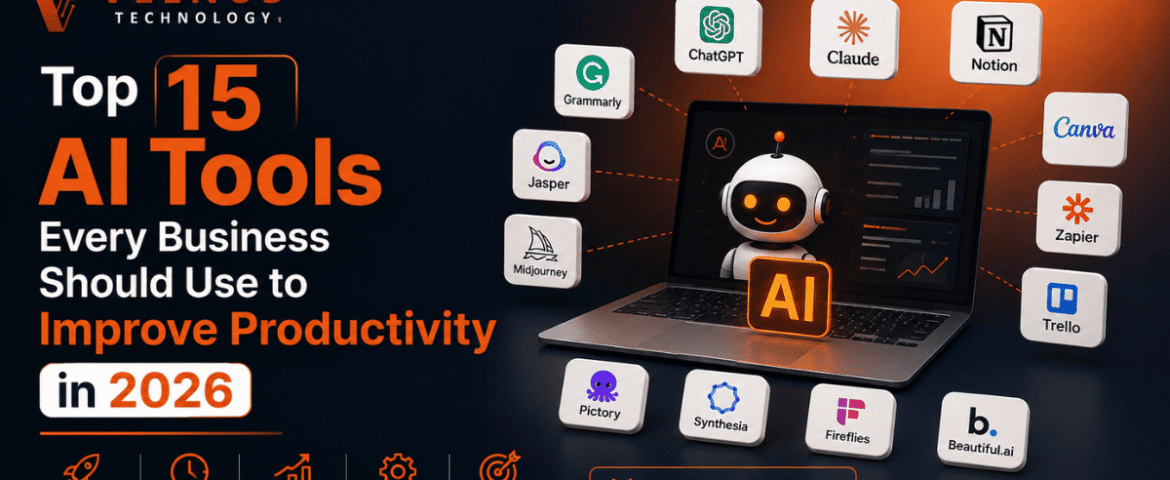
Top 15 AI Tools Every Business Should Use to Improve Productivity in 2026
- By KHUSHI LIMBASIYA
- 0 Comments
- technology Latest News
Modern organizational workflows have moved far beyond manual operations, static spreadsheets, and repetitive routine tasks. To stay competitive in today’s fast-moving digital economy, integrating advanced AI Tools into your daily business stack is no longer an option—it is a core necessity. From intelligent content generation and complex data analysis to automated project management and predictive customer service, artificial intelligence is actively restructuring how work gets done. This comprehensive guide breaks down the top 15 AI Tools that every modern business should deploy in 2026 to streamline operations, eliminate administrative bottlenecks, and maximize overall output. The Transformation of Business Operations Through AI The integration of artificial intelligence across corporate departments has transitioned from basic task automation to full-scale autonomous execution. Modern enterprises are adopting specialized software engines capable of processing vast amounts of unstructured data, recognizing subtle operational patterns, and executing complex, multi-step decisions in real-time. When deployed effectively, business-grade AI Tools serve as specialized digital force multipliers. They allow human teams to shed repetitive administrative tasks—such as manual data entry, routine scheduling, and basic customer inquiries—and direct their efforts toward strategic planning, high-level creative execution, and core business expansion. 1. ChatGPT Enterprise Next-Generation Conversational Intelligence & Reasoning ChatGPT Enterprise remains a foundational tool for organizational operations. Powered by advanced frontier models, this platform acts as a versatile internal assistant capable of analyzing massive datasets, drafting technical documentation, writing code, and answering complex business queries. Key Productivity Benefits 2. Microsoft 365 Copilot Native Suite Productivity Acceleration Microsoft 365 Copilot integrates artificial intelligence directly into standard workplace applications like Word, Excel, PowerPoint, Outlook, and Teams. It serves as an embedded digital assistant that understands full organizational context across your entire operational ecosystem. Key Productivity Benefits 3. Google Gemini Multimodal Workspace Integration Google Gemini offers deep integration across cloud storage, email, document processing, and spreadsheet applications. Its primary strength lies in its native multimodal processing, allowing it to interpret and synthesize text, high-resolution visuals, code, and audio seamlessly within a single workspace. Key Productivity Benefits 4. Claude Long-Document Processing and High-Reasoning Tasks Developed with a strict focus on precision, safety, and deep contextual understanding, Claude excels at processing massive volumes of complex text. It is widely adopted by legal, compliance, and research departments that require rigorous document analysis and nuanced logical reasoning. Key Productivity Benefits 5. Zapier AI Orchestration and Workflow Automation Zapier serves as the central neural network for modern tech stacks. By connecting thousands of distinct software applications, its AI-powered features allow non-technical teams to construct intricate, multi-step automated workflows using standard conversational language. Key Productivity Benefits 6. Notion AI Centralized Knowledge Management and Documentation Notion AI turns static company workspaces into dynamic knowledge repositories. It provides built-in writing, editing, summarization, and search capabilities across all internal project notes, meeting transcripts, and corporate wikis. Key Productivity Benefits 7. Motion Automated Task and Calendar Scheduling Motion acts as an intelligent executive assistant that manages time allocation for entire organizations. Using predictive algorithms, it builds custom daily schedules for team members, constantly rearranging priorities as new urgent tasks emerge. Key Productivity Benefits 8. GitHub Copilot Developer Productivity and Pair Programming For software engineering departments, GitHub Copilot acts as an AI pair programmer. Operating directly within developer coding environments, it provides real-time code completion, suggests optimizations, and writes unit tests automatically. Key Productivity Benefits 9. Perplexity Real-Time Market Research and Information Retrieval Perplexity functions as an advanced, citation-backed intelligence engine designed specifically for fast business research. Instead of requiring researchers to open dozens of search tabs, it scans the web in real-time, synthesizes verified answers, and cites every source explicitly. Key Productivity Benefits 10. Jasper Enterprise Marketing and Brand Copy Generation Jasper is an AI writing engine tailored specifically for enterprise marketing teams, brand managers, and creative agencies. It generates on-brand promotional material across multiple channels while strict adherence to brand voice guides. Key Productivity Benefits 11. Midjourney Visual Asset Conceptualization and Creative Ideation Midjourney is a premier generative image platform recognized for producing high-fidelity visual assets, photorealistic concept art, and innovative marketing graphics. Key Productivity Benefits 12. Fireflies Conversation Intelligence and Meeting Transcription Fireflies operates as an autonomous meeting assistant that joins digital video conferences, records discussions, generates transcriptions, and extracts key action items automatically. Key Productivity Benefits 13. Grammarly Real-Time Communication and Style Optimization Grammarly goes far beyond simple spell-checking, serving as an enterprise-wide communication assistant. It monitors written output across web browsers, email clients, and desktop applications to ensure clarity, proper tone, and brand compliance. Key Productivity Benefits 14. Synthesia AI Video Generation and Multilingual Localization Synthesia allows businesses to create professional video content using photorealistic avatars and synthetic speech, entirely eliminating the need for traditional camera setups, actors, or studio equipment. Key Productivity Benefits 15. Glean Enterprise Search and Grounded Context Layer Glean acts as an intelligent search engine that indexing data across all your disparate corporate tools, including cloud drives, messaging applications, ticketing systems, and databases. It provides a secure context layer so employees can find accurate answers without switching platforms. Key Productivity Benefits Strategic Framework for Evaluating AI Tools Selecting the right software requires a clear framework to avoid tool bloat and integration bottlenecks. Organizations should evaluate new software solutions using four essential criteria: Key Selection Criteria Also Read : How AI Chatbots Are Transforming Customer Support And Engagement Conclusion The corporate landscape in 2026 demands operational speed, contextual clarity, and administrative efficiency. Deploying the right suite of AI Tools allows modern businesses to automate repetitive tasks, extract actionable insights from unstructured data, and streamline cross-departmental workflows. By adopting enterprise-grade intelligence platforms—spanning conversational reasoning, automated project scheduling, intelligent software development, and centralized organizational search—businesses can eliminate operational bottlenecks and build a resilient, future-ready workforce. The key to sustainable growth lies in building a cohesive, connected software ecosystem that amplifies human capability at every level. Frequently Asked Questions (FAQs) Q1 What are AI Tools and how do they benefit modern businesses? AI Tools are software applications that leverage machine learning algorithms, natural language processing, and advanced neural models
How AI Chatbots Are Transforming Customer Support And Engagement
- By KHUSHI LIMBASIYA
- 0 Comments
- Latest News technology
The landscape of customer experience has undergone a seismic shift. In 2026, we have definitively crossed the tipping point where artificial intelligence is no longer an experimental novelty but the foundational pillar of digital communication. At the heart of this transformation are AI Chatbots, intelligent systems that have evolved far beyond the rigid, rule-based scripts of the past. Today, these conversational engines are autonomous, context-aware, and emotionally intelligent tools capable of resolving complex issues, predicting user needs, and driving measurable business outcomes across every industry. The Evolution of Customer Support: From Rule-Based Scripts to Conversational AI Chatbots To understand the magnitude of today’s technology, one must look at how quickly the industry has evolved. For years, digital support was synonymous with frustration. Early iterations of virtual assistants were built on simple decision trees. If a user’s query did not exactly match a pre-programmed keyword, the bot would fail, leading to cyclical errors and ultimate user abandonment. Breaking the Limitations of Legacy Systems Legacy systems relied on static logic. They were fundamentally reactive, waiting for a user to input a command and responding with a generic, one-size-fits-all answer. These systems lacked memory, meaning that if a user switched from a mobile app to a desktop browser, the conversation would reset. This lack of continuity was a primary driver of customer dissatisfaction. Modern AI Chatbots have completely broken free from these limitations. Driven by advanced Large Language Models (LLMs) and sophisticated machine learning algorithms, today’s conversational AI does not look for exact keyword matches. Instead, it understands the underlying intent and semantic meaning behind a user’s words. It can decipher colloquialisms, handle typos, and even interpret the emotional state of the user, crafting responses that are dynamic, empathetic, and highly accurate. The Rise of Context-Aware AI Chatbots The most significant leap in modern customer support is the transition to context-aware systems. In 2026, an AI Chatbot does not treat each message in a vacuum. It accesses a rich tapestry of historical data—previous purchases, past support tickets, browsing behavior, and real-time signals—to inform its responses. If a user visits a pricing page, leaves, and later opens a chat widget, the AI Chatbot already knows what the user was looking at and can proactively offer tailored assistance or relevant discounts. This level of contextual awareness transforms a simple support tool into a proactive engagement engine. Core Capabilities of Modern AI Chatbots The transformation of customer engagement is fueled by several core technological advancements. The capabilities of AI Chatbots have expanded rapidly, making them indistinguishable from top-tier human representatives in many routine scenarios. Natural Language Processing and Sentiment Analysis At the core of every modern AI Chatbot is Natural Language Processing (NLP). NLP allows the system to read, decipher, and understand human language in a way that is highly valuable. However, the true game-changer in 2026 is the integration of real-time Sentiment Analysis. AI Chatbots can now detect frustration, urgency, or satisfaction in a user’s text or voice. If a customer uses urgent language or types in all caps to express dissatisfaction about a delayed delivery, the AI Chatbot recognizes this negative sentiment immediately. It can automatically adjust its tone to be more empathetic, prioritize the ticket, or instantly route the conversation to a specialized human escalation team, ensuring that high-risk situations are diffused rapidly. Memory-Rich and Omnichannel Experiences Personalization is no longer a luxury; it is a baseline expectation. AI Chatbots now operate with shared memory across all communication channels. Whether a customer initiates contact via SMS, transitions to a web chat, and finally sends an email, the AI Chatbot maintains the entire thread of the conversation. This omnichannel consistency eliminates the most universally despised aspect of customer support: forcing the user to repeat their problem multiple times to different systems. By providing a continuous, unbroken narrative, AI Chatbots ensure that every interaction feels like an ongoing relationship rather than an isolated transaction. Multimodal Interactions Text-based chat is no longer the sole medium for support. The latest AI Chatbots are multimodal, meaning they can process and respond to multiple forms of input simultaneously. A user attempting to assemble a piece of furniture or troubleshoot a blinking router can now upload a photo or a short video directly into the chat. The AI Chatbot analyzes the visual input alongside the text, identifies the specific model or the error in the setup, and provides visual annotations or step-by-step video responses to solve the problem. This multimodal capability bridges the gap between digital convenience and the hands-on guidance traditionally requiring a physical technician. How AI Chatbots Are Driving Unprecedented Business Outcomes The financial and operational impacts of deploying sophisticated conversational AI are staggering. The global AI customer service market is projected to reach $15.12 billion in 2026, on its way to $47.82 billion by 2030, representing a compound annual growth rate (CAGR) of over 25%. This growth is driven by tangible, measurable returns. Scalability and 24/7 Availability One of the most immediate benefits of AI Chatbots is infinite scalability. A human workforce is limited by physical constraints, time zones, and shift schedules. During seasonal spikes, product launches, or unexpected outages, support queues can stretch for hours. AI Chatbots absorb these massive spikes in volume instantaneously. They provide instant resolutions at 2:00 AM on a Sunday just as effectively as they do at 10:00 AM on a Tuesday. This 24/7 availability ensures that global consumer bases receive immediate attention, fundamentally eliminating the concept of “business hours” in the context of customer support. Substantial Return on Investment (ROI) The deployment of AI Chatbots is no longer viewed purely as a cost center, but as a massive driver of profitability. Organizations implementing advanced AI support are currently seeing returns on investment ranging from 3.5x to 8x. By successfully resolving up to 80% of routine interactions autonomously—such as password resets, order tracking, and basic troubleshooting—AI Chatbots drastically reduce overhead. It is estimated that conversational AI will reduce contact center labor costs by a staggering $80 billion globally in 2026 alone.