
- Mail Address info@velnustech.com
- Phone Number +91-90990-05498

Contact Info
- C-1024, Siddhivinayak Tower, Kataria Automobile Road Makarba, Ahmedabad - 380051
- +91 90990 05498
- info@velnustech.com
- Week Days: 09.00 to 18.00 Sunday: Closed
AI Disruption
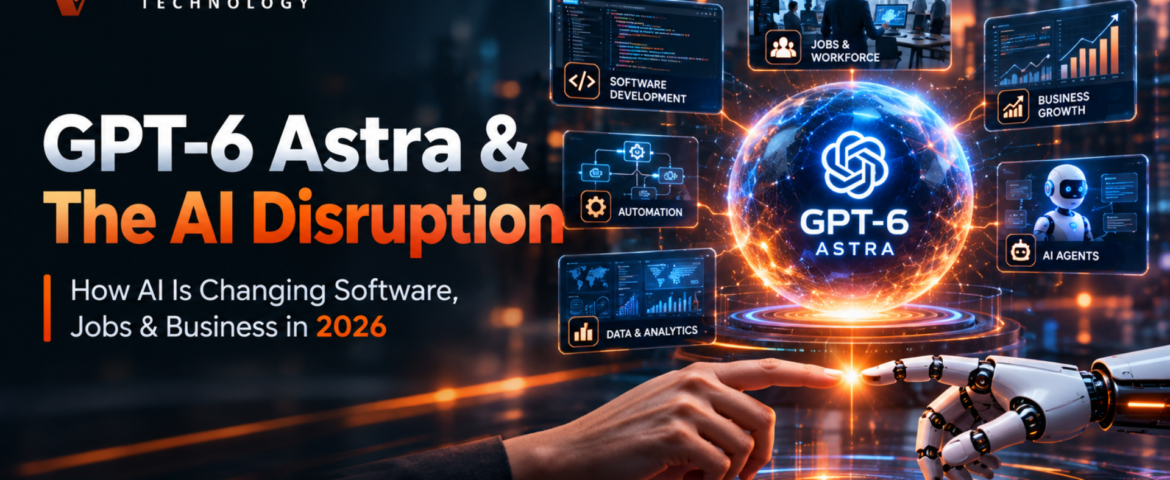
GPT-6 Astra and AI Disruption: The Powerful Shift Changing Software, Jobs & Business
- By pmayank658@gmail.com
- 2 Comments
- Latest News technology
GPT-6 Astrais most important for us because ai is moving beyond simply genrating answers , text and code. OpenAI says that astra is designed for computer use, browsing, software engineering, cybersecurity, science and professional work. In practical terms, the bigger shift is from AI as a tool you use to AI as an agent that can carry out multi-step work for you. That shift could change how companies buy software, how freelancers work, how employees complete routine tasks, and how small businesses automate their operations. But does that mean that traditional software and human jobs will disappear? Not exactly. The more realistic picture is that the way we use software and divide work between humans and AI is changing very quickly. And GPT-6 Astra is one of the clearest examples of that transition. What Is GPT-6 Astra? GPT-6 Astra is OpenAI’s latest advanced AI model, announced on September 3, 2026. OpenAI describes Astra as its most intelligent and aligned model to date. According to the company, the model brings significant advances in computer use, web browsing, software engineering, cybersecurity, scientific work, and other professional tasks. OpenAI has also published strong benchmark results for Astra, including 99.9% on ARC-AGI-3, 98% on FrontierMath Tier 4, and 100% on ExploitBench. Those numbers are worth paying attention to, but there is an important distinction to make: these are results from OpenAI’s own evaluations. They show how Astra performed under particular benchmark conditions; they do not establish that the model is better than humans at every kind of work. The more interesting question, then, is not simply how high Astra can score on a benchmark. It is what the model can actually do when given a complicated task. Consider a typical business request: “Research these 20 competitors, compare their pricing, put the information into a spreadsheet, identify the strongest opportunities, and prepare a presentation.” A conventional chatbot could help with parts of that assignment. You could ask it to write a competitor-analysis template, summarize information, generate spreadsheet formulas, or create presentation content. But a person would generally still have to move between websites, applications, documents, and other tools to complete the entire workflow. That is where the agent-style approach becomes important. Instead of treating every instruction as a separate question, an agent can approach the request as a larger task. It can reason about the steps involved, interact with available tools and computer interfaces, work through several actions, and move toward a final deliverable. That changes the role AI can play. The conversation is no longer only about generating an answer. It is increasingly about whether the system can participate in the process that produces the answer. For GPT-6 Astra, that distinction is central. The potential impact of the model comes from its ability to handle more of the work between an initial instruction and the final result—not simply from producing better-written paragraphs. Why Is GPT-6 Astra Different From Previous AI Models? The difference becomes clearer when traditional AI assistants are compared with agent-style systems. Traditional AI Assistant Agent-Style AI Answers questions Works toward a specific goal Generates text Can work through multiple steps Suggests code Can assist with software-engineering tasks Explains a process Can execute parts of the process Usually waits for the next instruction Can continue through a workflow Produces individual outputs Can work toward an end-to-end result This does not mean Astra can simply be given control of an entire company and left to operate without supervision. Real-world AI systems still depend on permissions, connected tools, available data, context, and appropriate human oversight. The quality of the final result can also depend heavily on how clearly a task is defined and what information the system is allowed to access. The important change is happening at the level of interaction. AI systems are moving beyond the traditional question-and-answer interface and becoming increasingly capable of working inside the digital environments where modern work takes place. According to OpenAI, Astra can use computers, browse the web, create documents, spreadsheets, and presentations, and work through complex multi-step tasks. That matters because most professional work is rarely a single action. A marketer might research a market, collect information, analyze the results, update a campaign document, and prepare a report. A developer might inspect a codebase, identify a problem, modify several files, run tests, and review the results. A researcher might gather sources, organize findings, compare evidence, and turn the analysis into a structured report. The value of an agent-style model lies in its ability to connect those individual steps. That is the larger shift represented by GPT-6 Astra: AI is being developed not only as something that answers questions, but as a system that can potentially participate in the workflows people use to get work done. What Can GPT-6 Astra Actually Do? Computer Use One of the most important capabilities is computer use. Instead of only telling you which buttons to click, an advanced AI agent can potentially interact with software and websites as part of completing a task. For example, imagine a small business owner needs to organize customer information. A traditional workflow might look like this: Open CRM → search customers → update records → create follow-ups → prepare report → send report. With an AI-agent workflow, the long-term goal is closer to: Give the AI the objective → AI works through the CRM and other tools → human reviews the result. That could save considerable time on repetitive digital work. Of course, businesses should not give an AI unrestricted access to important systems simply because the technology can operate a computer. Permissions and human approval still matter. Coding and Software Engineering Software development is another major area. AI coding tools are already useful for: A more capable model can take a larger software task and reason through multiple stages. For a freelancer, this could mean spending less time writing repetitive code and more time understanding the client’s actual problem. For a small software company, it could mean a smaller team can build and