- Mail Address info@velnustech.com
- Phone Number +91-90990-05498
Contact Info
- C-1024, Siddhivinayak Tower, Kataria Automobile Road Makarba, Ahmedabad - 380051
- +91 90990 05498
- info@velnustech.com
- Week Days: 09.00 to 18.00 Sunday: Closed
The Ultimate Guide to Google AI Updates 2026: Revolutionizing Search
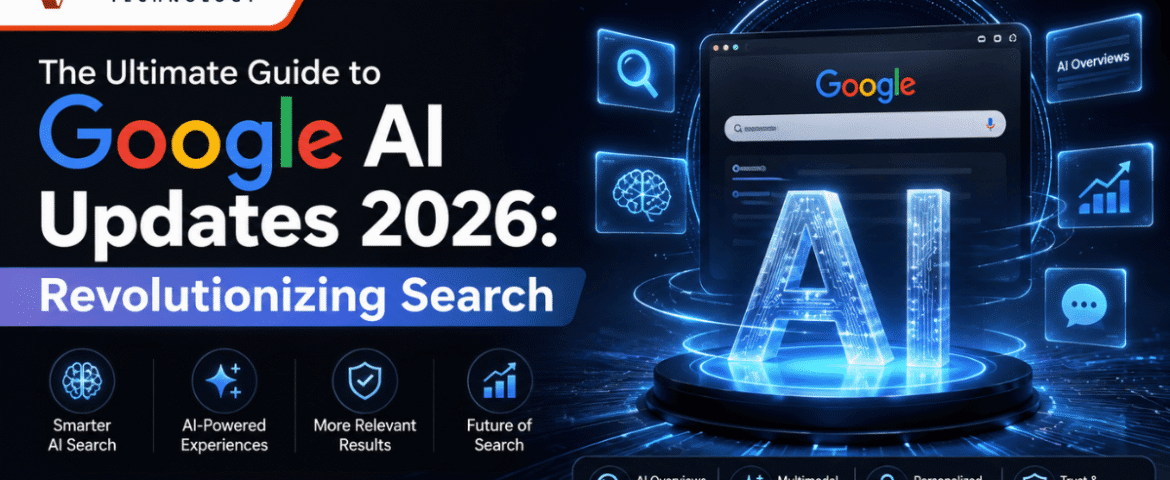
The digital landscape is undergoing its most dramatic transformation in a quarter of a century. With the rollout of the Google AI Updates 2026, the very foundation of how we retrieve information, manage our daily digital tasks, and interact with the web has shifted. This comprehensive guide explores the monumental changes introduced in 2026, focusing on the sophisticated new capabilities of modern AI, the complete overhaul of the search interface, and the autonomous tools now working seamlessly in the background of your devices.
If you want to stay ahead of the curve in understanding digital search visibility and modern digital infrastructure, grasping the nuances of the Google AI Updates 2026 is no longer optional—it is absolutely essential.
Introduction to the New Era of Search
For over two decades, retrieving information meant typing a few fragmented keywords into a blank text box and scrolling through a list of blue links. The Google AI Updates 2026 have effectively ended that era. The search interface has transitioned from a static index of web pages into a dynamic, highly personalized digital environment.
The tech giant has fundamentally re-engineered its core algorithms, prioritizing sophisticated artificial intelligence integrations that do much more than simply answer questions. The focus has moved toward autonomous action, deep contextual reasoning, and seamless cross-application functionality. This shift has massive implications for everyday users seeking quick answers, professionals managing complex workflows, and digital content creators striving for visibility in an increasingly automated web ecosystem.
Core Advancements in the Ecosystem
The announcements made throughout mid-2026 have proven that the industry is no longer satisfied with reactive chatbots. The ecosystem has evolved to prioritize proactive, multi-step execution.
The Complete Redesign of the Search Experience
The traditional search interface has received its largest redesign in 25 years. The static search bar is being replaced by a fluid, conversational interface that expands dynamically for complex queries. Instead of forcing users to refine their keywords manually, the interface now suggests intuitive follow-up questions in real-time as you type.
AI Overviews now reach over 2.5 billion monthly users, fundamentally changing the traffic distribution of the internet. When you search for a concept, the engine synthesizes multiple perspectives, compiling a cohesive narrative rather than forcing you to click through five different websites. This unified digital experience is the crown jewel of the Google AI Updates 2026.
Conversational and Multimodal Inputs
We are no longer restricted to text. The modern interface fully embraces multimodal inputs. Users can now combine voice, video, images, and text into a single prompt. For instance, you can upload a video of a broken appliance, add a text prompt asking how to fix a specific visible part, and receive a step-by-step troubleshooting guide complete with generated diagrams. More than 16 percent of searches within the newly optimized AI mode are now multimodal, a number that is growing exponentially as users realize the power of combining different data formats.
Deep Dive into the Latest AI Models
At the heart of the Google AI Updates 2026 is a brand-new family of sophisticated models designed to balance extreme processing speed with unprecedented reasoning capabilities.
The Arrival of Gemini 3.5 Flash
The standout release of the year is Gemini 3.5 Flash. Designed to be the default engine powering the vast majority of consumer and professional queries, this model is incredibly fast and highly efficient. It excels in executing complex, multi-step workflows. Whether you need to analyze a 100-page document in seconds or build a working software prototype, this model operates with zero lag. It has been heavily optimized for lower latency, making the conversational experience feel as natural as speaking to a human expert.
Multimodal Creation with Gemini Omni
While previous models excelled at text generation, Gemini Omni represents the pinnacle of digital creation. This advanced system allows users to input any combination of media—audio, text, video, or images—and generate high-quality video outputs grounded in real-world physics and logic. This is an absolute game-changer for digital creators, educators, and professionals who need to visualize complex data instantly.
Background Automation and Intelligent Processes
Perhaps the most revolutionary aspect of the Google AI Updates 2026 is the introduction of software that runs autonomously in the background, minimizing the need for constant user input.
Continuous Information Monitoring
Instead of manually checking for updates on volatile subjects—like flight deals, housing market trends, or real-time sports scores—users can now deploy autonomous background processes. These intelligent routines monitor the web 24/7 on your behalf. When a significant change occurs, they do not just send a raw hyperlink; they synthesize the development, compare different data points, and deliver a comprehensive digest directly to your device.
Generative User Interfaces and Dashboards
One of the most visually striking features released this year is the Generative UI. When you ask a complex, ongoing question—such as tracking your fitness goals alongside real-time weather data and local gym schedules—the search engine builds a custom, interactive widget specifically for that query. These on-the-fly dashboards remain active, updating continuously, meaning your search results are no longer static pages but personalized, interactive software applications.
The Evolution of Digital Assistants
The year 2026 also marks the end of an era for legacy voice technology, making way for vastly superior artificial intelligence integrations.
Sunsetting Legacy Assistants
The tech ecosystem is officially phasing out older voice command software. Starting in September 2026, the legacy digital assistant that users have relied on for years will be discontinued across mobile devices, smartwatches, and wireless headphones. Users attempting to access the old system will be seamlessly transitioned to the newer, more capable Gemini infrastructure.
The Shift Toward Autonomous Workflows
The replacement technology is not just a voice that answers trivia; it is an autonomous digital helper. With proper permissions, this advanced software can navigate your device, open your email, extract necessary data, and fill out complex web forms on your behalf. It understands on-screen context, meaning you can simply hold a button and say, “Summarize this,” and it will read whatever is currently displayed on your monitor.
Impact on Search Engine Visibility and Digital Strategy
For digital marketers, the Google AI Updates 2026 require a complete dismantling of old strategies. Traditional Search Engine Optimization (SEO) is undergoing a massive paradigm shift.
Shifting from Keywords to Conversational Queries
Because the AI now understands complex reasoning, targeting robotic, short-tail keywords is no longer viable. Users are typing (or speaking) complete, highly detailed sentences. Search queries have tripled in length. Digital content must now be written naturally, comprehensively addressing user intent rather than stuffing phrases into headings.
Adapting to Direct Answer Formatting
With AI Overviews pulling information directly into the search results, the traditional click-through rate to standard websites is dropping. To maintain visibility, digital publishers must focus on unique, first-hand experiences and highly structured data that the AI recognizes as authoritative. Content creators must prioritize direct, concise answers paired with deep, comprehensive analysis to ensure they are cited in these new AI-generated summaries.
Workspace and Productivity Enhancements
The workplace has not been ignored. The Google AI Updates 2026 have deeply integrated these advanced models into everyday productivity software.
Daily Digital Briefs
Professionals now wake up to a highly personalized Daily Brief. The system autonomously reads your incoming emails, reviews your calendar, scans your task list, and provides a concise, prioritized summary of exactly what you need to focus on that morning. It flags urgent deadlines and categorizes less important messages, acting as a highly efficient digital secretary.
Seamless Application Integration
The technology now lives natively inside document editors, spreadsheets, and presentation software. You do not need to copy and paste text between different windows. You can simply command your spreadsheet to analyze a specific email thread, and the data is imported, categorized, and mathematically analyzed in seconds. This seamless integration drastically reduces friction in professional environments.
Also Read : Top 15 AI Tools Every Business Should Use to Improve Productivity in 2026
Conclusion
The Google AI Updates 2026 represent a massive leap forward in how humanity interacts with digital information. By moving away from static links and legacy voice commands, and embracing autonomous background processes, generative interfaces, and lightning-fast multimodal reasoning, the internet has become infinitely more personalized and proactive. Adapting to these changes—whether you are a casual user wanting a smarter device, or a digital professional aiming to maintain online visibility—is the key to thriving in this new technological era.
Frequently Asked Questions (FAQs)
Q1 What are the biggest changes in the Google AI Updates 2026? The most significant changes include the complete redesign of the search interface to feature Generative UI, the release of Gemini 3.5 Flash, the introduction of continuous background monitoring processes, and the phase-out of legacy digital voice assistants.
Q2 When is the legacy digital assistant being replaced? The transition begins globally in September 2026, gradually phasing out the older software on mobile devices and wearables in favor of the newer AI infrastructure.
Q3 How does the new Generative UI work? Instead of showing a list of links, the engine generates customized, interactive dashboards and widgets directly on the results page based on the specific context of your query.
Q4 What is the difference between standard AI and Gemini Omni? Gemini Omni features advanced multimodal creation capabilities. It can take a mixture of audio, text, and images as input, and generate high-quality, physics-grounded video content in return.
Q5 How should digital creators adapt to the 2026 updates? Creators must move away from keyword stuffing and focus on providing conversational, highly structured, and authoritative answers that sophisticated models can easily synthesize and cite in their Overviews.
Leave A Comment