- Mail Address info@velnustech.com
- Phone Number +91-90990-05498
Contact Info
- C-1024, Siddhivinayak Tower, Kataria Automobile Road Makarba, Ahmedabad - 380051
- +91 90990 05498
- info@velnustech.com
- Week Days: 09.00 to 18.00 Sunday: Closed
Meta Muse AI Agent: 7 Powerful Features, Pricing, Availability & How It Works
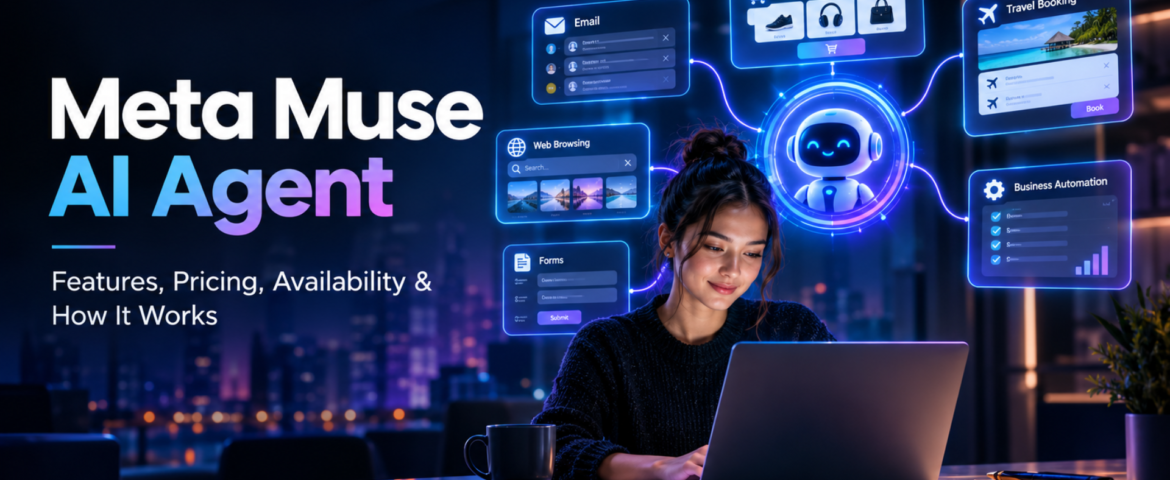
In brief: Meta Muse is a new personal AI agent designed to perform tasks for users rather than simply answering questions. You can tell Muse what you want to achieve, and—based on the task, permissions, and necessary approvals—it can plan the work, browse websites, fill out forms, send emails, assist with completing purchases, and continue working on longer tasks even after you close the app. Meta officially launched Muse on September 8, 2026, initially making it available in the US via the Muse app and WhatsApp.
And yes, Meta Muse AI Agent is trending right now. Google Trends’ India trending page currently shows the query “meta muse ai agent” at 20K+ searches, up 900%, with the trend active around two hours ago.
But the interesting part is not just that Meta launched another AI product.
The bigger story is that AI is moving from “I will give you an answer” toward “I will try to get the task done for you.”
What Is Meta Muse AI Agent?
Meta Muse is a personal AI agent developed by Meta.
A normal AI chatbot generally waits for your prompt, generates an answer and then waits again.
An AI agent works differently.
You can give an agent a goal, and it can decide which steps are needed to move toward that goal.
For example, instead of asking:
“How do I plan a trip to Dubai?”
you could potentially tell an agent:
“Plan my Dubai trip for next month, find suitable flights and hotels within my budget, and prepare the options for me.”
The important difference is action.
Meta says Muse can work across applications and websites, open a browser, fill forms, coordinate tasks and continue working on longer jobs.
In simple words:
Chatbot = gives you information.
AI agent = can use information and tools to take action.
That difference is the main reason Meta Muse is getting so much attention.
How Does Meta Muse AI Agent Work?
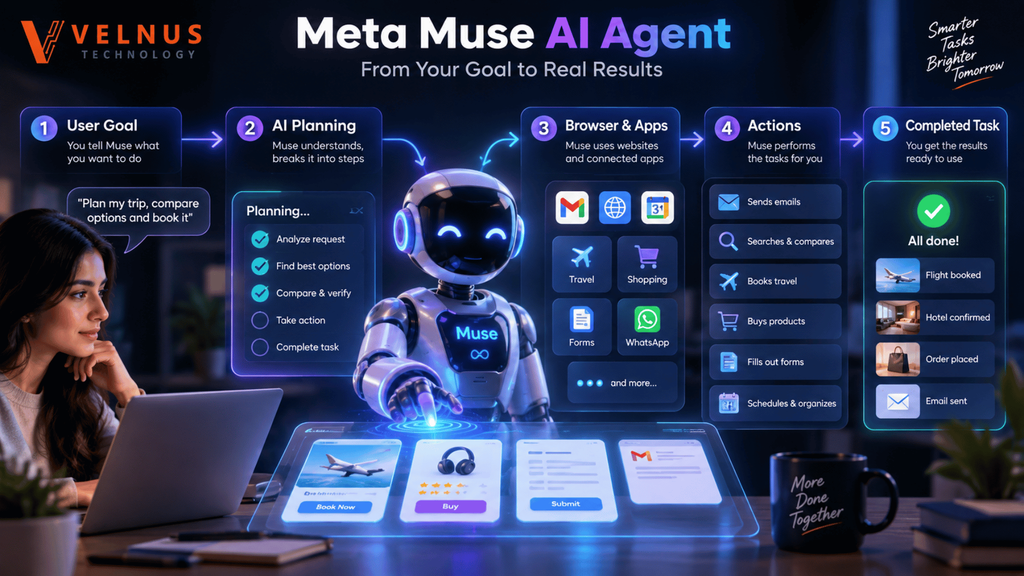
Muse is powered by Muse Spark, which Meta describes as its most capable model for real-world agentic work.
But the model itself isn’t the whole story.
Meta has built a separate environment called Muse Secure VM.
A VM, or virtual machine, is basically an isolated computer environment running in the cloud.
Meta says every Muse operates inside a dedicated secure virtual machine containing the agent and the user’s data. It also has its own browser so Muse can interact with websites while keeping that activity inside the controlled environment.
What is agentic AI?
Agentic AI refers to AI systems that can do more than generate text or images.
They can:
- Understand a goal.
- Break the goal into smaller tasks.
- Use tools.
- Take actions.
- Check what happens.
- Continue or adjust the plan.
That makes agentic AI particularly interesting for automation.
For example, a freelancer could theoretically ask an AI agent to research potential clients, organize information and prepare outreach material instead of manually completing every small step.
The agent still needs supervision, especially when money, private information or important decisions are involved.
What is Muse Spark?
Muse Spark is the AI model powering the Muse personal agent.
Meta says it was designed for real-world agentic work rather than simply producing conversational answers.
This distinction is important because Muse and Muse Spark are not exactly the same thing.
Muse is the personal AI agent/product.
Muse Spark is the model powering that agent.
What is Sentinel?
Meta also describes a separate safety system called Sentinel.
According to Meta, Sentinel controls what Muse can send to the internet and can require user permission for sensitive actions. Muse can also show an audit trail of actions it has taken or plans to take.
This matters because an AI that can actually act needs stronger controls than a chatbot that only generates text.
What Can Meta Muse AI Agent Actually Do?
This is probably the biggest question for beginners.
Meta says Muse can perform a range of tasks across connected services.
Can Meta Muse AI Agent send emails?
Yes.
Muse can help draft and send emails, although sensitive actions can require user approval.
This is different from asking ChatGPT:
“Write an email to my client.”
Muse’s goal is to move further toward:
“Write the email, send it to my client and let me know when they respond.”
The second example involves an actual workflow.
Can Meta Muse book travel?
Meta says Muse can help with travel planning and booking.
It can search, compare information, fill forms and work through the steps required to complete a task.
That makes travel planning an interesting example of agentic AI because it often involves several connected tasks rather than one answer.
Can Meta Muse shop online?
Yes, shopping is another major use case.
Meta says Muse can help search for products and make purchases. For payments, Meta has partnered with Stripe’s Link system, including one-time-use card details intended to keep a user’s actual payment information hidden from the agent.
However, users should still review purchases before approving them.
An AI finding a product is one thing.
An AI spending your money is a much bigger responsibility.
Can Meta Muse fill forms?
Yes.
Meta says Muse can open a browser and fill out forms on a user’s behalf.
This could be useful for repetitive online tasks where the user has to enter the same type of information again and again.
Can Meta Muse work on long-term goals?
This is one of the more interesting parts.
Meta says Muse isn’t limited to one simple command. Users can give it bigger goals, and Muse can help create a personalized action plan and continue working on it.
For example:
“Help me organize my fitness routine for the next few months.”
or
“Help me plan the launch of my small online business.”
The important idea is that the user describes the outcome, rather than every individual step.
Why Is Meta Muse AI Agent Trending Right Now?
There are a few reasons.
First, the timing is huge.
Meta launched Muse on September 8, 2026, and major technology and news publications immediately started covering it. Reuters described it as an AI agent capable of tasks such as emailing, selling items and booking travel.
Second, AI agents are becoming a major direction in the industry.
People are already familiar with ChatGPT-style AI.
Now the conversation is changing from:
“Which AI gives the best answer?”
to:
“Which AI can actually do the work?”
Third, Muse is coming from Meta, a company that already operates huge consumer platforms including WhatsApp, Instagram and Facebook.
That gives the product a potentially very large distribution opportunity.
Google Trends in India is also currently showing a sharp spike around the exact “meta muse ai agent” query.
How Is Meta Muse Different From a Normal AI Chatbot?
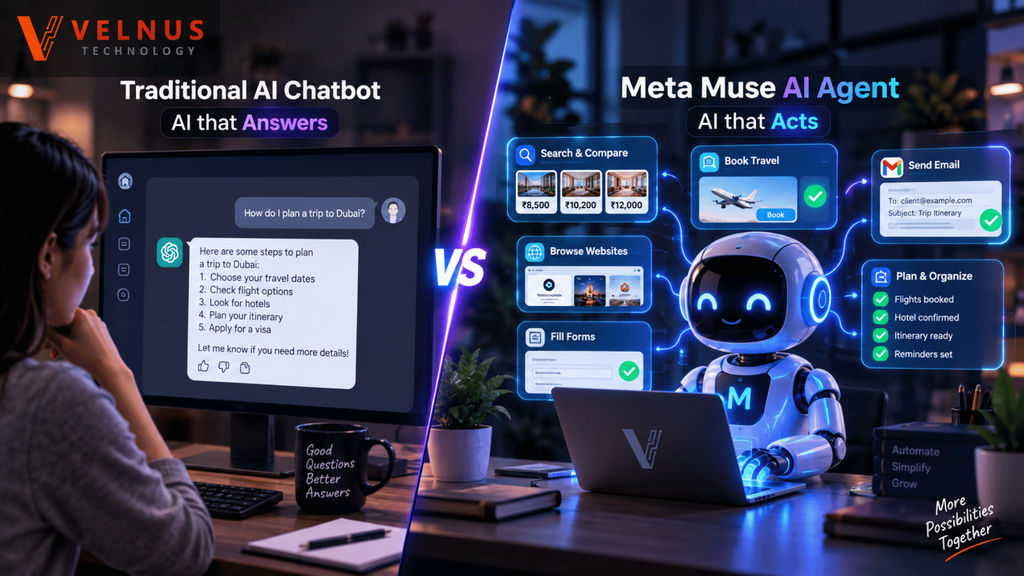
The easiest way to understand the difference is with an example.
Imagine you say:
“I want to buy a laptop under ₹70,000.”
A normal chatbot might give you a list of recommended laptops.
An AI agent could potentially search websites, compare options, check requirements and help you move toward completing the purchase.
So the difference isn’t simply intelligence.
It is agency.
| Capability | Traditional AI chatbot | Meta Muse |
|---|---|---|
| Answer questions | Yes | Yes |
| Generate content | Yes | Yes |
| Plan tasks | Limited | Yes |
| Browse/use websites | Limited depending on system | Designed for this |
| Fill forms | Limited | Yes |
| Send emails | Usually requires user action | Designed to act with approval |
| Make purchases | Generally not autonomous | Designed to support purchases |
| Long-running tasks | Limited | Yes |
The exact capabilities available to a user can depend on permissions, connectors, region and product changes.
Is Meta Muse AI Agent Safe and Private?
This is one of the most important questions—and it shouldn’t be ignored.
An AI that can read information, access services and take actions creates a completely different security problem from a chatbot.
Meta says Muse was designed around privacy and security.
According to Meta, users decide which apps Muse can connect to and how much access it receives. Users can revoke access, and Meta says sensitive actions such as sending an email or making a purchase can require confirmation.
Meta also says Muse does not directly see passwords or payment methods stored in its secure environment.
However, that doesn’t mean users should blindly trust an AI agent.
Independent reporting has highlighted concerns around reliability and security, including problems discovered during earlier testing. Reuters reported that internal testing found security and reliability issues before the launch, while Meta said it delayed the product to improve safety.
So the practical rule is simple:
Give an AI agent only the access it actually needs.
Don’t connect every account just because the option exists.
How Much Does Meta Muse AI Agent Cost?
Meta says Muse is free for most use, with subscription options for people who want higher usage.
Reports around the launch describe a free tier and paid plans, including reported prices of $20 and $100 per month for higher usage levels.
Because pricing and usage limits can change during an early rollout, users should check Meta’s current pricing before subscribing.
For a new AI product, this is also an area worth watching because agentic AI can require significantly more computing resources than a basic chatbot conversation.
Is Meta Muse AI Agent Available in India?
Not at launch.
Meta says Muse is initially rolling out in the United States on iOS, Android and the web, with WhatsApp access also available as part of the experience.
Indian users may see information about the product online, but availability should not be confused with global availability.
This is likely to become an important search query as interest grows:
“Meta Muse India”
For now, users in India should check Meta’s official availability information rather than downloading unofficial apps or using suspicious third-party services claiming to provide access.
How Can Freelancers Use Meta Muse?
For freelancers, the most useful concept isn’t “AI will replace my work.”
It is:
AI can potentially remove repetitive work around my actual work.
For example, a freelancer might use an agent for tasks such as:
- Researching potential clients
- Organizing information
- Preparing email drafts
- Comparing software subscriptions
- Planning meetings
- Creating task lists
- Collecting information from websites
- Managing repetitive online workflows
Imagine a freelance web designer.
Instead of spending an hour researching five potential software tools, the freelancer could give an AI agent a clear research goal and ask it to compare pricing, features and suitability.
The freelancer still makes the final decision.
The AI handles more of the boring steps.
How Can Small Businesses Use AI Agents?
Small businesses are probably one of the most interesting audiences for agentic AI.
A small business owner often does not have separate employees for every function.
One person might handle:
- Sales
- Customer support
- Marketing
- Admin
- Research
- Vendor communication
- Scheduling
AI agents could eventually help coordinate some of these repetitive tasks.
For example:
“Find 10 potential suppliers, compare their pricing, organize the results in a table and prepare an email asking for their latest quotation.”
That is a workflow.
And this is where agentic AI becomes more interesting than simply asking an AI to write an email.
What Are the Limitations of Meta Muse?
Muse is impressive, but it isn’t magic.
1. AI can still make mistakes
An agent can misunderstand an instruction or choose the wrong action.
Meta itself describes Muse as still learning, and the app listing warns that it may be inaccurate or take unexpected actions.
2. Access is limited by permissions
Muse cannot magically control every service.
Users have to connect services and provide appropriate permissions.
3. Availability is currently limited
At launch, the product is rolling out in the US.
4. Privacy becomes more complicated
Giving an AI access to email, shopping, calendars or payments creates a much bigger privacy question than using an AI simply to generate text.
5. Human supervision still matters
For anything involving:
- Money
- Legal commitments
- Important emails
- Business decisions
- Personal information
you should review the action before allowing it to happen.
Meta Muse AI Agent vs ChatGPT: What’s the Difference?
It would be misleading to simply say one is “better.”
They are increasingly moving toward overlapping categories, but the product experiences are different.
ChatGPT is widely known as a conversational AI system that can help with reasoning, writing, coding, research and many other tasks.
Muse is being positioned specifically as a personal AI agent that can take actions across connected services.
The key distinction is therefore:
Chat-based AI: “Help me figure this out.”
Agentic AI: “Help me get this done.”
The line between these products is becoming less clear as AI platforms add tools and action capabilities.
That’s actually the larger trend worth watching.
What Does Meta Muse Mean for the Future of AI Agents?
Muse is important because it represents a shift in how people may interact with software.
For decades, humans learned how to use software.
We opened an app.
Clicked buttons.
Filled forms.
Searched menus.
Copied information.
Then AI assistants arrived and made software easier to talk to.
AI agents could take this one step further.
Instead of learning:
“Which button do I click?”
you could simply say:
“Please do this.”
The software becomes less visible.
The goal becomes more important than the interface.
That could have a major impact on freelancers, businesses, customer support, marketing and online commerce.
But there is another side.
The more control an AI has, the more important trust, security, permissions and accountability become.
Meta appears to understand that challenge, which is why Muse’s Secure VM and Sentinel architecture are such a significant part of its launch story.
What Should Beginners Learn From Meta Muse?
If you’re new to AI, don’t worry about learning every technical term.
Start with one concept:
AI assistant ≠ AI agent.
An assistant mainly helps you.
An agent is designed to take action for you.
A useful way to start experimenting with agentic AI is:
Step 1: Choose a repetitive task
Don’t start with something highly sensitive.
Pick something boring and repeatable.
Step 2: Define the result
Instead of giving 20 instructions, describe the outcome you want.
Step 3: Give limited permissions
Only connect the accounts required for that task.
Step 4: Review important actions
Especially purchases, emails and anything involving confidential information.
Step 5: Measure the time saved
The real value of an AI agent isn’t how impressive the demo looks.
It’s whether it actually saves you time.
Also Read : GPT-6 Astra and AI Disruption: The Powerful Shift Changing Software, Jobs & Business
Final Thoughts
Meta Muse AI Agent is interesting for a reason that goes beyond Meta.
It shows where the AI industry appears to be heading.
For the last few years, the main question was:
“How intelligent is the chatbot?”
Now another question is becoming equally important:
“What can the AI actually do?”
Muse is Meta’s answer to that question.
It can plan tasks, interact with websites, work across connected services and, in some cases, continue working without the user sitting in front of the screen.
But the technology also brings a new responsibility.
The moment AI can send your email, spend your money or interact with your accounts, trust becomes as important as intelligence.
For beginners, freelancers and small business owners, that is probably the biggest lesson from Meta Muse.
Don’t look at AI agents only as futuristic chatbots.
Think of them as digital workers that still need clear instructions, limited permissions and human oversight.
And if Meta gets the balance between automation and trust right, Muse could be an important step toward the next generation of personal AI.
FAQs About Meta Muse AI Agent
What is Meta Muse AI Agent?
Meta Muse is Meta’s personal AI agent designed to perform tasks on behalf of users. Unlike a basic chatbot, it can plan and execute multi-step activities such as browsing websites, filling forms, sending emails and helping with purchases.
Is Meta Muse free?
Meta says Muse is free for most use, with paid subscription options for users who need more usage. Pricing and limits may change as the service expands.
Is Meta Muse available in India?
Not at launch. Meta initially rolled Muse out in the United States. Availability in other countries is expected to expand over time, but users should check Meta’s latest official announcement for current availability.
Can Meta Muse send emails?
Yes. Meta says Muse can handle email-related tasks, including sending emails, with user approval for sensitive actions.
Can Meta Muse make online purchases?
Muse is designed to assist with online purchases. Meta says its integration with Stripe’s Link system can use one-time-use card details so the user’s actual card information isn’t exposed to the agent.
What is Muse Spark?
Muse Spark is the AI model that powers Meta’s Muse personal AI agent.
What is Muse Secure VM?
Muse Secure VM is the dedicated virtual-machine environment Meta built to run the agent and store the user’s data and credentials in an isolated environment.
Is Meta Muse better than ChatGPT?
Not necessarily. They are designed around somewhat different experiences. Muse is focused heavily on personal agentic actions, while ChatGPT supports a broader range of conversational, reasoning, research, coding and productivity use cases. Capabilities continue to evolve quickly.
Is Meta Muse safe?
Meta has built multiple security and permission controls into Muse, including a Secure VM, Sentinel and approval requirements for sensitive actions. However, no AI agent should be treated as completely risk-free. Independent reporting has also highlighted reliability and security concerns surrounding agentic AI.
Can small businesses use Meta Muse?
Potentially, yes. Its ability to handle repetitive research, planning, communication and web-based tasks could make agentic AI useful for freelancers and small businesses. The exact business use cases will depend on available connectors, permissions and regional availability.
One Reply to “Meta Muse AI Agent: 7 Powerful Features, Pricing, Availability & How It Works”
[…] Also Read : Meta Muse AI Agent: 7 Powerful Features, Pricing, Availability & How It Works […]