- Mail Address info@velnustech.com
- Phone Number +91-90990-05498
Contact Info
- C-1024, Siddhivinayak Tower, Kataria Automobile Road Makarba, Ahmedabad - 380051
- +91 90990 05498
- info@velnustech.com
- Week Days: 09.00 to 18.00 Sunday: Closed
AI for Business
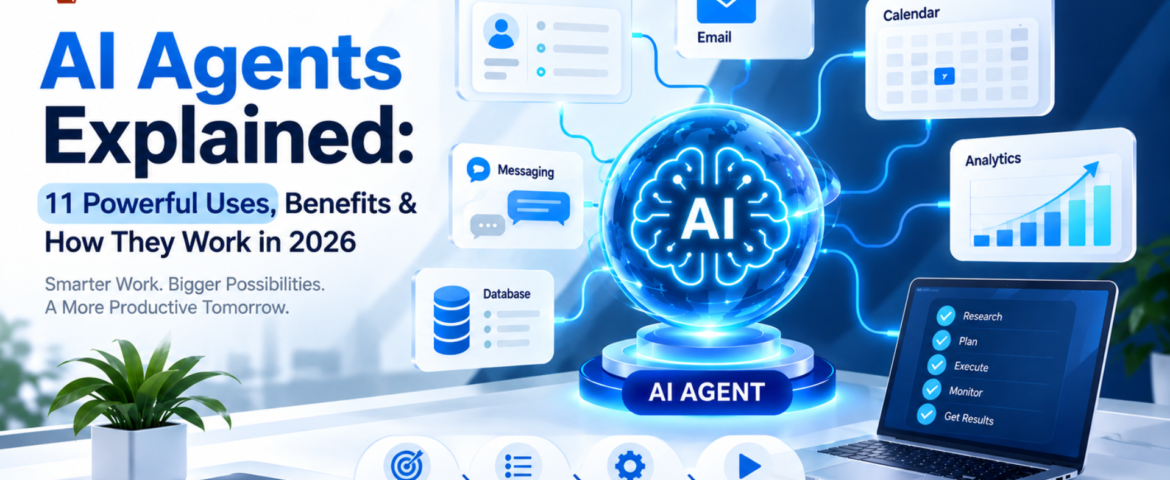
AI Agents Explained: 11 Powerful Uses, Benefits & How They Work in 2026
- By pmayank658@gmail.com
- 1 Comment
- Latest News technology
An AI agent is a software system that can understand a goal, decide what steps are needed, use connected tools, and take actions to complete a task with limited human intervention. Unlike a traditional chatbot that mainly responds to questions, an AI agent can work through a multi-step workflow. Depending on its design and permissions, it can retrieve information, update a CRM, create tasks, send messages, search approved sources, prepare reports, and hand complicated situations to a human. In simple terms: A chatbot mainly talks. An AI agent can understand, decide, use tools, and act. For a freelancer, that could mean turning a new client inquiry into a project brief and follow-up task. For a small business, it could mean qualifying leads, updating a CRM, answering customer questions, and escalating unusual cases. This guide explains what AI agents are, how they work, what they can do, how they differ from chatbots and traditional automation, how much they cost, their limitations, and how beginners can start using them. What Is an AI Agent? An AI agent is an AI-powered software system designed to pursue a goal and complete a workflow rather than simply generate a single response. A practical AI agent generally combines: OpenAI describes agents as systems that can independently accomplish tasks on a user’s behalf, use tools to interact with external systems, and operate within defined instructions and guardrails. Google Cloud similarly describes modern agents in terms of capabilities such as reasoning, planning, memory, and action. A simple example Imagine telling an AI agent: “Find today’s new leads, identify which ones are high priority, update the CRM, prepare personalized follow-ups, and create reminders for leads that need another contact.” A basic chatbot might explain how you could perform those steps. An appropriately configured AI agent can potentially perform the workflow itself by: The important difference is that an agent is designed around completing work, not simply producing text. How Does an AI Agent Work? The easiest way to understand an AI agent is to think of it as a digital worker operating within a defined set of rules. A typical workflow looks like this: Goal → Understand → Plan → Use Tools → Take Action → Check Result → Complete or Escalate Let’s break that down. 1. The AI Agent Understands the Goal The user or business provides an objective. For example: “Follow up with customers who haven’t replied for seven days.” The agent needs to understand what the desired result is and what information it needs before taking action. A clear goal is important because vague instructions can produce inconsistent results. 2. It Determines the Required Steps Instead of immediately generating an answer, an agent can determine the sequence of actions required to reach the goal. For the follow-up example, it might need to: The exact process depends on the agent’s instructions, tools, and permissions. 3. It Uses Tools Tools are one of the most important differences between a simple conversational AI application and an agent designed to perform work. An agent may connect to tools such as: Tools allow an agent to retrieve information and, where permitted, take actions in external systems. OpenAI’s agent guidance describes data tools for retrieving context and action tools for changing systems or performing actions such as updating CRM records or sending messages. 4. It Takes an Action After determining what needs to happen, the agent can perform an approved action. For example, it might: Not every action should happen automatically. Sensitive or irreversible actions may require human approval. 5. It Checks the Result A reliable agent should not simply assume that every action worked. It can check whether: If something falls outside its instructions, the safest behavior may be to stop and request human intervention. This is why testing, monitoring, permissions, and guardrails are important when deploying AI agents. What Are the Main Components of an AI Agent? Most practical AI agents can be understood through several building blocks. Component What it does AI Model Understands information and supports reasoning or decision-making Instructions Defines what the agent should do and how it should behave Tools Connects the agent to external systems Knowledge Provides relevant business information and context Memory Helps maintain useful context when the system supports it Guardrails Restricts unsafe, unauthorized, or unwanted behavior Orchestration Controls how tasks, tools, and agents work together A simple way to remember this is: Model = brainTools = handsKnowledge = reference materialInstructions = operating procedureGuardrails = boundaries OpenAI identifies the model, tools, and instructions as fundamental components of an agent, while more complex systems can add orchestration and multiple specialized agents. AI Agent vs Chatbot: What’s the Difference? This is one of the most common questions beginners ask. Feature Traditional Chatbot AI Agent Answers questions Yes Yes Understands natural language Yes Yes Performs multi-step tasks Limited Yes Uses external tools Sometimes Common Retrieves information Sometimes Yes, when connected Makes bounded decisions Limited Yes Takes actions Limited Yes, when permitted Works toward a goal Usually limited Yes Operates with less supervision Limited More capable Example: “Where is my order?” A traditional chatbot might: An AI agent could potentially: The difference is not simply that one uses AI and the other doesn’t. The bigger difference is workflow execution. AI Agent vs Traditional Automation AI agents are also different from traditional rule-based automation. Traditional automation A conventional workflow might look like: Trigger → Rule → Action For example: New form submission → Add contact to CRM → Send predefined email The path is generally predetermined. AI agent An agent-based workflow can look more like: Goal → Interpret context → Decide next step → Select tool → Act → Check result For example: New lead → Understand inquiry → Check CRM → Determine lead type → Choose appropriate action → Update CRM → Prepare follow-up → Escalate if needed Traditional automation is often better when the process is completely predictable. An AI agent becomes more useful when the workflow involves unstructured information, changing context, tool selection, or
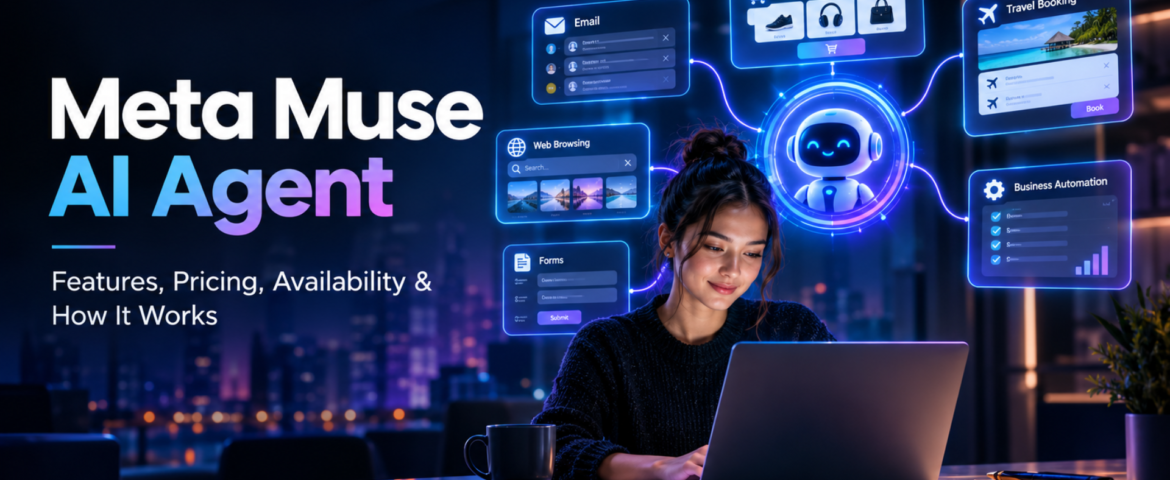
Meta Muse AI Agent: 7 Powerful Features, Pricing, Availability & How It Works
- By pmayank658@gmail.com
- 1 Comment
- Latest News technology
In brief: Meta Muse is a new personal AI agent designed to perform tasks for users rather than simply answering questions. You can tell Muse what you want to achieve, and—based on the task, permissions, and necessary approvals—it can plan the work, browse websites, fill out forms, send emails, assist with completing purchases, and continue working on longer tasks even after you close the app. Meta officially launched Muse on September 8, 2026, initially making it available in the US via the Muse app and WhatsApp. And yes, Meta Muse AI Agent is trending right now. Google Trends’ India trending page currently shows the query “meta muse ai agent” at 20K+ searches, up 900%, with the trend active around two hours ago. But the interesting part is not just that Meta launched another AI product. The bigger story is that AI is moving from “I will give you an answer” toward “I will try to get the task done for you.” What Is Meta Muse AI Agent? Meta Muse is a personal AI agent developed by Meta. A normal AI chatbot generally waits for your prompt, generates an answer and then waits again. An AI agent works differently. You can give an agent a goal, and it can decide which steps are needed to move toward that goal. For example, instead of asking: “How do I plan a trip to Dubai?” you could potentially tell an agent: “Plan my Dubai trip for next month, find suitable flights and hotels within my budget, and prepare the options for me.” The important difference is action. Meta says Muse can work across applications and websites, open a browser, fill forms, coordinate tasks and continue working on longer jobs. In simple words: Chatbot = gives you information. AI agent = can use information and tools to take action. That difference is the main reason Meta Muse is getting so much attention. How Does Meta Muse AI Agent Work? Muse is powered by Muse Spark, which Meta describes as its most capable model for real-world agentic work. But the model itself isn’t the whole story. Meta has built a separate environment called Muse Secure VM. A VM, or virtual machine, is basically an isolated computer environment running in the cloud. Meta says every Muse operates inside a dedicated secure virtual machine containing the agent and the user’s data. It also has its own browser so Muse can interact with websites while keeping that activity inside the controlled environment. What is agentic AI? Agentic AI refers to AI systems that can do more than generate text or images. They can: That makes agentic AI particularly interesting for automation. For example, a freelancer could theoretically ask an AI agent to research potential clients, organize information and prepare outreach material instead of manually completing every small step. The agent still needs supervision, especially when money, private information or important decisions are involved. What is Muse Spark? Muse Spark is the AI model powering the Muse personal agent. Meta says it was designed for real-world agentic work rather than simply producing conversational answers. This distinction is important because Muse and Muse Spark are not exactly the same thing. Muse is the personal AI agent/product. Muse Spark is the model powering that agent. What is Sentinel? Meta also describes a separate safety system called Sentinel. According to Meta, Sentinel controls what Muse can send to the internet and can require user permission for sensitive actions. Muse can also show an audit trail of actions it has taken or plans to take. This matters because an AI that can actually act needs stronger controls than a chatbot that only generates text. What Can Meta Muse AI Agent Actually Do? This is probably the biggest question for beginners. Meta says Muse can perform a range of tasks across connected services. Can Meta Muse AI Agent send emails? Yes. Muse can help draft and send emails, although sensitive actions can require user approval. This is different from asking ChatGPT: “Write an email to my client.” Muse’s goal is to move further toward: “Write the email, send it to my client and let me know when they respond.” The second example involves an actual workflow. Can Meta Muse book travel? Meta says Muse can help with travel planning and booking. It can search, compare information, fill forms and work through the steps required to complete a task. That makes travel planning an interesting example of agentic AI because it often involves several connected tasks rather than one answer. Can Meta Muse shop online? Yes, shopping is another major use case. Meta says Muse can help search for products and make purchases. For payments, Meta has partnered with Stripe’s Link system, including one-time-use card details intended to keep a user’s actual payment information hidden from the agent. However, users should still review purchases before approving them. An AI finding a product is one thing. An AI spending your money is a much bigger responsibility. Can Meta Muse fill forms? Yes. Meta says Muse can open a browser and fill out forms on a user’s behalf. This could be useful for repetitive online tasks where the user has to enter the same type of information again and again. Can Meta Muse work on long-term goals? This is one of the more interesting parts. Meta says Muse isn’t limited to one simple command. Users can give it bigger goals, and Muse can help create a personalized action plan and continue working on it. For example: “Help me organize my fitness routine for the next few months.” or “Help me plan the launch of my small online business.” The important idea is that the user describes the outcome, rather than every individual step. Why Is Meta Muse AI Agent Trending Right Now? There are a few reasons. First, the timing is huge. Meta launched Muse on September 8, 2026, and major technology and news publications immediately started covering it. Reuters described it as an AI agent capable