
- Mail Address info@velnustech.com
- Phone Number +91-90990-05498

Contact Info
- C-1024, Siddhivinayak Tower, Kataria Automobile Road Makarba, Ahmedabad - 380051
- +91 90990 05498
- info@velnustech.com
- Week Days: 09.00 to 18.00 Sunday: Closed
Business Growth
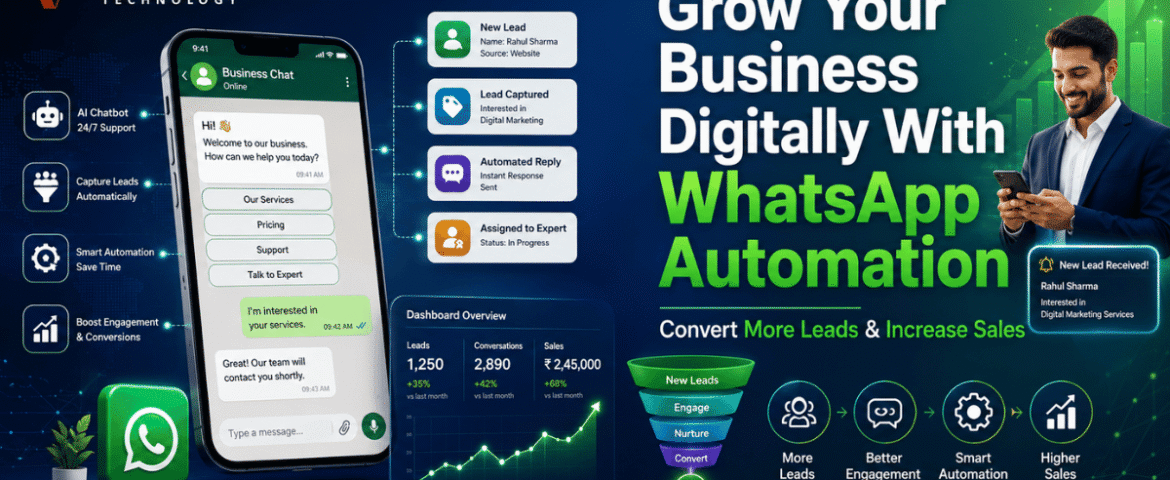
Grow Your Business Digitally With WhatsApp Automation: Convert More Leads & Increase Sales
- By KHUSHI LIMBASIYA
- 0 Comments
- technology Latest News
The digital landscape is shifting, and the way consumers communicate with businesses has evolved dramatically. In 2026, relying purely on traditional email capture forms and slow-moving sales funnels means leaving massive amounts of revenue on the table. Modern consumers demand instant, personalized, and interactive communication. Enter WhatsApp Automation—the single most powerful lead generation and sales channel available today. With over 3 billion active users globally, this messaging platform is no longer just a way to chat with friends. It has transformed into a highly efficient business ecosystem. By implementing WhatsApp Automation, businesses can capture verified leads instantly, reduce response times from hours to seconds, and guide prospects seamlessly through the sales funnel. If your goal is to convert more leads and increase sales, adopting this technology is no longer optional; it is an absolute necessity. The Shift from Traditional Funnels to Conversational Commerce Why Email and Web Forms Are Falling Behind For years, the standard lead generation model involved driving traffic to a landing page, forcing visitors to fill out a static form, and adding them to an automated email sequence. While this method once worked, it is fundamentally broken in today’s fast-paced digital economy. When a potential customer receives an automated email, there is a high probability it lands in a promotions folder or spam filter. Average email open rates hover around 20%, and click-through rates rarely exceed 2% to 5%. Furthermore, web forms often result in drop-offs; every extra field you ask a user to fill out decreases the likelihood of conversion. The traditional funnel creates friction, delays communication, and causes businesses to lose high-intent prospects simply because the response was not fast enough. The Superiority of Messaging Platforms By contrast, WhatsApp Automation completely flips this dynamic. Messages sent through this platform boast an astounding open rate of over 98%, with the vast majority of them read within three minutes of delivery. This medium is inherently conversational. Because it happens in an environment users are already familiar with and trust, they are far more likely to engage, answer qualification questions, and build a relationship with your brand. Key Benefits of WhatsApp Automation for Business Growth Capturing Verified Data Instantly One of the biggest hurdles in traditional lead generation is fake data. Users frequently submit temporary or “junk” email addresses to bypass forms. When you leverage WhatsApp Automation, you automatically capture a verified phone number and a real profile name. This ensures your sales team is dedicating their time to real people, completely eliminating the guesswork and dramatically improving the quality of your database. Achieving Lightning-Fast Response Times Speed is the ultimate competitive advantage. Studies consistently show that businesses replying within the first five minutes of an inquiry see significantly higher conversion rates. WhatsApp Automation allows you to deploy intelligent workflows that respond to new leads instantly, 24/7. Whether it is the middle of the night or a busy holiday weekend, your automated system ensures that no prospect is ever left waiting. A prompt, helpful response captures the lead while their interest is at its absolute peak. Gathering Zero-Party Data Without Friction Instead of relying on complex buyer persona assumptions or long surveys, WhatsApp Automation enables you to ask direct, conversational questions. By setting up an automated qualification flow, you can playfully ask a prospect about their budget, timeline, and specific needs. This zero-party data is given willingly by the customer in a chat interface, providing you with a perfectly qualified lead without the friction of a traditional web form. Powerful Strategies to Convert More Leads and Increase Sales Deploying Click-to-Chat Advertisements One of the most effective ways to fill your sales pipeline is by combining your paid advertising efforts with WhatsApp Automation. Instead of directing ad clicks to a slow-loading website, Click-to-Chat ads instantly open a conversation in the messaging app. When the user hits send on a pre-filled message, your automated system takes over. This strategy opens a crucial messaging window where you can interact with the prospect, answer their questions, and guide them toward a purchase without them ever leaving the app. By minimizing redirects and keeping the user in a native environment, you significantly lower your cost per acquisition and increase your return on ad spend. Utilizing Interactive Conversational Flows Modern WhatsApp Automation goes far beyond basic text replies. You can now build highly interactive flows directly within the chat window. Imagine a potential customer wanting to book an appointment, configure a product, or check availability. Instead of sending them a link to a website, the automation provides a rich, app-like interface right inside the conversation. These interactive elements reduce abandonment rates drastically because they eliminate the need for page loads and external navigation. The entire transaction, from initial inquiry to final confirmation, happens seamlessly in one place. Automated Lead Nurturing and Drip Campaigns Not every lead is ready to buy on day one. For those who need more time, WhatsApp Automation allows you to create sophisticated nurturing sequences. Unlike easily ignored email drip campaigns, conversational nudges delivered directly to a user’s phone are highly effective. If a prospect abandons a transaction or stops responding during the qualification phase, the system can automatically send a gentle, personalized follow-up message 24 hours later. You can share product tutorials, success stories, or limited-time offers, systematically moving the lead closer to a purchasing decision. Partnering with Velnus Technology for Automation Success Implementing a robust automation strategy requires technical expertise and a deep understanding of conversational design. This is where Velnus Technology excels. By partnering with Velnus Technology, businesses can unlock the full potential of WhatsApp Automation without struggling through a steep learning curve. Velnus Technology specializes in building tailored communication workflows that align perfectly with your specific sales objectives. From setting up complex API integrations to designing intelligent qualification chatbots, Velnus Technology ensures that your automated systems run flawlessly. Their expertise means you get a customized solution that not only captures leads but strategically guides them through a high-converting pipeline, leaving your competitors far behind. Step-by-Step Guide
WhatsApp Marketing: The Complete Guide to Growing Your Business
- By KHUSHI LIMBASIYA
- 0 Comments
- technology Latest News
What is WhatsApp Marketing? WhatsApp marketing is a communication strategy that uses WhatsApp to connect with customers, promote products or services, provide support, send updates, and build long-term relationships. With billions of active users worldwide, WhatsApp has become one of the most effective messaging platforms for businesses that want direct and personalized communication. Unlike traditional marketing channels, WhatsApp enables real-time conversations. Messages are delivered instantly, allowing businesses to interact with customers in a more engaging and convenient way. From sharing promotional offers to answering customer queries, WhatsApp marketing creates a seamless communication experience. The platform supports text messages, images, videos, PDFs, voice notes, product catalogs, and interactive buttons, making it a versatile marketing tool for businesses of all sizes. Why WhatsApp Marketing is Important Customer expectations have changed significantly over the years. People prefer quick responses, personalized communication, and convenient support. WhatsApp fulfills these expectations by offering a familiar and user-friendly platform. Some major reasons why WhatsApp marketing has become important include: Businesses that communicate effectively through WhatsApp often experience stronger customer loyalty and better conversion rates. Benefits of WhatsApp Marketing High Open Rates WhatsApp messages are generally opened much faster than emails or SMS. This allows businesses to deliver important information quickly. Instant Customer Communication Customers can receive updates, ask questions, and get immediate responses without waiting for long email replies. Personalized Customer Experience Businesses can send personalized messages based on customer interests, previous purchases, or inquiries, creating a more meaningful interaction. Multimedia Support WhatsApp supports: This makes marketing campaigns more engaging than plain text messages. Improved Customer Support Customers appreciate fast assistance. Businesses can resolve queries, handle complaints, and provide after-sales support directly through WhatsApp. Cost-Effective Marketing Compared to many advertising channels, WhatsApp marketing requires relatively low investment while offering excellent engagement. Better Customer Retention Regular communication helps businesses stay connected with existing customers, increasing repeat purchases and long-term loyalty. How WhatsApp Marketing Works WhatsApp marketing begins by obtaining customer consent before sending messages. Businesses should always communicate with users who have voluntarily agreed to receive updates. The typical workflow includes: Building a Contact List Collect customer phone numbers through: Always ensure customers provide permission before messaging them. Segmenting Your Audience Not every customer has the same interests. Organizing contacts into groups improves message relevance. Examples include: Segmentation improves engagement and reduces unnecessary messaging. Creating Valuable Content Effective WhatsApp marketing focuses on delivering value rather than constant promotions. Useful content includes: Sending Messages at the Right Time Timing plays an important role in customer engagement. Avoid sending messages: Choose times when customers are more likely to read and respond. Types of WhatsApp Marketing Campaigns Promotional Campaigns Promotional campaigns inform customers about: Lead Generation Campaigns Businesses can capture potential customers by encouraging users to request information or inquire about services. Customer Support Campaigns Support messages improve customer satisfaction by providing: Feedback Campaigns Customer opinions help improve products and services. Businesses can request: Event Marketing WhatsApp is useful for promoting: Reminder Campaigns Reminder messages help customers remember: Features That Make WhatsApp Marketing Effective Rich Media Messaging Businesses can share attractive content through: Visual content usually performs better than plain text. Quick Replies Frequently asked questions can be answered quickly using predefined responses, saving time and improving efficiency. Automated Responses Automation allows businesses to: Automation ensures customers receive immediate responses even outside working hours. Labels and Contact Organization Contacts can be organized using labels for better management and faster follow-up. Broadcast Messaging Broadcast messages allow businesses to send updates to multiple customers individually without creating group conversations. Interactive Buttons Interactive buttons simplify customer actions by allowing them to: Best Practices for WhatsApp Marketing Obtain Customer Consent Always receive permission before sending marketing messages. Respecting customer preferences builds trust and complies with communication standards. Personalize Every Message Use customer names and tailor content according to their interests whenever possible. Keep Messages Short People prefer concise and easy-to-read messages. Avoid lengthy paragraphs. Provide Value Every message should offer something useful, such as: Avoid Excessive Messaging Sending too many promotional messages may cause customers to ignore future communications or unsubscribe. Use High-Quality Images Professional visuals improve customer engagement and increase the effectiveness of marketing campaigns. Include Clear Calls-to-Action Encourage customers to take action using simple instructions such as: Common WhatsApp Marketing Strategies Product Announcements Inform customers whenever new products or services become available. Exclusive Offers Reward subscribers with special discounts available only through WhatsApp. Customer Education Share educational content that helps customers understand products, services, or industry trends. Seasonal Promotions Plan campaigns around holidays, festivals, and shopping seasons. Limited-Time Offers Create urgency by promoting offers available for a short duration. Loyalty Programs Reward repeat customers with exclusive promotions and early access to new products. Abandoned Inquiry Follow-Up Reconnect with potential customers who previously expressed interest but did not complete their purchase or inquiry. Content Ideas for WhatsApp Marketing Businesses can regularly share: Educational Tips Provide useful information related to your industry. Product Demonstrations Show how products work through short videos or images. Customer Success Stories Share real experiences that highlight positive outcomes. Behind-the-Scenes Content Offer customers a glimpse into product creation, daily operations, or company culture without revealing confidential information. Polls and Surveys Ask customers for opinions to encourage interaction. Frequently Asked Questions Answer common questions proactively to reduce support requests. Common Mistakes to Avoid Sending Messages Without Permission Unsolicited messaging can damage customer trust and reduce engagement. Ignoring Customer Responses WhatsApp is designed for conversations. Respond promptly to customer inquiries. Overloading Customers Sending too many promotional messages may lead customers to stop engaging. Poor Quality Content Low-quality images, unclear messages, and spelling mistakes reduce professionalism. Inconsistent Communication Long periods without communication followed by excessive messaging create an inconsistent customer experience. Not Segmenting Contacts Sending identical messages to every customer often results in lower engagement. Measuring WhatsApp Marketing Performance Successful campaigns should be measured regularly. Key performance indicators include: Message Delivery Rate Measures how many messages successfully reach customers. Open Rate Indicates how many recipients view your messages. Response Rate Shows how many