
- Mail Address info@velnustech.com
- Phone Number +91-90990-05498

Contact Info
- C-1024, Siddhivinayak Tower, Kataria Automobile Road Makarba, Ahmedabad - 380051
- +91 90990 05498
- info@velnustech.com
- Week Days: 09.00 to 18.00 Sunday: Closed
automation tools
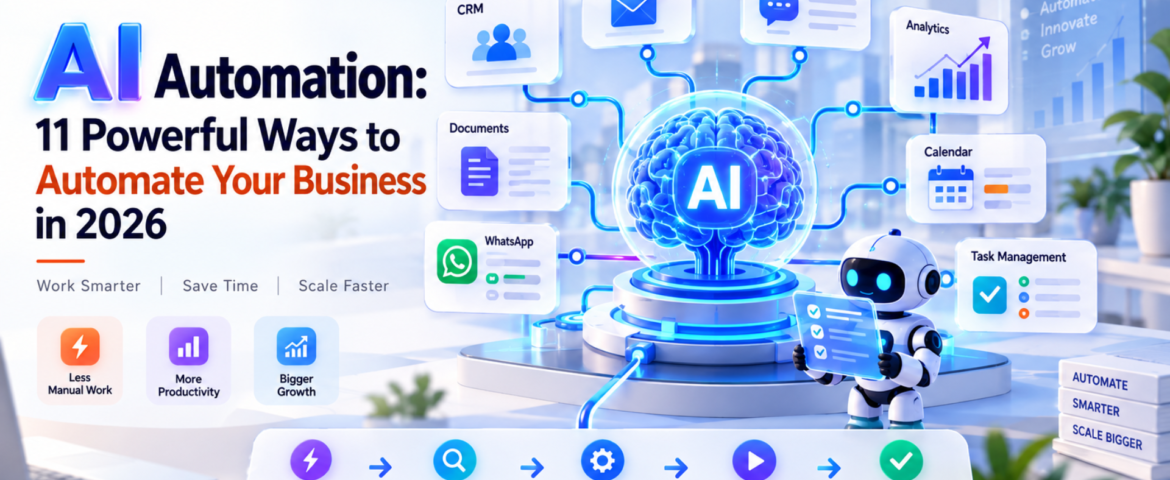
AI Automation: 11 Powerful Ways to Automate Your Business in 2026
- By pmayank658@gmail.com
- 0 Comments
- Latest News technology
AI Automation: 11 Powerful Ways to Automate Your Business in 2026 AI Automation means using artificial intelligence to understand information, make decisions, and complete repetitive business tasks with little or no manual effort. For beginners, freelancers, and small business owners, it can automate everything from lead follow-ups and customer support to reporting, scheduling, and data entry. The important point is this: AI automation is not about replacing every person with AI. It is about removing repetitive work so people can focus on work that actually needs human judgment. In 2026, businesses are moving beyond simple chatbots toward AI-powered workflows and agents that can perform multiple steps inside a business process. Google Cloud’s 2026 AI Agent Trends report, for example, identifies agentic workflows as an important direction for business automation. In simple words: AI automation lets you tell a system what needs to happen, and the system handles much of the work for you. Table of Contents What Is AI Automation? AI automation is the use of artificial intelligence within automated workflows to understand inputs, make decisions, generate outputs, and perform actions. Traditional automation usually follows fixed rules. For example: If a customer fills out a form → send an email. AI automation can handle a more flexible situation: A customer submits an enquiry → AI understands the enquiry → identifies the customer’s requirement → checks relevant information → creates or updates a CRM record → sends a personalized response → alerts a salesperson when human attention is needed. That’s the major difference. Traditional automation mostly follows predefined instructions. AI automation can interpret information and handle situations that aren’t always perfectly predictable. What is a simple example of AI automation? Imagine a small web-design agency receiving 30 enquiries every day. Without automation, someone might need to: With AI automation, much of this workflow can happen automatically. The AI can understand the enquiry, categorize it, update the CRM, draft a personalized response, and trigger a follow-up sequence. The human still controls important decisions. How Does AI Automation Work? A typical AI automation workflow has five basic stages: Trigger → Understand → Decide → Act → Verify 1. Trigger Something starts the workflow. Examples: 2. Understand AI processes the information. For example, it can identify: 3. Decide The system determines what should happen next. For example: “This customer wants a product demo, so create a qualified sales lead.” 4. Act The automation performs an action. It could: 5. Verify A good AI automation system shouldn’t blindly trust every AI output. For sensitive actions, it can ask a person for approval. This human-in-the-loop approach is especially useful for financial, legal, customer-facing, or high-risk workflows. What Are the Best AI Automation Use Cases? AI automation can be applied to almost any repetitive workflow. But small businesses should start with tasks that happen frequently and follow a reasonably clear process. Here are 11 practical examples. 1. Lead Generation and Qualification AI can read incoming enquiries and identify potential customers based on criteria such as: Instead of manually checking every lead, the sales team can focus on qualified prospects. 2. Customer Support AI automation can answer common questions, classify support requests, find relevant information, and escalate complicated cases to a human. For example: Customer question → AI understands request → searches knowledge base → responds → escalates if necessary This doesn’t mean every customer interaction should be handled by AI. Complex or sensitive issues should still have a human escalation path. 3. Email Automation AI can classify incoming emails and decide what should happen next. For example: Sales enquiry → CRMInvoice email → Finance folderSupport issue → Help deskMeeting request → Calendar workflow This can save small teams a surprising amount of administrative time. 4. CRM Updates CRM data often becomes outdated because employees don’t have time to update it. AI automation can extract information from emails, calls, forms, or messages and use it to update customer records. This makes the CRM more useful without forcing employees to enter every detail manually. 5. Appointment Scheduling Instead of exchanging multiple messages to find a suitable time, automation can: This is particularly useful for consultants, agencies, clinics, coaches, and service businesses. 6. Content Creation AI automation can support a content workflow: Topic → Research → Brief → Draft → Review → Publish But there’s an important difference between automating content production and publishing everything generated by AI. Human review is still valuable for: Google’s current guidance emphasizes useful, original content rather than simply producing more AI-generated pages. 7. Social Media Workflows AI can help transform one piece of content into multiple formats. For example: Blog article → LinkedIn post → Instagram caption → short video script → email newsletter A person can then review and approve the content before publishing. 8. Invoicing and Administrative Work AI automation can extract information from invoices, organize documents, identify missing information, and trigger reminders. For example: Invoice received → extract vendor + amount + date → categorize → send for approval → update accounting workflow. Financial actions should generally have appropriate approval and security controls. 9. Weekly Business Reports Instead of manually collecting data from multiple systems, an automation can gather information and prepare a summary. For example: CRM + website analytics + sales data → AI analysis → weekly business report The owner can then spend time interpreting the results rather than assembling spreadsheets. 10. WhatsApp Customer Communication For businesses that receive many customer enquiries through WhatsApp, AI automation can help with: The key is to connect the automation to accurate business information rather than allowing the AI to invent answers. 11. Internal Task Management AI can turn conversations and messages into actionable tasks. For example: “Please prepare the proposal for ABC before Friday.” An automation could identify the task, assign it to the correct person, set a deadline, and add it to a project-management system. How Can Small Businesses Use AI Automation? Small businesses don’t need to automate everything. In fact, trying to automate the entire business at once is
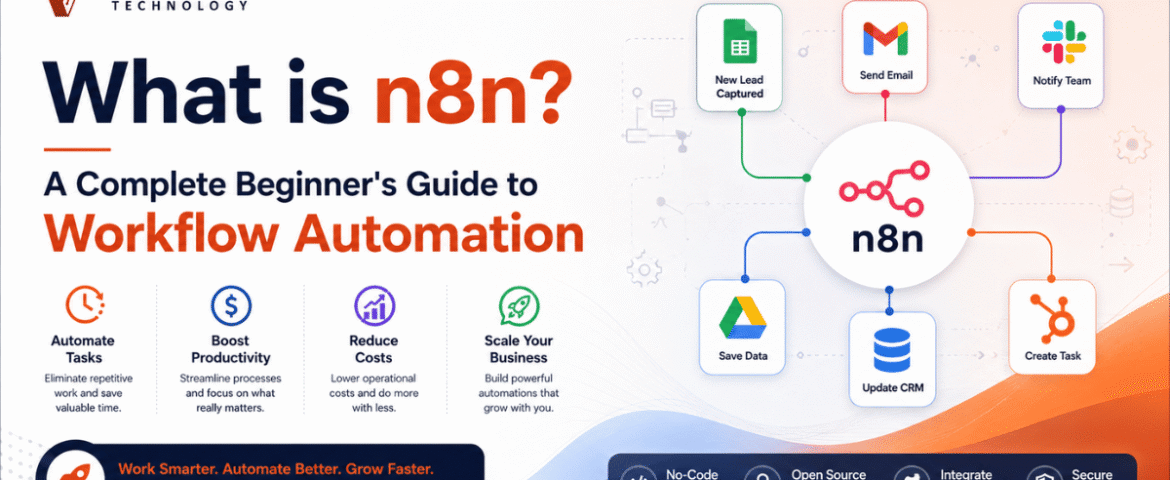
What Is n8n? A Complete Beginner’s Guide To Workflow Automation
- By KHUSHI LIMBASIYA
- 0 Comments
- Latest News technology
Businesses and individuals spend countless hours performing repetitive digital tasks every day. Copying data between applications, sending emails, updating spreadsheets, managing customer information, posting on social media, and organizing files are just a few examples of routine work that consumes valuable time. Workflow automation solves this problem by allowing software to perform repetitive tasks automatically. One of the fastest-growing workflow automation platforms is n8n. It enables users to connect multiple applications, automate processes, and build complex workflows with minimal manual effort. Whether you are a beginner exploring automation or a developer looking for advanced customization, n8n provides the flexibility to automate almost any digital process. Unlike many automation platforms that restrict customization, n8n offers a visual workflow builder combined with the ability to write custom code whenever needed. This makes it suitable for beginners who prefer drag-and-drop automation as well as professionals who require advanced logic. This beginner’s guide explains everything you need to know about n8n, including its features, benefits, use cases, workflow creation process, integrations, AI capabilities, and best practices. What is n8n? n8n is a workflow automation platform that connects different applications and services to automate repetitive tasks. Instead of manually transferring information between multiple systems, users can create workflows that execute automatically based on predefined conditions. A workflow consists of connected steps called nodes. Each node performs a specific task such as: The platform provides a visual interface where workflows are created by connecting these nodes together. One of n8n’s biggest strengths is its flexibility. Simple workflows can be built without coding, while advanced users can extend workflows using JavaScript, APIs, expressions, and custom logic. Why Workflow Automation Matters Modern businesses use dozens of digital tools every day. Managing them manually often results in: Time-consuming repetitive work Employees waste hours copying information between systems. Increased human errors Manual data entry increases the possibility of mistakes. Slow response times Customers expect instant communication and quick processing. Poor productivity Staff spend less time on meaningful work and more time on repetitive tasks. Workflow automation solves these challenges by creating reliable, repeatable, and scalable processes. How Does n8n Work? n8n works by connecting applications through workflows. A typical workflow follows these steps: Trigger The workflow starts when an event occurs. Examples include: Process Data After receiving information, n8n processes the data. This may include: Execute Actions The workflow performs one or more actions. Examples include: End Workflow The workflow finishes after completing all configured actions. Key Features of n8n Visual Workflow Builder The drag-and-drop interface allows users to build workflows without writing large amounts of code. Each node represents one action, making workflows easy to understand. Large Integration Library n8n supports hundreds of integrations with popular services including: It also supports any REST API. Custom Code Support Developers can use JavaScript to: This provides unlimited flexibility. Webhook Support Webhooks allow applications to instantly trigger workflows whenever an event occurs. This enables real-time automation. Scheduling Workflows can run: Perfect for reports, backups, and recurring tasks. Conditional Logic Users can create intelligent workflows using conditions. For example: Different actions can execute based on these conditions. Error Handling n8n includes features for: This improves workflow reliability. Benefits of Using n8n Saves Time Automation eliminates repetitive manual work. Reduces Errors Automated workflows execute consistently without typing mistakes. Improves Productivity Teams focus on important tasks instead of routine operations. Scalable Automation As workloads increase, workflows continue running automatically. Flexible Development Suitable for beginners and developers alike. Cost-Effective Users can automate complex business processes without expensive custom software. Common Use Cases Lead Management Automatically: Email Automation Automatically: Social Media Automation Schedule and publish content automatically. Examples include: Customer Support Automate: Data Synchronization Keep multiple applications synchronized. For example: File Management Automatically: AI Automation Integrate AI services to: Understanding Nodes in n8n Nodes are the building blocks of every workflow. Trigger Nodes Start workflows. Examples: Action Nodes Perform tasks. Examples: Logic Nodes Control workflow behavior. Examples: Data Nodes Transform information. Examples: Creating Your First Workflow Step 1 Create a new workflow. Step 2 Add a trigger. Example: Manual Trigger Step 3 Connect another node. Example: Google Sheets Step 4 Configure credentials. Step 5 Choose the desired action. Step 6 Test the workflow. Step 7 Activate the workflow. Once activated, it will run automatically whenever the trigger occurs. Popular n8n Integrations Some commonly used integrations include: Productivity Communication Databases Marketing Development Cloud Storage AI and n8n Artificial Intelligence has become an important part of workflow automation. n8n allows users to combine AI with automation to create intelligent workflows. Examples include: AI Content Generation Generate: AI Chatbots Create automated conversations with customers. Document Processing Automatically: Customer Sentiment Analysis Analyze customer messages and classify them as: Data Classification Automatically organize large datasets using AI. Best Practices for Beginners Start Small Build simple workflows before creating advanced automations. Name Every Node Clear names make workflows easier to understand. Test Frequently Run workflows step by step before activating them. Handle Errors Always create fallback paths for failed executions. Use Variables Avoid hardcoding values whenever possible. Organize Workflows Group related workflows into logical folders or projects. Monitor Executions Regularly review execution history to identify issues. Common Beginner Mistakes Overcomplicating Workflows Keep workflows simple. Ignoring Error Handling Always prepare for unexpected failures. Not Testing Test every workflow before deploying it. Poor Documentation Document workflow logic for future maintenance. Forgetting Security Protect credentials and sensitive data. Future of Workflow Automation Workflow automation continues to evolve rapidly with artificial intelligence, machine learning, and cloud computing. Future automation trends include: As organizations continue adopting digital transformation, workflow automation platforms like n8n will become increasingly important for improving efficiency and reducing manual work. Also Read : WhatsApp Chat Automation: The Complete Guide to Smarter Customer Communication Conclusion n8n is a powerful and flexible workflow automation platform that helps automate repetitive digital tasks across multiple applications. Its visual workflow builder, extensive integrations, custom code support, AI capabilities, and scalable architecture make it suitable for beginners and experienced users alike. Whether you want to automate emails, synchronize databases,